Security Operations AI Agents Need Standards, Not Another SOC Copilot

Security operations AI agents are getting added to SOC roadmaps faster than most teams can define what they should own.
The demo is usually clean: an alert comes in, an agent summarizes it, queries a few tools, drafts a response, and hands the analyst a neat recommendation. Then production happens. The SIEM field is missing. The EDR token is over-permissioned. The case already changed state. The agent cannot prove which credential it used or why it took an action.
Teams think the problem is model quality. The real problem is operational architecture.
A useful way to think about security operations AI agents is not as smarter chatbots for analysts, but as distributed actors inside a controlled SOC workflow. That changes the conversation. You stop asking whether the agent can reason. You start asking how it is identified, how it receives events, which tools it can call, how approvals work, where state lives, and how every action is audited.
This guest post comes from the team at threatcrush.com, where we work with security operations professionals dealing with the messy gap between detection, investigation, automation, and response.
Table of contents
- Why security operations AI agents are an architecture problem
- Define the operational contract before the agent
- Design security operations AI agents around events
- Security operations AI agents and MCP
- Coordination patterns for multi-agent SOC work
- Credential sharing without credential sprawl
- What works: a production implementation sequence
- What fails when teams deploy badly
- Operating metrics for security operations AI agents
- Product fit: LogicSRC as an open standards surface
Why security operations AI agents are an architecture problem
Model quality is not workflow ownership
The mistake teams make is treating an agent like an analyst with a text box. They wire a model to a SIEM search API, give it access to documentation, and call the result an AI SOC assistant.
That can help with summarization. It does not solve ownership.
A security operations agent needs to know what work item it owns, what state it inherited, what action it is allowed to take, what evidence supports that action, and when it must stop. Without that contract, the agent becomes another interface analysts must supervise.
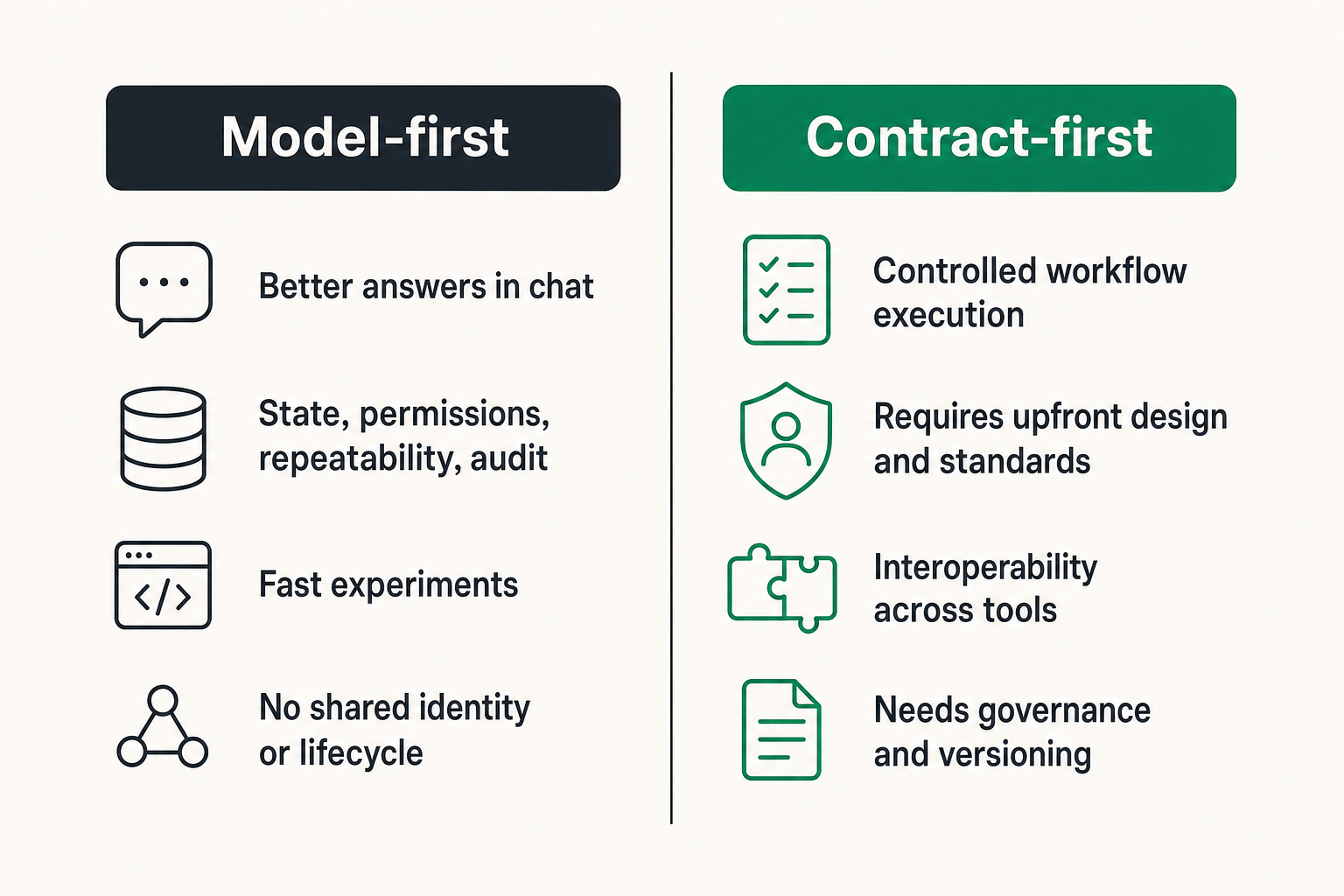
There is a sharp difference between these two approaches:
| Approach | What it optimizes | What breaks in practice |
|---|---|---|
| Model-first SOC copilot | Better answers in chat | State, permissions, repeatability, audit |
| Contract-first SOC agent | Controlled workflow execution | Requires upfront design and standards |
| Ad hoc scripts with LLM calls | Fast experiments | No shared identity or lifecycle |
| Standards-based agent runtime | Interoperability across tools | Needs governance and versioning |
The practical question is not: can the model describe the incident? The practical question is: can the system safely assign, execute, validate, and audit the work?
Practical rule: If an agent cannot be assigned a workflow state, permission scope, and audit trail, it is not ready to operate inside the SOC.
What changed in 2026
By 2026, many SOCs already have automation. They have SOAR playbooks, detection-as-code pipelines, enrichment scripts, ticketing workflows, and response runbooks. The issue is not the absence of automation. The issue is that automation is fragmented across interfaces.
AI agents make that fragmentation more visible. An agent may need to read a detection, query asset context, inspect identity logs, retrieve vulnerability exposure, ask for approval, call an endpoint action, update the case, and notify a human. That crosses tool boundaries quickly.
If every vendor implements agents as a closed extension of its own console, the SOC ends up with five assistants that cannot coordinate. Analysts still become the message bus.
Open standards change the conversation
Open agent standards matter because SOC work is cross-system by default. Identity, coordination, events, credentials, MCP tools, payments for hosted services, and audit records cannot be trapped in one UI.
For platform architects, this means the agent layer should be designed as an interoperability layer. The model is one component. The durable value is the standard contract around the model: who the agent is, what it can do, which event triggered it, which tools it invoked, and what evidence it produced.
That changes the conversation from agent demos to operating models.
Define the operational contract before the agent
Agent identity must be first class
An agent needs its own identity. Not a shared service account. Not an analyst token. Not a hidden backend credential that shows up in logs as automation.
The agent identity should answer basic operational questions:
- Which agent instance acted?
- Which version or policy profile was active?
- Which tenant, environment, or workspace did it operate in?
- Which human, if any, delegated authority?
- Which workflow state gave it permission to act?
This is where security operations AI agents start to look more like service principals with workflow context than chat sessions. That is a good thing. SOC work requires accountability.
A minimal identity record might include:
agent_identity:
  id: soc-triage-agent-prod
  version: 2026.08.3
  tenant: acme-prod
  role: alert_triage
  policy_profile: triage-readonly-plus-case-update
  issuer: agent-control-plane
The identity must travel with tool calls, event emissions, approvals, and audit records. If it disappears after the prompt is sent, you do not have an operational agent. You have a model invocation.
Permissions need workflow scope
Traditional API permissions are often too broad for agentic workflows. Read alerts. Search logs. Update cases. Isolate hosts. Disable users. These are not equivalent actions.
The better pattern is workflow-scoped permission. The agent can perform a tool call only when a specific work item is in a state that permits it. For example, enrichment may be allowed during triage, but containment requires human approval or confidence thresholds plus policy constraints.
A useful permission check includes:
- Agent identity
- Work item ID
- Current workflow state
- Requested tool and action
- Target asset or user
- Approval status
- Policy version
Practical rule: Do not grant agents static tool access when the real permission depends on case state, risk, and approval context.
Human approval is a system boundary
Human-in-the-loop is often described as a product feature. In production, it is a boundary in the system design.
The approval should be structured, durable, and replayable. An analyst approving a Slack message is not enough if the action later needs to be explained to legal, compliance, or another SOC engineer.
A strong approval record contains:
- What action was proposed
- Why the agent proposed it
- Which evidence was used
- Which alternatives were considered
- Who approved or rejected it
- When approval expires
- Whether the target changed before execution
This matters because security operations is full of time-sensitive state. A host that looked suspicious five minutes ago may already be reimaged. A user account may already be disabled. Approval must bind to a specific state, not a vague recommendation.
Design security operations AI agents around events
Normalize the event envelope
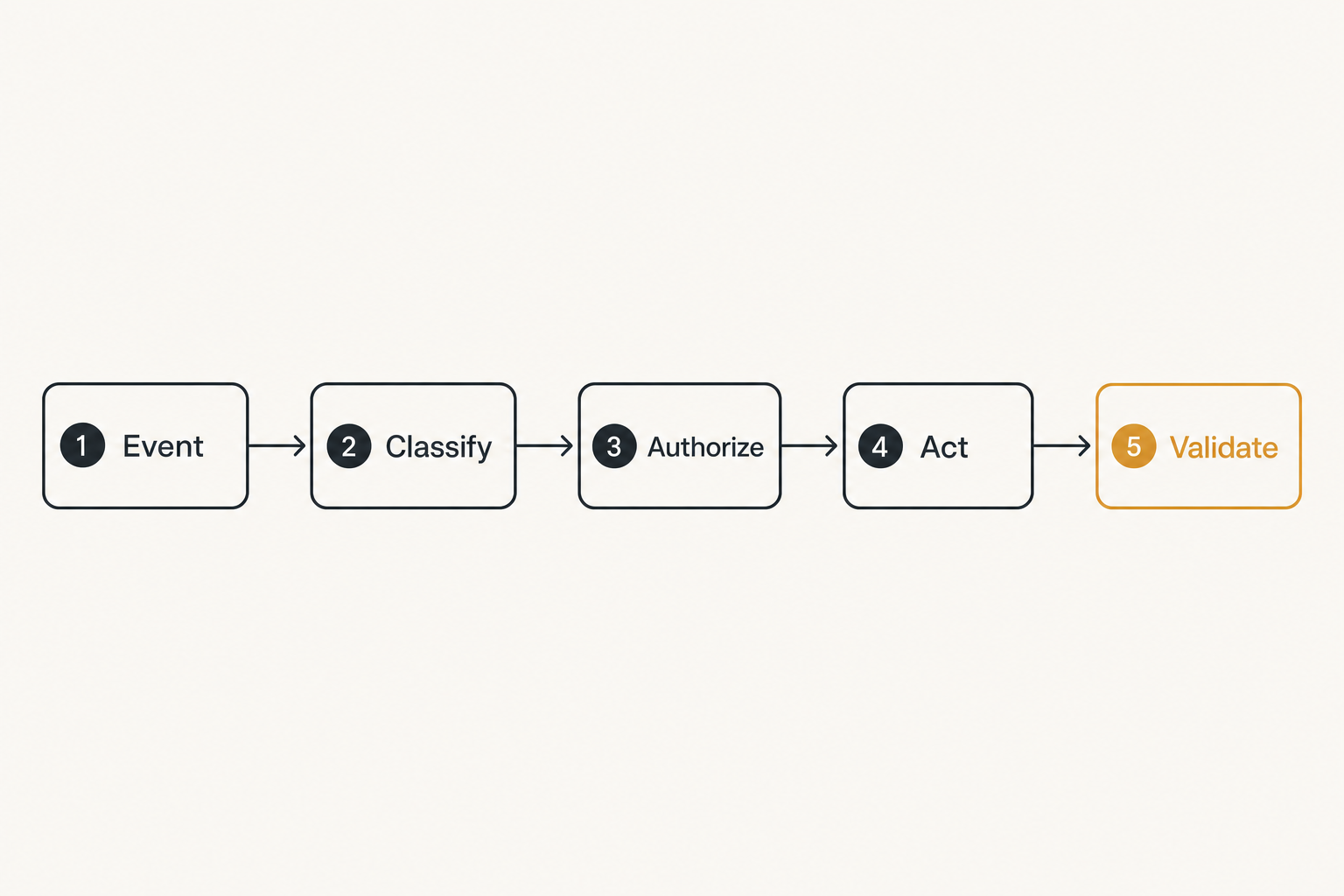
Security operations AI agents need events they can trust. Alerts, detections, asset changes, identity anomalies, vulnerability exposures, and case updates should arrive in a consistent envelope.
A practical envelope does not need to be complicated:
event:
  id: evt-01htriage9
  type: detection.alert.created
  source: siem
  occurred_at: 2026-08-31T14:08:22Z
  subject:
    kind: host
    id: workstation-4482
  severity: high
  workflow:
    case_id: case-7781
    state: new
  evidence_refs:
    - log-search-992
    - detection-rule-143
The event should point to evidence. It should not paste everything into a prompt. Large context blobs create brittle systems and leak boundaries between tools.
Preserve state outside the chat window
What breaks in practice is state management. If the only record of the investigation is the chat transcript, downstream systems cannot reliably continue the work.
State belongs in workflow storage, case systems, or an agent coordination layer. The model can reason over state, but it should not be the only place state exists.
Important state includes:
- Current case status
- Assigned agent or human owner
- Evidence collected
- Tools already called
- Findings and confidence
- Pending approvals
- Actions taken
- Validation results
This lets another agent or analyst resume the work without reconstructing it from conversation history.
Route work, not conversations
Routing is where agent systems either become useful or noisy. The SOC does not need every agent to talk to every other agent. It needs controlled handoffs.
Examples:
- A detection triage agent enriches an alert and emits
triage.completed. - A malware analysis agent receives only cases with suspicious binary evidence.
- An identity response agent receives approved user containment requests.
- A human analyst receives escalations when policy requires judgment.
That routing model is cleaner than asking one general agent to decide everything. It also lets you test each step independently.
Practical rule: Design SOC agent systems around durable events and explicit state transitions, not free-form agent conversations.
Security operations AI agents and MCP
MCP is an interface, not a policy layer
MCP gives agents a standard way to discover and call tools. That is useful. It does not replace authorization, workflow state, approval, or audit.
The mistake teams make is exposing powerful tools through MCP and assuming the agent will use them responsibly because the prompt says so. Prompts are not access control. Tool descriptions are not governance.
For SOC use cases, an MCP server should sit behind policy checks or participate in them. When an agent calls a tool, the request should include identity and workflow context. The server should be able to deny the call even if the model asks correctly.
Tool schemas should encode intent
Tool schemas should not mirror raw vendor APIs when the underlying operation has security meaning. A raw endpoint API might have dozens of parameters. The agent-facing tool should express the SOC action.
Instead of exposing:
tool: edr_update_device_network_status
parameters:
  device_id: string
  network_status: string
Expose something closer to:
tool: request_host_isolation
parameters:
  case_id: string
  host_id: string
  reason: string
  evidence_refs: list
  approval_id: string
That schema forces the agent to bind action to case context, reason, evidence, and approval. It also gives the policy layer something meaningful to evaluate.
Versioning and fallback are production features
SOC workflows cannot depend on a single brittle tool definition. Tool schemas change. Vendor APIs fail. Rate limits happen. Permissions expire. Agents need predictable fallback behavior.
Production MCP design should include:
- Tool version identifiers
- Deprecation windows
- Safe read-only fallbacks
- Retry policies with idempotency keys
- Explicit failure events
- Human escalation when action cannot be completed
The practical question is not whether the agent can call the tool on a good day. It is what the workflow does when the tool call fails halfway through an incident.
Coordination patterns for multi-agent SOC work
The dispatcher pattern
The dispatcher pattern uses one agent or workflow service to classify work and assign it to a specialist. It is useful when alerts are heterogeneous and routing logic matters.
The dispatcher should not become a magic brain. Its job is controlled classification:
- Identify event type
- Check required evidence
- Select workflow path
- Assign owner
- Emit routing event
This pattern keeps the first step simple and observable.
The specialist pattern
Specialist agents are narrow by design. One handles phishing triage. Another handles endpoint enrichment. Another handles identity anomaly review. Another drafts customer-facing incident summaries.
Specialists are easier to evaluate because their input and output are constrained. They also map better to permission boundaries. A phishing triage agent does not need host isolation rights. An endpoint response agent does not need mailbox search access unless the workflow explicitly requires it.
The escalation pattern
Escalation is not failure. It is part of the system.
An agent should escalate when evidence is incomplete, confidence is low, policy requires approval, a tool call fails, or the requested action exceeds scope. The escalation should include the current state, not just a summary.
A good escalation package includes:
- Case ID and current state
- Evidence collected
- Agent conclusion
- Confidence and uncertainty
- Requested human decision
- Available next actions
This reduces investigation time because the analyst receives a structured handoff instead of a transcript.
Credential sharing without credential sprawl
Use short-lived delegated access
Security operations AI agents often need access to sensitive systems. That does not mean they should hold long-lived credentials.
Use short-lived delegated access where possible. The agent requests access for a specific workflow action. The control plane issues a scoped token. The token expires quickly and is logged against the work item.
This is especially important in multi-tenant or hosted agent environments. The custody boundary for credentials must be explicit. If a plugin, MCP server, or hosted agent can act across customer environments, every delegation path needs to be inspectable.
Keep secrets out of prompts
Secrets do not belong in prompts, tool descriptions, memory, transcripts, vector stores, or agent scratchpads.
That sounds obvious. In practice, secrets leak when teams paste configuration into context, let agents read broad documentation stores, or log tool requests without redaction.
A safer design keeps secrets in a credential broker. The agent never sees the secret. It receives a capability or calls a tool that executes under delegated authority.
Audit every credential use
Every credential use should produce an audit event. Not just successful containment. Failed attempts matter too.
The record should include:
- Agent identity
- Delegated principal
- Work item
- Tool called
- Target resource
- Time issued
- Time used
- Expiration
- Result
Practical rule: If you cannot explain which credential an agent used for a specific SOC action, the agent should not be allowed to take that action.
What works: a production implementation sequence
Start with one high-friction workflow
Do not start by building a universal SOC agent. Start with a workflow that is common, repetitive, and painful.
Good candidates include:
- Phishing report triage
- Endpoint alert enrichment
- Cloud identity anomaly review
- Vulnerability exposure validation
- Case summary generation after investigation
Pick a workflow where the inputs, tools, decisions, and handoffs are already understood. The agent should reduce friction in a known process before it attempts new forms of reasoning.
Build the validation loop early
A practical implementation sequence looks like this:
- Define the work item and event envelope.
- Create an agent identity and permission profile.
- Expose only the minimum read tools required for enrichment.
- Store state outside the prompt.
- Require structured output with evidence references.
- Compare agent output with analyst decisions.
- Add write actions only after validation.
- Add approval gates for irreversible actions.
- Emit audit events for every tool call and transition.
- Review failures weekly and update schemas or policies.
This sequence keeps the first deployment boring. Boring is good. Boring means the SOC can reason about the system.
Measure handoff cost, not agent cleverness
Agent cleverness is hard to operate. Handoff cost is concrete.
Measure whether the agent reduces the time and effort required for the next actor, human or machine, to continue the case. A useful output is not a beautiful paragraph. It is a structured package that makes the next decision easier.
Look for:
- Fewer duplicate searches
- Less manual evidence gathering
- Fewer unclear escalations
- Faster case assignment
- Better consistency in case notes
- More complete audit trails
The agent should make the workflow more deterministic, not more mysterious.
What fails when teams deploy badly
Chat-first automation creates invisible state
Chat is useful as an interface. It is dangerous as the system of record.
When teams build around chat first, state gets trapped in messages. Tool calls are hard to reconcile. Approvals are ambiguous. Analysts cannot tell whether the agent is describing, deciding, or acting.
What fails:
- Cases diverge from chat history
- Agents repeat work already completed
- Analysts cannot audit tool usage
- Handoffs require manual reconstruction
- Incident timelines become unreliable
Chat should be a window into the workflow, not the workflow itself.
Silent privilege creep becomes the default
Agents start read-only. Then someone asks for case updates. Then endpoint actions. Then identity changes. Then cloud containment.
Each addition feels reasonable. Over time, the agent accumulates broad privileges because nobody re-modeled the workflow boundary.
The fix is not a longer prompt. The fix is permission review tied to workflow states and tool schemas. Every new capability should answer: which work item, which state, which approval, which target, which audit record?
No reconciliation means no trust
Security operations depends on reconciliation. If an agent says it isolated a host, the system needs to verify that the EDR state changed. If it says it updated a ticket, the case system should confirm the update. If it says an identity action failed, the workflow should emit a failure event and route the work.
Without reconciliation, teams learn not to trust the agent. They manually check every result. At that point, the agent becomes another source of noise.
Operating metrics for security operations AI agents
Speed metrics
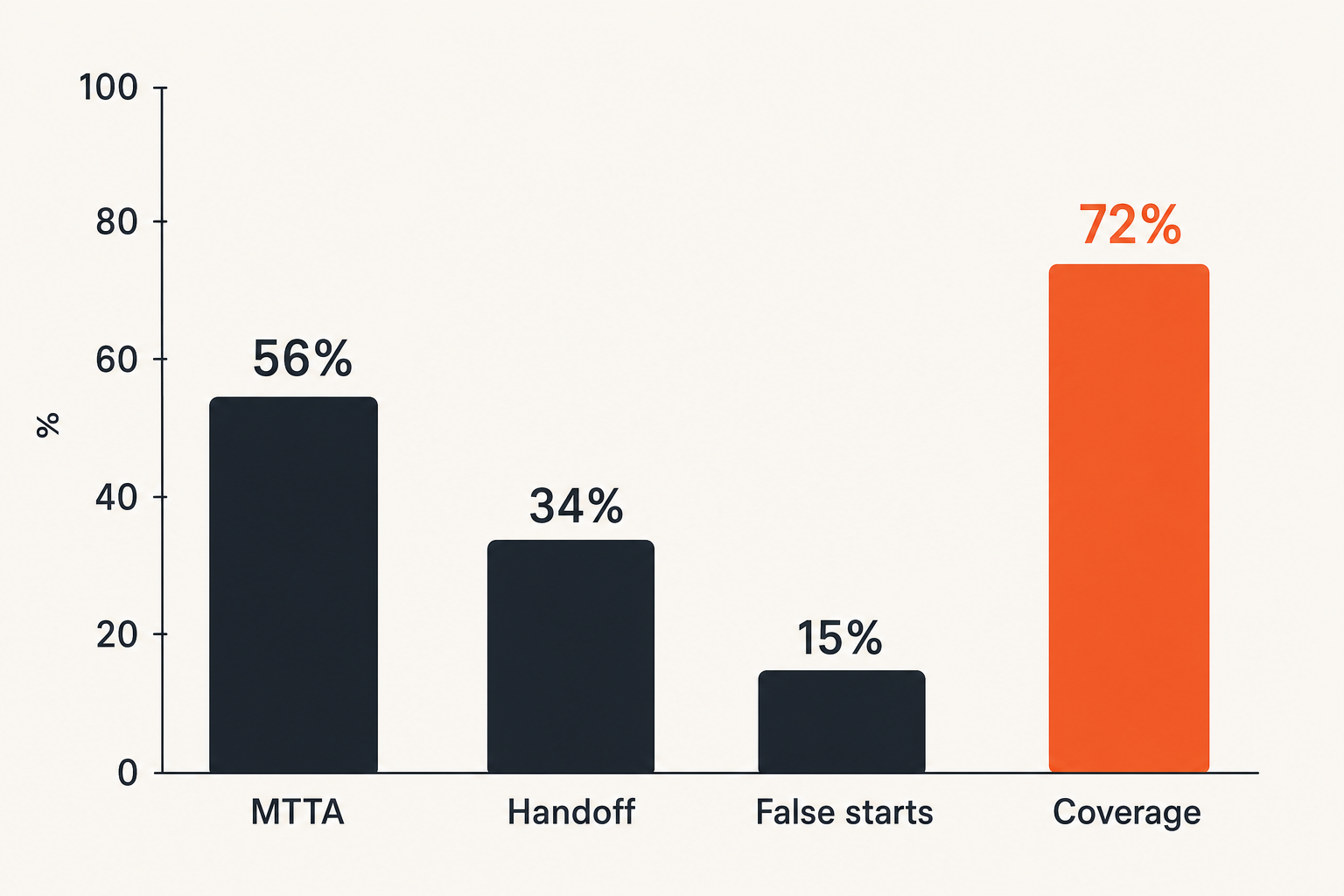
Speed metrics should focus on workflow movement, not just model latency.
Track:
- Time from event creation to agent assignment
- Time from assignment to first evidence package
- Time from triage start to escalation or closure
- Time waiting on human approval
- Time lost to failed tool calls
Model response time matters, but it is rarely the main bottleneck in production SOC work. The larger delays usually come from missing context, unclear ownership, and manual handoffs.
Trust metrics
Trust is operational, not emotional. Analysts trust systems that behave predictably and explain themselves.
Useful trust metrics include:
- Percentage of outputs with evidence references
- Percentage of tool calls linked to case IDs
- Approval rejection rate
- Analyst correction rate
- Reopened case rate
- Failed action reconciliation rate
Do not hide correction data. It is the training signal for the workflow, the schemas, and the policy boundaries.
Coverage metrics
Coverage tells you where agents are actually helping.
Track coverage by workflow type, detection source, business unit, asset class, and severity. A triage agent that works only on clean demo alerts is not production coverage. A useful agent handles normal messiness: missing fields, duplicate alerts, partial telemetry, vendor API failures, and ambiguous ownership.
Coverage also helps prevent unsafe expansion. If the agent performs well in phishing triage, that does not prove it is ready for endpoint containment. Each workflow needs its own operating evidence.
Product fit: LogicSRC as an open standards surface
Identity, coordination, and events
LogicSRC is relevant to security operations AI agents because the hard problem is not building one clever agent. The hard problem is creating a standards surface where many agents, tools, services, and human approvals can interoperate.
For SOC and platform teams, the important primitives are familiar:
- Agent identity that can be verified across systems
- Coordination that routes work without turning analysts into the message bus
- Event contracts that preserve context and state transitions
- Credential sharing that respects custody boundaries
- MCP tool surfaces that remain governable
- Auditable workflows that survive vendor and model changes
This is the layer many teams end up building themselves after the first agent pilot succeeds and the second one collides with production reality.
Auditable workflows across agent systems
The practical value of an open standards surface is that it gives engineering teams a place to define contracts once and reuse them across agent systems.
A SOC platform may have one agent for enrichment, one for detection validation, one for incident summarization, and one for response preparation. A developer platform may expose MCP servers, credential brokers, event streams, and approval services. Without shared standards, every integration becomes a custom trust negotiation.
With shared contracts, teams can ask better questions:
- Which agent identity performed this action?
- Which workflow state allowed it?
- Which credential was delegated?
- Which event triggered the transition?
- Which human approved the action?
- Which tool version was used?
- Which audit record proves it?
That is the foundation for security operations AI agents that can operate beyond a demo environment.
Try logicsrc.com
LogicSRC provides an open standards surface for interoperable AI agents, identity, coordination, MCP, events, payments, credential sharing, and auditable workflows. If you are building security operations AI agents that need to work across real systems, Try logicsrc.com.