Security Operations AI Agents Need Open Workflow Architecture, Not Another SOC Chatbot

Security operations AI agents are moving from demo rooms into production SOC workflows. That is where the optimism gets expensive.
A chatbot that summarizes an alert is easy to pilot. An agent that can query SIEM data, inspect endpoint telemetry, enrich indicators, open tickets, request approval, and trigger containment is a different system. It touches identity, permissions, evidence, change control, incident response, and audit.
Teams think the problem is making the model smarter. The real problem is making the workflow governable.
That changes the conversation. Security operations AI agents are not just an AI feature. They are an architecture decision about how autonomous software participates in operational systems without breaking trust, accountability, or response discipline.
As guest contributors, the team at threatcrush.com sees the same pattern in SOC modernization work: automation succeeds when it has ownership, interfaces, validation, and rollback paths. Agents are no different.
Table of contents
- Why security operations AI agents are an architecture problem
- Reference architecture for security operations AI agents
- Identity and authorization for SOC agents
- Context memory and evidence handling
- Tool orchestration across detection and response
- Events queues and audit trails
- Human approval and escalation design
- Evaluation testing and drift control
- What breaks when teams implement agents badly
- Implementation workflow for platform teams
- Where LogicSRC fits in an open SOC agent stack
- Closing checklist for security operations AI agents
Why security operations AI agents are an architecture problem
The SOC does not need another chat box
Most SOCs already have too many panes of glass. Adding a conversational interface on top of the same fragmented systems can feel useful for a week, then it becomes another place analysts have to check.
The mistake teams make is treating the agent as a better search bar. That is too small. Search helps an analyst find information. A security operations agent needs to participate in a workflow: receive an event, gather evidence, choose tools, explain uncertainty, request approval, and preserve a record of what happened.
If the agent cannot preserve context across steps, bind actions to permissions, and produce an auditable trail, it is not operational infrastructure. It is a helpful assistant with unclear blast radius.
The agent boundary is the control boundary
A useful way to think about it is this: the boundary around the agent is the boundary around your controls. Everything the agent can see, call, store, or change becomes part of your security architecture.
That boundary has to be explicit. Which tools can it invoke? Under whose authority? With what data? For which incident classes? Can it act during a severity one event? Can it quarantine a host? Can it send a customer notification? Can it share credentials with another agent?
These are not UX questions. They are governance questions.
Practical rule: Do not connect an agent to a tool until you can describe the agent identity, allowed actions, approval requirements, evidence written, and rollback behavior.
Why open standards matter now
Security teams are not going to run one agent. They will run agents from SIEM vendors, endpoint platforms, cloud security tools, internal engineering teams, MSSPs, and open source projects. Some will be embedded inside products. Some will be orchestrators. Some will be narrow specialists.
Without open standards for identity, coordination, events, credentials, and tool invocation, every integration becomes a custom trust relationship. That does not scale. Worse, it creates brittle automation that no one can fully inspect.
Open standards matter because agents need to cooperate across organizational and vendor boundaries. In security operations, that cooperation must be constrained, observable, and revocable.
Reference architecture for security operations AI agents
Separate reasoning from execution
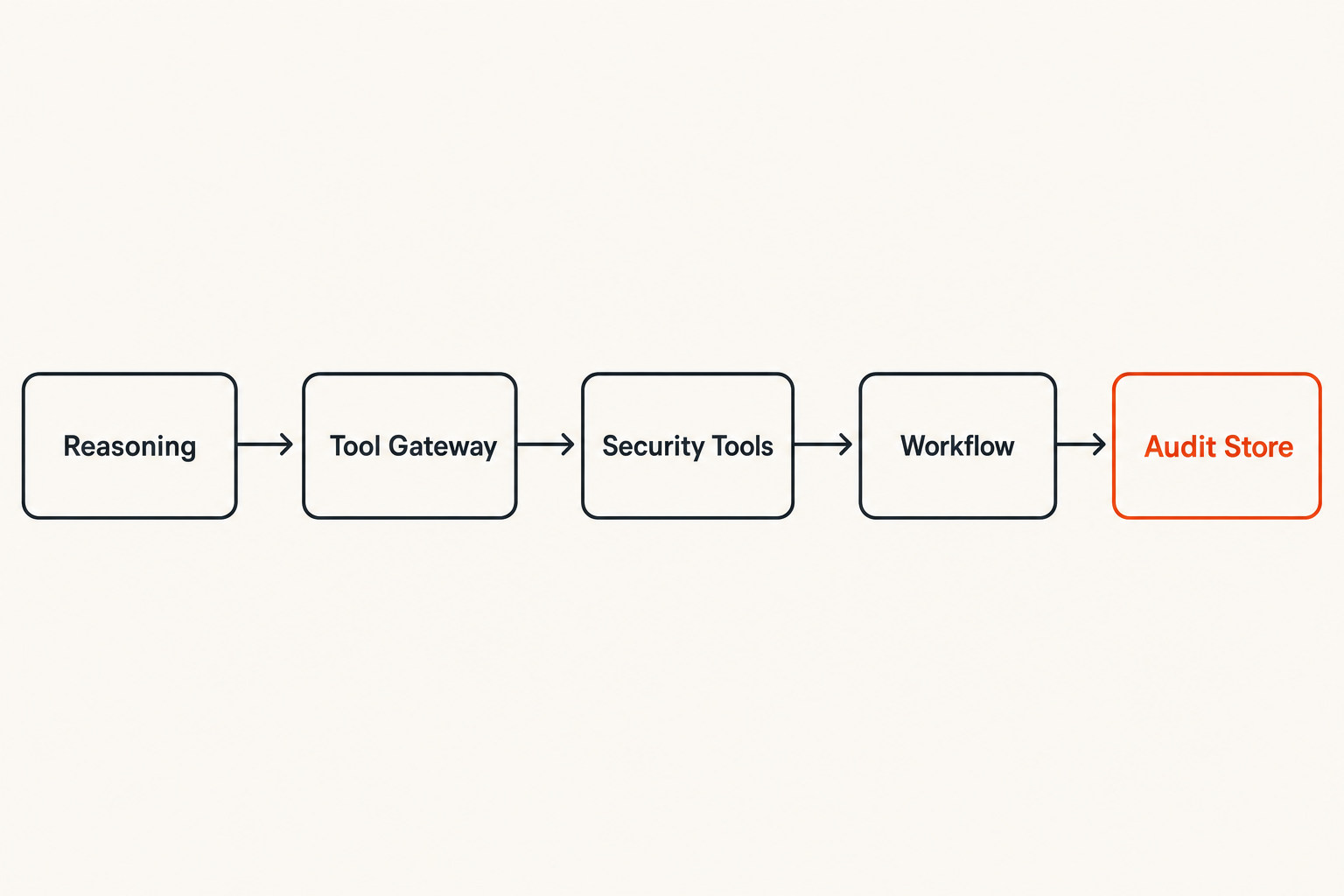
The first design decision is separating reasoning from execution. The model can propose, summarize, classify, and plan. Execution should happen through typed tools with policies, schemas, and logs.
That separation gives you leverage. You can improve the model without changing production permissions. You can test tools independently. You can deny an action even when the agent recommends it. You can replay decisions later and see whether the tool result or the reasoning step caused an error.
A common pattern looks like this:
| Layer | Responsibility | What should be logged |
|---|---|---|
| Agent runtime | Plans, reasons, routes work | Prompt version, model, task, confidence, selected tool |
| Tool gateway | Validates requests and scopes | Caller identity, tool name, parameters, policy decision |
| Security systems | Provide data or execute actions | Native request ID, result, error, state change |
| Workflow engine | Coordinates approvals and retries | State transition, approver, timeout, escalation |
| Audit store | Preserves evidence | Inputs, outputs, timestamps, actor chain |
The practical question is not whether the agent can call the endpoint platform. It is whether the platform team can prove why it did, what it saw, who allowed it, and what changed.
Use tools as contracts not suggestions
Tool definitions should behave like APIs, not vague instructions. A tool contract needs a name, schema, allowed scopes, timeout behavior, idempotency expectations, and error classes.
For example, a host isolation tool should not accept free form text like isolate suspicious machine. It should accept a validated host identifier, incident ID, requested duration, justification, and approval token. The tool should return a structured result with state, provider request ID, and rollback instructions if available.
That contract limits ambiguity. It also makes evaluation easier. If the agent passes a user email into a host ID field, the request fails before it becomes a production incident.
Practical rule: If a security action cannot be represented as a typed request with policy checks and a durable result, it is not ready for agent execution.
Make every action replayable
Replayability is the difference between automation and guesswork. When an agent closes an alert, escalates an incident, or recommends containment, the team should be able to replay the path that led there.
That does not mean storing every raw token forever. It means preserving enough structured state to reconstruct the decision: source event, evidence gathered, tools called, versions used, approvals granted, and final output.
Replay matters during incident review. It matters for compliance. It matters when a model update changes behavior. It also matters when an analyst disagrees with an agent and the team needs to understand whether the disagreement came from bad telemetry, weak policy, or bad reasoning.
Identity and authorization for SOC agents
Agents need their own identities
Do not run agents under a shared service account called automation. That approach hides accountability and makes least privilege almost impossible.
Each agent should have its own identity. In many environments, each deployment or workspace should have an identity too. A malware triage agent and a cloud exposure agent should not have the same permissions. A staging agent should not be able to reach production response tools.
Agent identity should show up in logs across systems. If the SIEM, ticketing system, endpoint platform, and workflow layer all record different actor names, investigation becomes painful. Consistent identity is a prerequisite for trust.
Scopes should map to operational intent
Traditional API scopes often map to product features: read alerts, update case, isolate host. That is necessary but not sufficient. SOC agents need scopes that map to operational intent.
A better authorization model distinguishes between enrichment, triage, recommendation, notification, containment, remediation, and closure. Those are different levels of authority even when they touch the same tool.
For example:
- Enrichment may allow read only access to asset inventory and threat intelligence.
- Triage may allow case annotations and severity suggestions.
- Recommendation may allow draft response plans but no execution.
- Containment may require human approval and a high severity incident.
- Closure may require evidence completeness and analyst confirmation.
This keeps permission design aligned with SOC process instead of vendor menus.
Delegation must be explicit
Agents often act on behalf of humans, teams, or other agents. That delegation chain must be explicit. If an analyst asks an agent to isolate a host, the audit trail should show both the analyst and the agent. If an orchestrator agent delegates enrichment to a specialist agent, both identities should be preserved.
Delegation without proof creates attribution gaps. During a review, nobody wants to discover that five agents acted through the same token and one of them made a destructive change.
Practical rule: Every agent action should answer three questions: who initiated it, which agent executed it, and which policy allowed it.
Context memory and evidence handling
Treat context as evidence not convenience
Context is where many agent projects get messy. Teams feed the model a pile of alerts, logs, tickets, chat messages, runbooks, and asset data, then hope the answer is useful.
The problem is not that the model lacks context. The problem is that the context has no provenance. Security operations depends on knowing where evidence came from and how fresh it is.
Agent context should carry metadata: source, timestamp, sensitivity, owner, confidence, and retention class. A threat intelligence hit from last month should not be weighted the same way as an endpoint process tree captured two minutes ago. A Slack message is not the same as an EDR detection.
Keep sensitive data out of prompts by default
Security operations data is full of secrets: tokens, credentials, customer identifiers, employee data, investigation notes, and legal context. The agent should not receive more of that than the task requires.
Use redaction, retrieval filters, field level access, and purpose based data selection. If a workflow only needs to classify whether an alert resembles credential theft, it may not need raw secrets, full packet payloads, or user PII.
This is also where hosted and self hosted design matters. Platform teams need to know which data leaves their boundary, which vendors receive it, and which retention controls apply.
Design memory with retention rules
Long term memory can be useful for recurring investigations, environment specific patterns, and analyst preferences. It can also become a shadow data store that no one governs.
Memory should have retention rules. Some memory is task scoped and should expire when the incident closes. Some is case scoped and should remain with the investigation. Some is organizational knowledge and should be promoted through review, not learned silently from every interaction.
What breaks in practice is silent accumulation. An agent remembers outdated exceptions, old asset owners, temporary suppression logic, or one analyst's informal workaround. Six months later, it makes a decision based on stale memory nobody knew existed.
Tool orchestration across detection and response
Start with read heavy workflows
The safest first production use cases are read heavy. Alert enrichment, duplicate detection, asset lookup, runbook matching, case summarization, and evidence collection create value without immediately changing production systems.
Read heavy does not mean low value. A large amount of SOC time is spent gathering context from disconnected tools. An agent that reliably assembles the right evidence, cites sources, and prepares a clean case can shorten investigation time without taking risky actions.
Start where failure is recoverable. If the agent misses an enrichment source, an analyst can add it. If it isolates the wrong production host, the cost is much higher.
Containment needs stronger gates
Containment is where authority matters. Disabling a user, rotating a credential, quarantining a host, blocking an IP, or modifying firewall rules changes the environment.
Those workflows need gates:
- Severity threshold
- Asset criticality check
- Business owner lookup
- Human approval
- Time limited action
- Rollback plan
- Post action verification
The agent can still do useful work. It can prepare the containment request, validate preconditions, estimate blast radius, and monitor completion. But the final execution should be bound to policy.
Normalize tool results before reasoning
Security tools return inconsistent data. One system says high severity, another says critical. One returns hostnames, another returns device IDs. One timestamps in UTC, another in local time. If agents reason directly over inconsistent tool output, they will make inconsistent decisions.
Use a normalization layer. Convert tool responses into canonical entities: user, host, process, file, IP, domain, cloud account, alert, incident, control action. Preserve raw data, but reason over normalized forms.
This is not glamorous work. It is also where many agent systems become reliable.
Events queues and audit trails
Agents should emit events like services
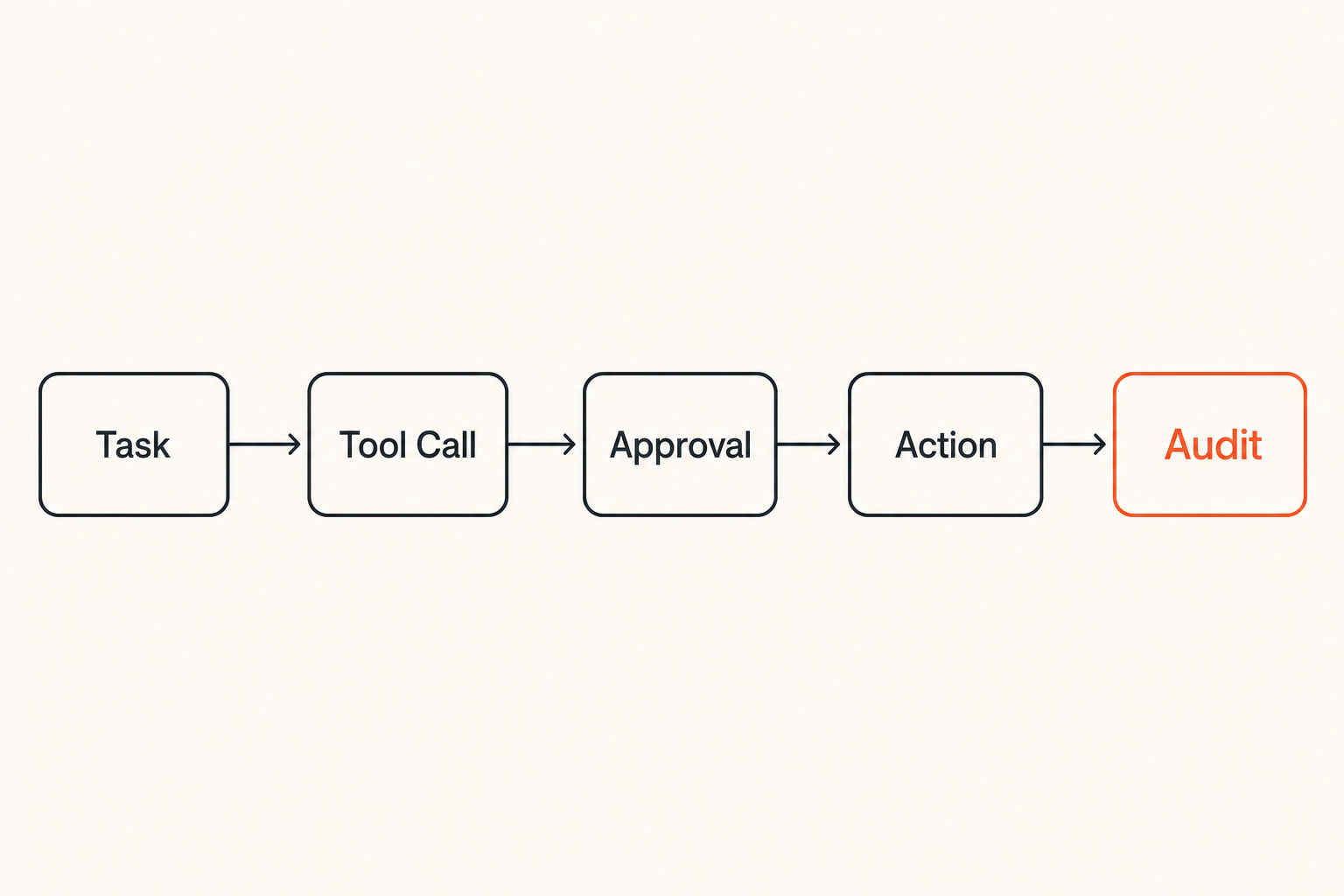
Agents should not be invisible helpers living inside chat windows. They should emit events like any other production service.
Important events include task created, evidence requested, tool called, policy denied, approval requested, action executed, action failed, analyst overridden, case closed, and model version changed. These events should be consumable by workflow systems, SIEMs, data lakes, and audit tools.
Eventing turns agent behavior into operational data. It lets platform teams monitor volume, latency, failure rates, approval backlog, and policy denials. It also allows other agents to coordinate without scraping chat transcripts.
Queues absorb uncertainty
Agent workflows are full of uncertainty. Tools time out. Analysts are offline. APIs rate limit. Detections arrive in bursts. Cloud inventories lag. A queue based architecture handles this better than synchronous chains of fragile calls.
Queues let you retry enrichment, pause for approval, route high severity incidents differently, and dead letter failed tasks for review. They also give you backpressure. If the endpoint API slows down, the agent should not keep firing requests until everything breaks.
For SOC use cases, queue messages should include correlation IDs, incident IDs, priority, expiry, and idempotency keys. If the same alert is processed twice, the workflow should not create duplicate tickets or execute duplicate containment.
Audit logs must include intent
A normal application log says what happened. An agent audit log also needs to capture intended purpose.
For example, called tool X with host Y is not enough. The log should say the agent called the endpoint lookup tool to validate whether host Y was active before recommending isolation in incident Z. That intent helps reviewers distinguish appropriate failed actions from inappropriate successful ones.
Intent also helps with policy. A tool call that is acceptable for enrichment may not be acceptable for containment. Same API, different purpose, different control.
Human approval and escalation design
Approval is a workflow primitive
Approval should not be bolted on as a chat reply. It should be a first class workflow state with requester, approver, evidence packet, deadline, allowed actions, and recorded decision.
Approvals should be specific. Approve containment of host H for two hours because evidence E indicates lateral movement is better than approve response. Specific approvals reduce accidental authority expansion.
The approval object should be reusable across interfaces. An analyst might approve in the case tool, a mobile incident app, or an internal command center. The agent should not care which UI captured approval as long as the workflow receives a valid approval event.
Escalation should carry state
Escalation often loses context. A tier one analyst hands off to tier two. An agent posts a summary. Someone asks for raw evidence. Time disappears.
A well designed agent escalation carries state: what triggered the escalation, what evidence was collected, what hypotheses were considered, which actions were blocked, what approvals are pending, and what the recommended next step is.
That state should be structured, not only prose. Prose is useful for humans. Structured state is useful for tools, dashboards, and downstream agents.
Analysts need override paths
Analysts must be able to override agents. They should be able to stop a workflow, mark a recommendation as wrong, force escalation, reopen a case, or revoke an action.
The override should become data. If analysts repeatedly override the same recommendation, that is a signal. Maybe the policy is wrong. Maybe a runbook is stale. Maybe the model prompt overweights one evidence source. Maybe the tool result is misleading.
Operator feedback is not a vibe. It is a production input.
Evaluation testing and drift control
Test the workflow not just the model
Model benchmarks are not enough. A SOC agent can produce a good written answer and still fail operationally because it called the wrong tool, ignored a timeout, skipped approval, or wrote incomplete evidence.
Evaluation should cover the whole workflow. Given this alert and this asset context, did the agent collect the right evidence? Did it avoid restricted data? Did it classify severity correctly? Did it request approval before containment? Did it produce a useful case note? Did it stop when policy denied an action?
The unit of testing is not the prompt. It is the operational scenario.
Build scenario based regression suites
Create regression suites from real and synthetic incidents. Include common cases and ugly edge cases.
Useful scenarios include:
- True positive credential theft on a normal user
- False positive impossible travel alert
- Malware on a high value server
- Suspicious PowerShell on a developer laptop
- Cloud key exposure in a public repository
- Duplicate alerts from the same root cause
- Missing asset owner data
- EDR API timeout during containment
- Analyst denial of recommended action
Run these scenarios when you change prompts, models, tool schemas, policies, or data sources. Track differences in behavior. If a newer model becomes more confident but less policy compliant, that is not an upgrade.
Measure operational outcomes
Measure what matters to SOC operators and platform owners. Examples include evidence completeness, enrichment latency, case quality, approval cycle time, duplicate ticket rate, policy denial rate, analyst override rate, and reopened incident rate.
Avoid vanity metrics. Number of agent messages is not success. Number of autonomous actions is not success. The goal is better operations: less manual gathering, fewer mistakes, clearer ownership, faster safe response, and more consistent documentation.
What breaks when teams implement agents badly
Noise moves instead of disappearing
Bad automation does not remove noise. It moves noise from one queue to another.
An agent that summarizes every low fidelity alert still creates work if it opens tickets, asks analysts to review weak recommendations, or floods Slack with uncertain conclusions. If the detection quality is poor, the agent must either suppress, correlate, or enrich intelligently. Otherwise it becomes a polite noise amplifier.
A useful agent reduces decision load. It does not merely rephrase alerts.
Ownership becomes ambiguous
When agents create cases, modify severity, or recommend actions, ownership can blur. Did the analyst decide? Did the agent decide? Did the runbook decide? Did a vendor policy decide?
This matters during incidents. Ambiguous ownership slows response because people hesitate. It also matters after incidents because teams need to know where to improve.
Define ownership per workflow state. The agent may own enrichment. The analyst may own severity confirmation. The incident commander may own containment approval. The platform may own tool reliability. Write it down.
The audit trail is incomplete
The fastest way to lose trust in SOC agents is an incomplete audit trail. If an agent acted and nobody can explain why, the organization will either disable it or restrict it to low value work.
Common audit failures include missing prompt versions, unlogged tool parameters, absent approval records, overwritten case notes, no correlation IDs, and vendor systems that do not preserve delegated identity.
Practical rule: If an incident reviewer cannot reconstruct the agent's path in under ten minutes, the workflow is not production ready.
Implementation workflow for platform teams
Map the job before adding autonomy
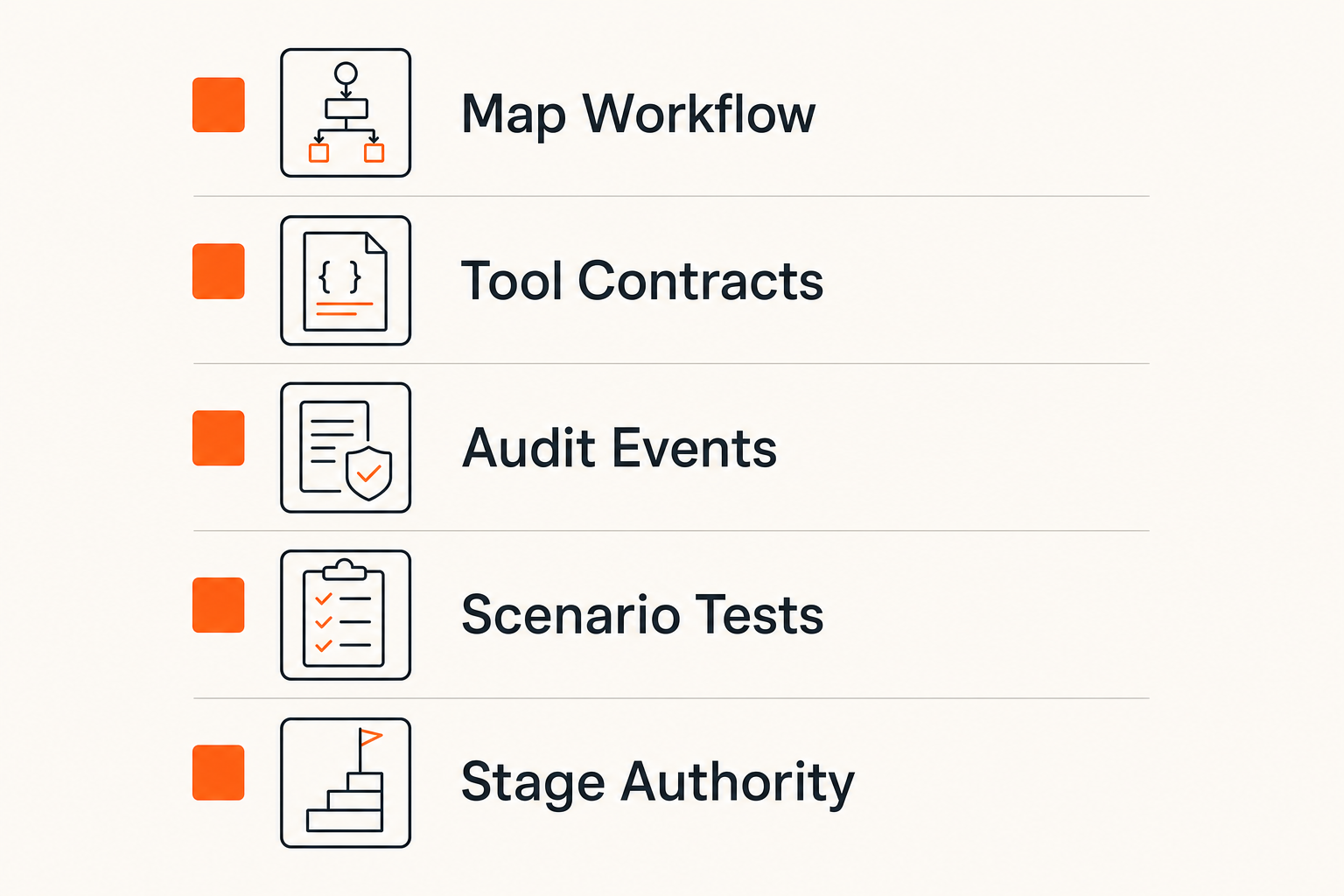
Start with the job, not the model. Pick one SOC workflow and map it end to end.
A practical implementation sequence looks like this:
- Select one workflow with clear boundaries, such as phishing triage or endpoint alert enrichment.
- Document inputs, systems touched, decisions made, outputs, and escalation paths.
- Identify which steps are read only, which are write actions, and which require approval.
- Define canonical entities and evidence fields.
- Create tool contracts with schemas, scopes, timeouts, and error classes.
- Add an agent runtime that can plan within those contracts.
- Emit workflow events and audit records from day one.
- Run scenario tests before production exposure.
- Launch in observe mode, then recommendation mode, then gated execution.
- Review overrides, failures, and drift on a fixed cadence.
This sequence is slower than a demo. It is faster than cleaning up uncontrolled automation later.
Define tool contracts and failure behavior
Every tool needs failure behavior. What happens if the SIEM query times out? If the asset inventory has no owner? If the endpoint tool returns conflicting host IDs? If the ticket API creates a case but fails before returning the ID?
Define retry rules, fallback paths, dead letter handling, and idempotency. Security operations is already stressful. Agents should not add uncertainty during failure.
A minimal tool contract should include:
- Purpose
- Input schema
- Output schema
- Required scope
- Allowed workflow states
- Timeout
- Retry policy
- Idempotency key
- Audit fields
- Human readable error mapping
Roll out by authority level
Do not launch with full autonomy. Roll out by authority level.
Observe mode lets the agent watch and produce recommendations without writing to systems. Assist mode allows case notes, summaries, and evidence packets. Recommend mode allows proposed actions and approval requests. Gated execution allows policy checked actions after approval. Limited autonomy allows narrow actions under predefined conditions.
This staged rollout gives teams time to measure behavior, tune policies, and build trust.
Where LogicSRC fits in an open SOC agent stack
Interoperability beats one off integration
Security operations AI agents will not live in a single vendor console. They need to coordinate across detection, response, identity, ticketing, messaging, cloud, and custom internal systems.
LogicSRC is interesting in this context because the hard problem is not another agent SDK by itself. The hard problem is the standards surface around agents: identity, coordination, events, credential sharing, MCP, payments where relevant, and auditable workflow handoffs.
For platform teams, interoperability means an internal triage agent can work with a vendor enrichment agent without sharing a giant token or relying on an undocumented chat transcript. The coordination layer becomes part of the control plane.
Credential sharing needs policy and proof
Credential sharing between agents is dangerous when it is informal. Passing secrets through prompts, environment variables, or hidden tool configs creates audit and revocation problems.
A better pattern is brokered access. The requesting agent declares purpose. The policy layer checks identity, scope, workflow state, and approval. The receiving tool or agent gets a constrained credential or signed capability. The audit trail records what happened.
This is especially important for SOC workflows because credentials often unlock sensitive telemetry or response actions. Sharing must be narrow, time bound, and observable.
Auditable workflows become the product surface
The UI is not the product surface for operational agents. The workflow is.
A SOC platform team should be able to define an agent workflow, connect tools through standards, enforce policy, emit events, and prove what happened. Analysts may interact through chat, tickets, dashboards, or incident command systems. Those interfaces matter, but they should sit on top of the same auditable workflow substrate.
That is the architectural fit for open agent standards. They make agents composable without making them ungovernable.
Closing checklist for security operations AI agents
What works
Security operations AI agents work when they are treated like operational services with bounded autonomy.
The reliable pattern is clear:
- Give each agent a real identity.
- Use typed tools with schemas and scopes.
- Separate reasoning from execution.
- Preserve evidence provenance.
- Emit events for every meaningful state change.
- Require explicit approval for risky actions.
- Test scenarios, not just prompts.
- Roll out authority gradually.
- Review drift and analyst overrides.
This is less glamorous than a fully autonomous SOC demo. It is also much closer to what survives production.
What fails
What fails is the shortcut architecture: one broad service account, a chat interface, direct tool access, hidden memory, weak logs, and optimistic assumptions about model judgment.
That design may produce impressive demos. In production, it creates noise, unclear ownership, policy bypasses, and audit gaps. Eventually the team either disables the agent or restricts it to summarization.
The mistake teams make is asking whether the model can do the job. The better question is whether the system can control, observe, and improve the job when the model participates.
The practical next step
Pick one workflow. Draw the boundaries. Name the agent. Define the tools. Decide what evidence matters. Add events. Add approvals. Test the ugly cases. Then increase authority only when the workflow proves it can be trusted.
That is the practical path for security operations AI agents in 2026: not hype, not magic autonomy, but open, auditable, interoperable workflow architecture.
Try logicsrc.com
LogicSRC provides an open standards surface for interoperable AI agent systems, including identity, coordination, events, credential sharing, MCP, and auditable workflows. Try logicsrc.com