Agent Framework Comparison in 2026: How to Choose Architecture, Not Just an SDK

Agent framework comparison usually starts in the wrong place.
A team opens a spreadsheet, lists LangGraph, AutoGen, CrewAI, Semantic Kernel, custom orchestration, maybe a hosted agent platform, and starts scoring features. Does it have memory? Does it support tools? Does it have tracing? Can it do multi-agent workflows?
Teams think the problem is picking the most capable agent SDK. The real problem is deciding where your product will hold state, identity, permissions, execution, audit trails, and interoperability boundaries.
That changes the conversation. In 2026, an agent framework comparison is less about which library can call an LLM and more about which architecture will still work when agents need credentials, approvals, payments, events, plugins, MCP servers, human handoffs, and production support.
Table of contents
- Why agent framework comparison is really an architecture decision
- A practical agent framework comparison model
- The six layers every agent framework has to answer for
- Where popular agent framework categories fit
- Open standards change the agent framework comparison
- Implementation workflow for choosing an agent framework
- What works and what fails in production
- Build versus buy versus compose
- Where logicsrc.com fits
Why agent framework comparison is really an architecture decision
The SDK is not the system
The mistake teams make is treating an agent framework like a library choice. That works for prototypes. It does not work once agents touch customer data, internal tools, regulated workflows, or shared credentials.
An SDK can help you chain model calls, define tools, route messages, and retry steps. Your production system still needs answers to harder questions:
- Who is the agent acting for?
- Which tools can it use under which conditions?
- Where is durable state stored?
- How do humans approve risky actions?
- What happens when a model call succeeds but a downstream API fails?
- How do you replay a decision two months later?
- Can another agent, plugin, or hosted product understand the workflow state?
A useful way to think about it is this: the framework is the agent's application layer, not the whole control plane.
Practical rule: choose an agent framework only after you know which parts of identity, state, permissions, events, and audit must live outside the framework.
The lock-in you do not see during prototyping
Most lock-in does not look like lock-in at first. It looks like convenience.
The framework gives you a memory abstraction, so you use it. It gives you a tool schema, so you register everything there. It gives you traces, so you rely on them as your audit system. It gives you agent-to-agent messages, so your workflow state becomes a chain of unstructured chat turns.
Then you need to add a second runtime, expose a plugin API, support an enterprise customer's approval policy, or move one tool behind MCP. Suddenly, the framework is not just orchestration. It owns your product semantics.
That is the expensive part.
What changed by 2026
By 2026, many teams are no longer asking whether agents can perform useful work. They are asking whether agentic work can be made interoperable, governable, inspectable, and supportable.
The practical question is not, can this framework run an agent? The practical question is, can this framework participate in a larger system without becoming the only system?
Related reading from our network: teams dealing with high-trust payment infrastructure face a similar boundary problem in cloud computing crypto settlement architecture, where the visible interface is not the real system of record.
A practical agent framework comparison model
Compare control planes, not marketing pages
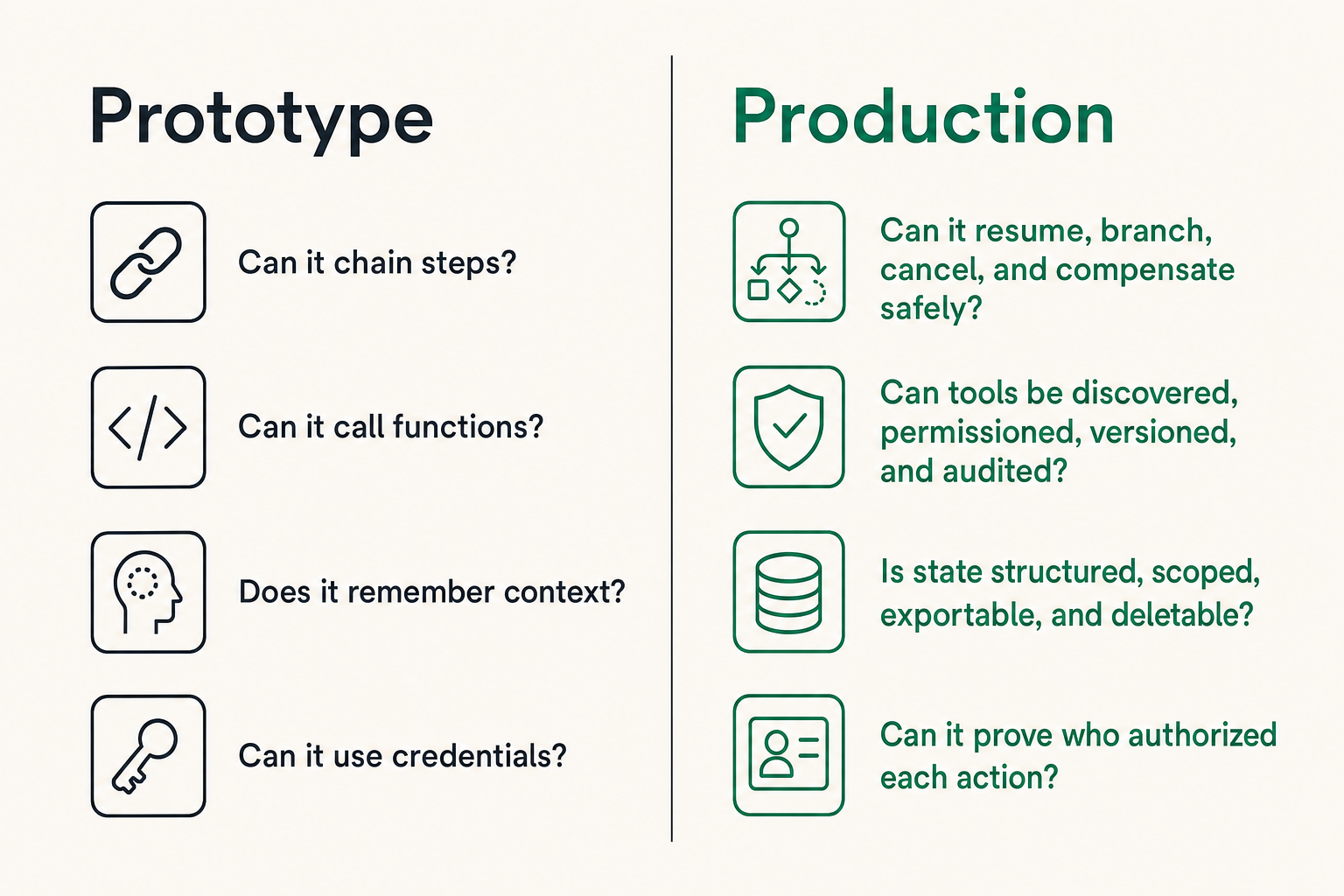
A good agent framework comparison starts with the control plane. That means you compare where decisions happen, where authority lives, and where state survives failures.
Use categories like these:
| Comparison area | Prototype question | Production question |
|---|---|---|
| Orchestration | Can it chain steps? | Can it resume, branch, cancel, and compensate safely? |
| Tooling | Can it call functions? | Can tools be discovered, permissioned, versioned, and audited? |
| Memory | Does it remember context? | Is state structured, scoped, exportable, and deletable? |
| Identity | Can it use credentials? | Can it prove who authorized each action? |
| Observability | Does it show traces? | Can traces support debugging, audit, billing, and support? |
| Interop | Does it support standards? | Can another runtime understand the same workflow? |
The mistake teams make is scoring feature checkboxes equally. A weak tracing UI is annoying. A weak permissions model can make the architecture unusable.
Separate orchestration from execution
Orchestration decides what should happen. Execution performs the action.
Frameworks often blur the two. A model decides to call a tool, the framework invokes it, and the result gets folded back into context. That is fine when the tool is harmless. It is risky when the tool sends email, changes infrastructure, moves money, shares credentials, or writes to customer systems.
A production architecture should let you insert gates between decision and execution:
- Agent proposes an action.
- Policy checks user, tenant, tool, scope, and risk.
- Human or service approval is requested when needed.
- Execution occurs with scoped credentials.
- Result and evidence are recorded.
- Downstream agents receive structured events, not just chat history.
This is where open standards matter. If the action proposal, credential scope, and event result are portable, the framework can change without rewriting the product.
Use a decision table before you write code
Before testing frameworks, build a short decision table for your own environment.
| Requirement | Must be inside framework | Should be external | Why it matters |
|---|---|---|---|
| Prompt routing | Yes | Maybe | Usually framework-specific and low-risk |
| Durable workflow state | No | Yes | Needed for replay, support, and migration |
| Tool catalog | Maybe | Yes | Shared by agents, plugins, and humans |
| User identity | No | Yes | Must align with product auth and compliance |
| Approval policy | No | Yes | Should not disappear if framework changes |
| Model provider selection | Maybe | Maybe | Depends on latency, cost, and governance |
| Audit trail | No | Yes | Must survive runtime swaps |
Practical rule: if a capability defines business authority, keep it outside the agent framework unless you are comfortable rebuilding it later.
The six layers every agent framework has to answer for
State and memory
Memory is often presented as a convenience feature. In production, it is a data management problem.
There are at least four different kinds of state:
- Conversation context used for short-term reasoning.
- Task state used to resume work.
- Domain state stored in your product database.
- Evidence state used for audit, review, or dispute handling.
What breaks in practice is mixing these into one vector store or one message transcript. The model may need context, but support teams need facts. Auditors need evidence. Users need deletion and access controls. Other systems need structured state transitions.
A framework can manage temporary context. It should not become the only place where task state exists.
Tools and capability boundaries
Tool calling is the center of most agent frameworks, but not all tool calls are equal.
A read-only search tool is not the same as a deployment tool. A summarization function is not the same as a credential-sharing flow. A customer support lookup is not the same as sending a refund.
Treat tools as capabilities with explicit boundaries:
- Inputs and outputs should be schema-defined.
- Side effects should be declared.
- Permissions should be checked before execution.
- Risk level should be visible to orchestration.
- Results should emit events.
For teams building shared access flows, credential portability is part of the architecture, not a convenience. LogicSRC's work on credential sharing is relevant because agents and plugins need scoped access without turning every framework into a secret vault.
Identity, permissions, and audit
Identity is where toy agents become production systems.
An agent may act as itself, as a user, as a service account, as a delegated automation, or as a temporary workflow principal. If your framework cannot represent that distinction cleanly, your logs will become ambiguous.
A minimum identity model should capture:
- Human initiator.
- Agent or workflow instance.
- Tenant or workspace.
- Tool identity.
- Credential source.
- Approval actor, if different from initiator.
- Final execution result.
Without this, audit trails become screenshots of traces. That does not scale.
Where popular agent framework categories fit
Graph and workflow-first frameworks
Graph-oriented frameworks are often the best fit when you have explicit states, branches, retries, and human handoffs. They make the workflow visible. That helps with debugging and support.
They work well for:
- Deterministic business processes with LLM steps inside them.
- Multi-step research, review, and approval flows.
- Systems that need resumability.
- Teams that want to test nodes independently.
Their weakness is usually integration surface area. If every node, message, and tool is expressed in framework-specific terms, the graph becomes hard to share with other runtimes.
Conversation and collaboration-first frameworks
Collaboration-first frameworks model agents as participants. They can be useful for research tasks, code review loops, design exploration, and situations where multiple specialized agents critique or refine work.
They work well when:
- The task benefits from debate or role separation.
- The output is mostly informational.
- Humans are comfortable supervising the conversation.
- State does not need to be a strict business workflow.
What fails is using conversational structure as a substitute for workflow state. A conversation transcript is not a queue, not a ledger, not an approval system, and not a durable business process.
Related reading from our network: screen sharing in software development makes a similar point about collaboration tools; the visible interaction is only one part of the operational workflow.
Hosted platforms and productized agent runtimes
Hosted agent platforms reduce time to first workflow. They often include UI, deployment, connectors, tracing, and model routing. That is valuable when your team needs speed or lacks platform capacity.
The tradeoff is boundary control.
Ask hard questions:
- Can you export traces and workflow state?
- Can you use external identity and permission systems?
- Can you bring your own tool registry?
- Can you run critical tools in your own environment?
- Can agents interact with external standards like MCP?
- What happens if a customer requires single-tenant execution?
Hosted does not mean bad. It means you need to be clear about which parts are commodity and which parts are your product's authority layer.
Open standards change the agent framework comparison
MCP moves tools out of the framework
MCP changed the agent framework comparison because tools no longer have to be embedded only in one SDK's registry. A tool server can expose capabilities that multiple clients and agents can use.
That changes the conversation. Instead of asking which framework has the best connector ecosystem, you can ask whether your tool surface is portable.
The practical model:
- Frameworks orchestrate reasoning and task flow.
- MCP servers expose tools and resources.
- Product auth controls who can access what.
- Events report what happened.
- Audit systems preserve evidence.
This separation is not academic. It lets platform teams change orchestration without rebuilding every integration.
Events move coordination out of the prompt
Many early multi-agent systems coordinate through messages in a prompt window. That is fragile. Prompts are not reliable transport, durable state, or a permission boundary.
Events give the system a backbone:
- Task created.
- Tool proposed.
- Approval requested.
- Credential issued.
- Action executed.
- Evidence attached.
- Workflow completed.
Once these are structured events, humans, agents, plugins, and hosted products can subscribe to the same operational reality. The framework can still reason, but it is no longer the only place where coordination exists.
For teams designing agentic task infrastructure, the same pattern appears in task management tools for open AI agent systems: task state has to outlive the chat surface.
Portable credentials prevent brittle integrations
Agents need access. Access creates risk.
The wrong approach is to put broad API keys into framework configuration and let the agent decide when to use them. That works until a prompt injection, tool confusion, tenant boundary mistake, or support escalation exposes how little control you actually have.
A better approach is scoped, auditable, time-limited delegation:
- The agent requests a capability.
- Policy evaluates the request.
- A credential is issued for a narrow purpose.
- The tool executes with that credential.
- The credential expires or is revoked.
- The action is logged with initiator and scope.
Practical rule: agents should receive capabilities, not permanent secrets. The framework should consume delegation, not own credential policy.
Implementation workflow for choosing an agent framework
Start with production paths
Do not begin by asking, which framework feels best? Begin with production paths.
Pick three workflows that represent your real product:
- A low-risk read-only workflow.
- A medium-risk workflow with a write action.
- A high-risk workflow requiring approval, scoped credentials, and audit.
For each path, define the actors, tools, states, failure cases, and support requirements. Then evaluate frameworks against those paths.
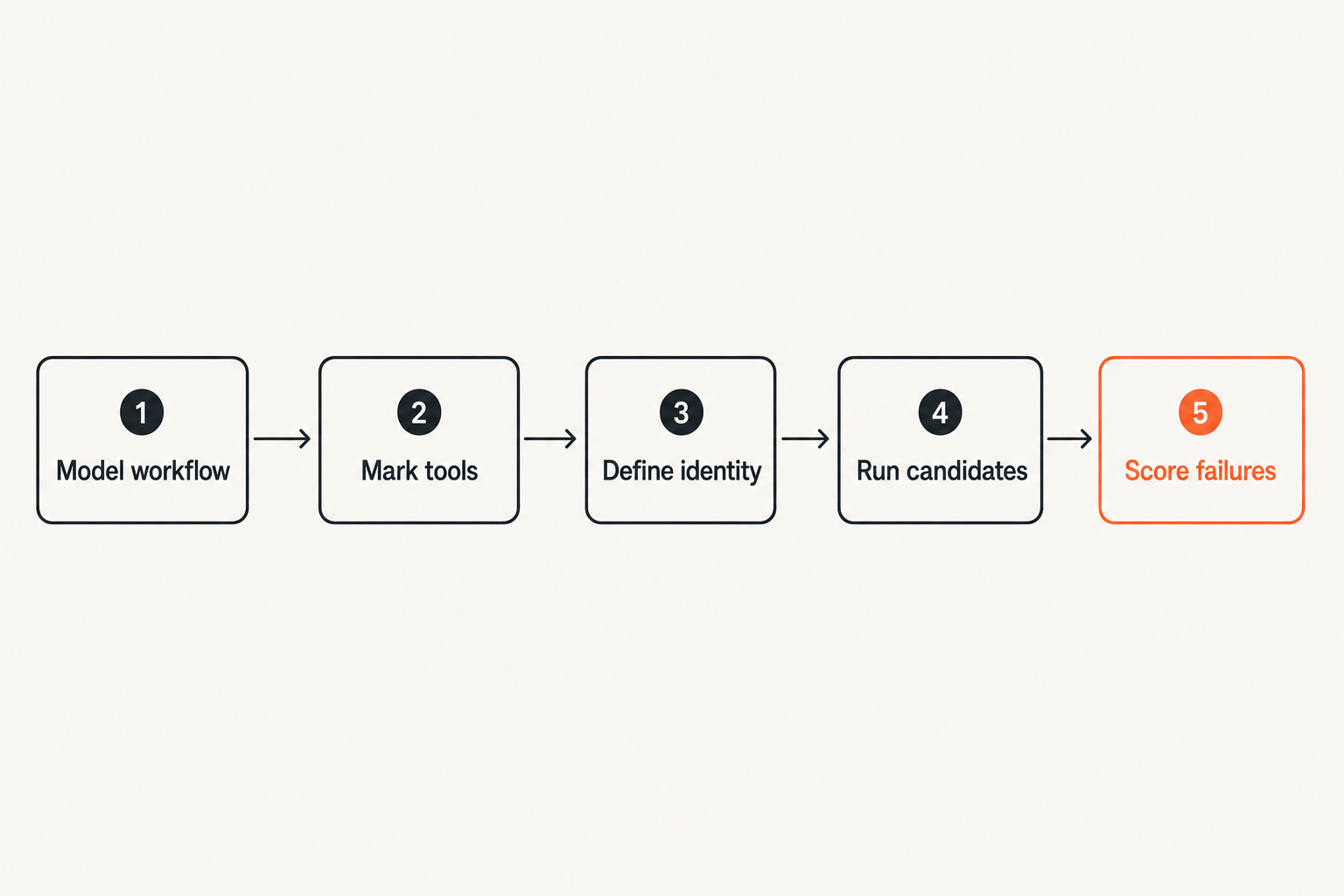
A basic implementation sequence looks like this:
- Write the workflow as a state machine before choosing a framework.
- Mark every external tool call and side effect.
- Define identity fields for user, agent, tenant, tool, and approver.
- Decide which state must be durable outside the runtime.
- Build one adapter per framework candidate.
- Run the same scenario and failure cases through each adapter.
- Compare traces, recovery behavior, and migration cost.
- Keep the framework-specific code at the edge.
This takes longer than a demo. It saves weeks later.
Run the same scenario through each candidate
A fair agent framework comparison requires the same scenario. Otherwise you end up comparing one polished demo with one rough prototype.
Use a scenario with real operational pressure. Example:
- User asks an agent to analyze a customer account.
- Agent reads account history and support tickets.
- Agent proposes a plan.
- A policy engine determines one step needs approval.
- Human approves.
- Agent calls a write tool.
- Downstream systems receive an event.
- Support can inspect the full timeline.
Now test each framework for:
- How much glue code is required.
- How easy it is to pause and resume.
- How tool permissions are represented.
- How failures are retried or compensated.
- How traces map to business events.
- How much state is trapped in framework internals.
Related reading from our network: content and platform teams face a comparable prioritization problem in scipy optimization minimize for AI crawler readiness, where the useful work is deciding what to optimize, not admiring the tool.
Score what breaks, not what demos
The demo path is not where frameworks fail. They fail around the edges.
Score candidates on ugly cases:
| Failure case | Question to ask | Good sign |
|---|---|---|
| Tool timeout | Can the workflow resume safely? | Idempotency and retry state are explicit |
| Partial success | Can compensation run? | Side effects are recorded separately |
| Human delay | Can the task wait for hours or days? | Durable state is externalized |
| Permission denial | Can the agent recover without hallucinating access? | Policy result is structured |
| Model switch | Can you change providers? | Prompts and state are portable enough |
| Audit request | Can you reconstruct the action? | Events and evidence are queryable |
The framework that looks slower in a demo may be the better production choice if it exposes the right boundaries.
What works and what fails in production
What works
What works is boring architecture.
- Keep business state in your product database or workflow store.
- Keep tool schemas explicit and versioned.
- Keep credentials scoped and external to the agent runtime.
- Emit events for important transitions.
- Store model inputs and outputs where policy allows.
- Use framework abstractions for orchestration, not authority.
- Make human approvals first-class states, not chat messages.
- Treat traces as debugging data, not the only audit trail.
A mature agent system looks less like a magic assistant and more like a distributed application with an LLM in the decision loop.
What fails
What fails is usually over-centralization inside the framework.
Common bad patterns:
- All state lives in message history.
- All tools share the same broad credential.
- Agents call write APIs without policy gates.
- Human approval is a Slack reply copied into a prompt.
- The system cannot replay why an action happened.
- Framework traces are treated as compliance records.
- Tool schemas drift across agents.
- Migration requires rewriting every integration.
The mistake teams make is assuming agent frameworks remove distributed systems problems. They do not. They add probabilistic reasoning to distributed systems problems.
Failure modes to test deliberately
Test failure modes before customers do.
Create a checklist for every candidate framework:
- Kill the process halfway through a tool call.
- Return malformed JSON from a tool.
- Deny a permission the agent expected to have.
- Delay human approval for 24 hours.
- Replay a completed workflow.
- Rotate credentials during execution.
- Swap the model provider.
- Change a tool schema version.
- Run two agents against the same task.
Practical rule: if you cannot explain exactly what happens after a partial failure, you have not finished the agent framework comparison.
Build versus buy versus compose
When to use an existing framework
Use an existing framework when orchestration is important but not your core product boundary.
That usually means:
- You need to ship agent workflows quickly.
- Your workflows are still changing.
- You want community integrations.
- Your team benefits from existing patterns.
- You can keep authority layers external.
Existing frameworks are especially useful for research agents, internal automation, support copilots, and workflow prototypes that may evolve into products.
The key is adapter discipline. Wrap the framework. Do not let it leak into every domain object.
When to build your own runtime
Build your own runtime only when you have a strong reason.
Good reasons include:
- You need strict deterministic workflow guarantees.
- You are building a developer platform where the runtime is the product.
- You need deep multi-tenant isolation.
- You have unusual latency, deployment, or compliance constraints.
- You need to support multiple agent frameworks behind one API.
Bad reasons include framework fatigue, aesthetic preference, or the belief that orchestration is simple. It is simple until you add retries, approvals, partial failures, billing, tenant boundaries, and support tooling.
If you build, keep the surface small. Define events, state transitions, tool contracts, and identity rules. Let model-specific and framework-specific code remain replaceable.
When to compose with standards
Composition is often the best default.
Use a framework for local orchestration. Use MCP for tool access where it fits. Use external identity for authorization. Use events for coordination. Use your own product database for durable business state. Use open schemas where other systems need to understand what happened.
This gives you optionality:
- Swap frameworks without rewriting tools.
- Add hosted agents without replacing product auth.
- Let plugins participate in workflows.
- Support humans and agents in the same task model.
- Expose auditable timelines to customers.
A composed architecture is not automatically easier. It requires discipline. But it avoids making one framework responsible for everything.
Where logicsrc.com fits
A standards surface between agents and products
logicsrc.com focuses on open schemas, primitives, and conventions for coordination between humans, AI agents, plugins, payment systems, and hosted products. That is exactly the layer many agent framework comparisons skip.
The point is not to replace every framework. The point is to define the shared surface around frameworks:
- Agent identity and delegation.
- Task and workflow coordination.
- Credential sharing boundaries.
- Tool and plugin interoperability.
- MCP-adjacent integration patterns.
- Events and auditable workflow records.
If you are building a platform, the framework is only one participant. Your customers, plugins, hosted products, and internal operators need a common language too.
You can learn more about the broader standards approach on logicsrc.com's about page, especially if your team is designing systems that need to coordinate across agents and products instead of locking coordination into one runtime.
Use it to reduce framework coupling
A useful product architecture keeps the framework behind adapters and exposes stable primitives to the rest of the system.
For example:
user request
  -> product identity
  -> task record
  -> agent framework adapter
  -> MCP/tool capability
  -> policy and credential delegation
  -> execution event
  -> audit timeline
In that model, the agent framework can be LangGraph, AutoGen, Semantic Kernel, a hosted runtime, or your own orchestration layer. The product-facing semantics remain stable.
That is the point of an open standards surface. It lets teams compare frameworks without turning the winner into a permanent architecture constraint.
The closing test is simple: after your agent framework comparison, can you still explain your system without naming the framework? If yes, you are probably designing the architecture. If no, you may just be adopting a runtime.
Try logicsrc.com
logicsrc.com is for developers and platform teams building interoperable AI agent systems, SDKs, plugins, and hosted products.
Try logicsrc.com and use your next agent framework comparison to define better boundaries, not just pick another SDK.