Task Management Tools for Open AI Agent Systems in 2026

Most task management tools were built for humans who can read a ticket, infer missing context, ask a teammate, and decide what done means. AI agents do not get that luxury. They need explicit state, typed inputs, permissions, event history, escalation paths, and a way to prove what happened.
Teams think the problem is picking a better task app. The real problem is designing a coordination layer that humans, agents, SDKs, plugins, and hosted products can all understand without brittle glue code.
That changes the conversation. The practical question is not whether your backlog has labels, views, or comments. It is whether a task can move across tools, call external capabilities, preserve provenance, trigger review, and remain auditable when multiple agents touch it.
In 2026, task management tools are becoming part of agent infrastructure. If you are building developer tools, open source automation, MCP servers, workflow engines, or hosted AI products, treating tasks as UI objects is the mistake that will show up later as broken retries, unsafe delegation, duplicate work, and support tickets nobody can reconstruct.
Table of contents
- Why task management tools are becoming agent infrastructure
- What teams mean by task management tools
- The agent task object
- Identity permissions and ownership
- Events webhooks and MCP integration
- The implementation workflow
- What breaks when teams implement this badly
- What works and what fails
- Choosing task management tools for agent ready teams
- Where logicsrc.com fits
Why task management tools are becoming agent infrastructure
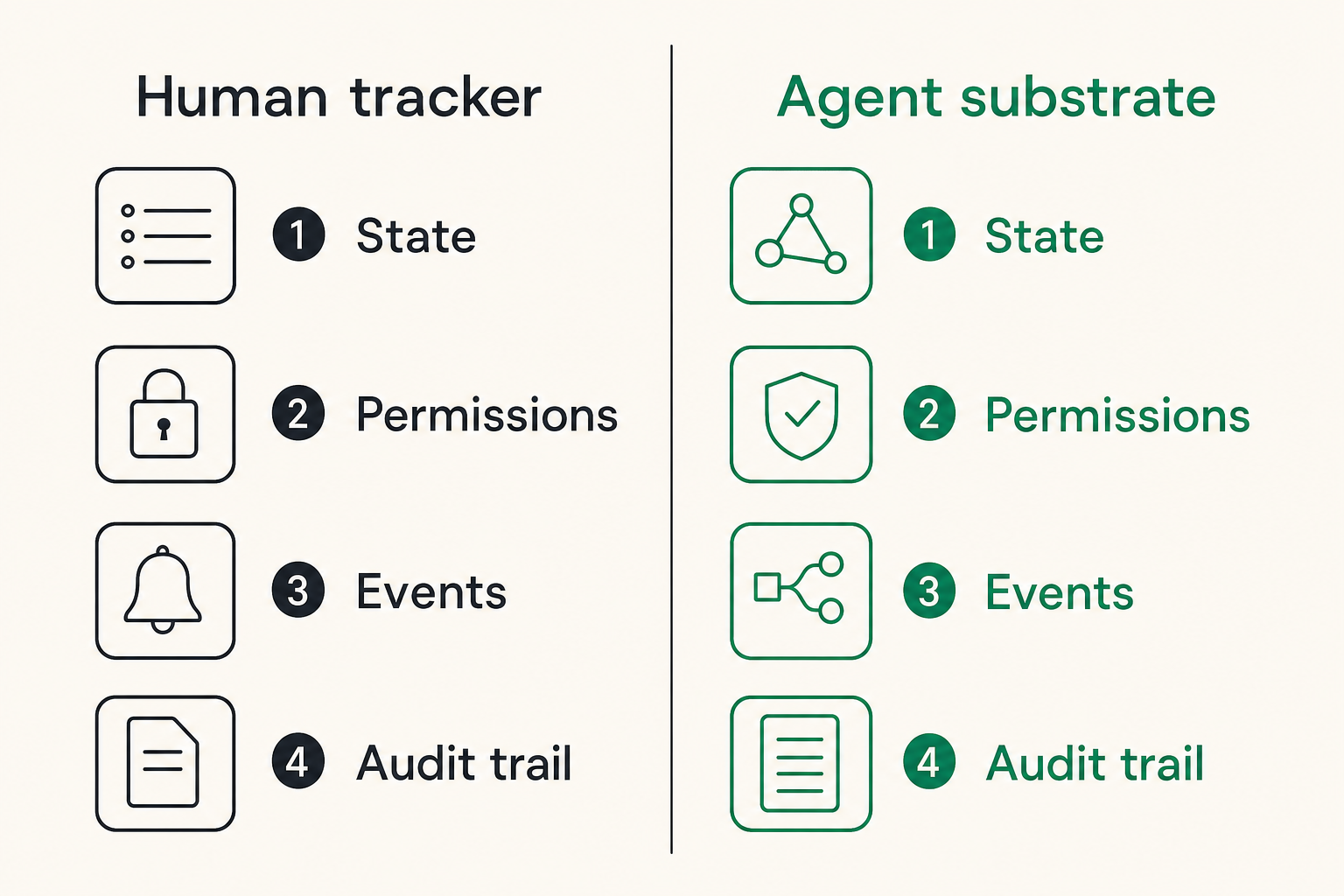
The mistake teams make is assuming agent work can be bolted onto the same ticketing patterns used by humans. That works for demos. It fails when the agent must coordinate across repositories, billing systems, credentials, approvals, customer accounts, observability data, and external plugins.
A task is no longer only a row in a database. In an agent system, a task is a coordination contract. It carries intent, authority, state, inputs, outputs, dependencies, and evidence. If that contract is vague, every downstream tool compensates with custom prompts, hidden assumptions, and one-off adapters.
Practical rule: If an agent can act on a task, the task must be machine-readable, permission-aware, and reconstructable after the fact.
From human queues to agent work graphs
Human task tools organize attention. Agent task systems organize execution.
A human queue can tolerate ambiguity. A ticket that says investigate failed checkout is enough because an engineer can open dashboards, talk to support, and choose the next step. An agent needs a scoped objective, allowed tools, data boundaries, success criteria, and an escalation path when confidence drops.
A useful way to think about it is a work graph rather than a task list. Nodes are tasks, subtasks, artifacts, reviews, credentials, API calls, and events. Edges describe dependency, delegation, evidence, or authorization. The graph matters because agents do not just complete tasks. They spawn work, subscribe to events, retry operations, and hand off partial results.
Why 2026 changes the architecture
The change is not that AI can write more tickets. The change is that AI systems are starting to operate inside production workflows. They triage issues, draft pull requests, enrich alerts, update CRM records, generate support replies, run OSINT-style enrichment, and coordinate plugin calls.
That makes task management tools part of the agent runtime. If tasks do not expose stable APIs and event semantics, teams build sidecar state stores. If permissions are not explicit, agents inherit too much access. If audit trails are weak, operators cannot explain why a task changed, who approved it, or what data the agent used.
Related reading from our network: teams buying operational software face similar workflow-fit problems in field service management software, where scheduling UI is less important than dispatch state, mobile execution, inventory, and rollout risk.
What teams mean by task management tools
Task management tools can mean a kanban board, an issue tracker, a workflow engine, a project management suite, or an internal queue service. For agent systems, those categories blur. The tool is less important than the contract it exposes.
The practical question is: can another system safely understand and advance the task without reading your team culture?
UI tracker versus execution substrate
A UI tracker is optimized for people. It has assignees, comments, due dates, labels, and saved views. Those are useful, but they are not enough for automated work.
An execution substrate has typed transitions, event emission, policy checks, idempotent actions, artifact references, and durable logs. It gives agents a narrow path to act without guessing. It also gives operators a way to stop, replay, inspect, or reassign work.
| Capability | Human-centric tracker | Agent-ready task substrate |
|---|---|---|
| State | Often informal status columns | Explicit state machine |
| Assignment | Person or team | Human, agent, service, or role |
| Context | Comments and links | Typed inputs and artifacts |
| Permissions | Workspace access | Per-action delegation scope |
| Automation | Rules and integrations | Events, webhooks, MCP tools, retries |
| Audit | Activity feed | Append-only execution history |
| Failure handling | Manual follow-up | Retry, compensate, escalate |
Neither model is wrong. The problem starts when teams expect the first model to behave like the second under production automation.
Tasks as state machines
Agents need state machines because state machines reduce interpretation. A task should not only be open, in progress, and done. It may need states such as queued, claimed, running, blocked, waiting for review, approved, failed, cancelled, superseded, and archived.
Each transition should answer three questions:
- Who or what initiated the transition?
- What evidence or artifact justified it?
- What downstream event should be emitted?
Practical rule: If a task transition cannot be validated by code, it is a comment, not workflow state.
The agent task object
The agent task object is the smallest useful unit of coordination. It should be boring. Boring schemas are good because they survive multiple vendors, SDKs, databases, and language runtimes.
The mistake teams make is putting too much intelligence in prompts and too little in the task object. Prompts are instructions. Tasks are operational records. You need both, but they have different jobs.
Minimum fields that agents need
At minimum, an agent-ready task should include:
- Stable task identifier
- Tenant or workspace identifier
- Objective in human-readable form
- Typed task kind
- Current state
- Requesting actor
- Acting actor
- Delegation scope
- Required inputs
- Produced artifacts
- Dependencies
- Review policy
- Event history pointer
- Deadline or budget constraints
- Error and retry metadata
Do not hide these inside comments. Comments are useful for humans. Agents need fields they can validate, index, and pass between systems.
A practical schema shape
A compact task record can look like this:
task_id: task_8f2a
kind: repo.pull_request_review
state: waiting_for_review
tenant_id: acme-prod
objective: Review generated PR for dependency upgrade
requester:
  type: human
  id: user_41
actor:
  type: agent
  id: agent_code_review_2
scope:
  tools:
    - github.read
    - github.comment
    - ci.read
  forbidden:
    - github.merge
inputs:
  repository: acme/api
  pull_request: 1842
artifacts:
  - type: report
    uri: artifact://task_8f2a/review.md
review:
  required: true
  approver_role: maintainer
retry:
  attempt: 1
  max_attempts: 3
This is not a universal standard. It is a shape. The point is to separate intent, authority, state, and evidence. Once those are explicit, tools can interoperate without relying on prompt archaeology.
Identity permissions and ownership
Task management tools become risky when identity is treated as an afterthought. A task is not only what should happen. It is also who is allowed to cause it to happen.
For AI agents, ownership is layered. A human may request work. A platform agent may claim it. A plugin may execute a sub-action. A hosted product may store the artifact. A reviewer may approve the result. If all of that collapses into one bot user, your audit model is already broken.
Who is acting and on whose behalf
Every agent action should distinguish between:
- The principal that requested the task
- The agent or service performing the action
- The resource owner affected by the action
- The policy that allowed the action
- The human or automated reviewer that approved escalation
This is especially important for SDKs and hosted products that operate across customer accounts. Agents should not inherit workspace-wide admin privileges because it is convenient. They should receive scoped delegation that maps to the task.
LogicSRC frames this as open coordination between humans, agents, plugins, payment systems, and hosted products; the broader standards surface is described on the LogicSRC about page for teams thinking beyond a single app boundary.
Review gates are product controls
Review gates are often treated as compliance decoration. In agent task systems, they are product controls.
A review gate decides whether an agent can publish, merge, pay, delete, notify, export, or share. That means it needs to be part of the task state machine, not a Slack reaction after the fact.
Practical rule: Any irreversible or externally visible action should have an explicit review policy, even if that policy sometimes allows automatic approval.
Review does not always mean a human click. It can be rule-based approval, quorum approval, automated validation, or risk-scored escalation. The key is that the decision is recorded as part of the workflow.
Events webhooks and MCP integration
Task systems do not fail because somebody forgot a label. They fail because state changes do not propagate reliably. Agents wait on stale data, webhooks arrive twice, plugins time out, and operators cannot tell which system owns the next move.
This is why events matter. An agent-ready task management layer should emit useful events and consume external events without turning every integration into custom middleware.
The event log is the real source of truth
In production, the activity feed is not enough. You need an event log that downstream systems can trust.
Useful task events include:
- task.created
- task.claimed
- task.input.attached
- task.tool.called
- task.artifact.created
- task.review.requested
- task.review.approved
- task.failed
- task.retry.scheduled
- task.completed
- task.cancelled
Each event should include actor, timestamp, task identifier, idempotency key, correlation identifier, and relevant artifact references. Avoid stuffing full sensitive payloads into events. Store references, hashes, and metadata where possible.
Related reading from our network: checkout teams face the same event and reconciliation problem with payment state, webhooks, custody boundaries, and retries in crypto checkout architecture.
Where MCP fits
MCP and similar tool protocols are useful because they give agents a structured way to access capabilities. But MCP is not a full task system by itself. It describes tools and interactions. Your task layer still needs ownership, state, review, eventing, and audit.
A practical architecture is:
- Task system stores intent and state
- MCP server exposes capabilities
- Agent runtime plans and executes within scope
- Event bus records transitions and external signals
- Review layer approves risky actions
- Artifact store preserves outputs and evidence
The key is not to make MCP carry every workflow concern. Keep tool invocation separate from task governance.
The implementation workflow
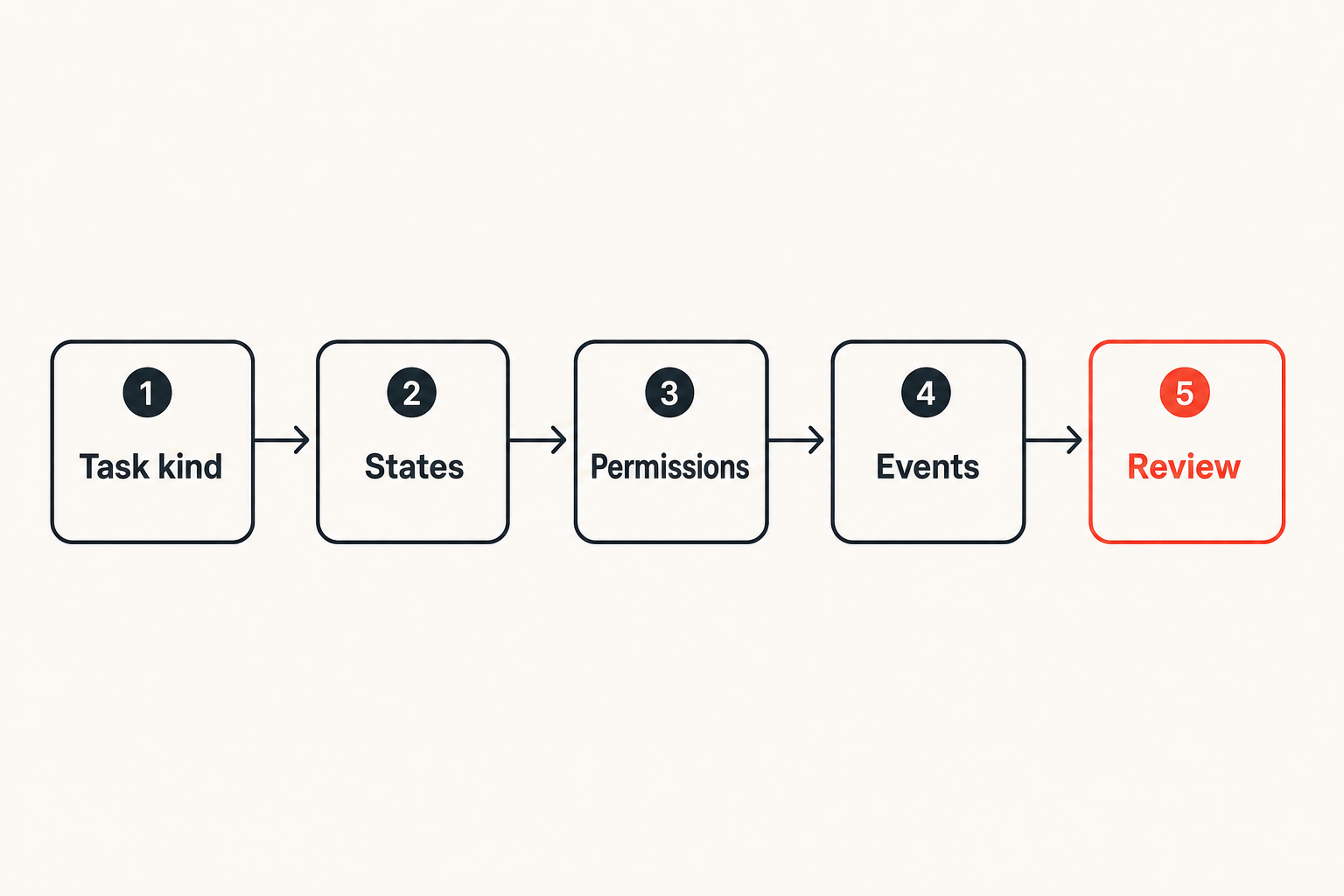
The best way to implement agent-ready task management tools is to start with one bounded workflow. Do not redesign the entire company operating model. Pick a workflow where ambiguity is expensive and state transitions are visible.
Good candidates include dependency update review, support escalation drafting, alert triage, invoice exception handling, credential request approval, documentation update pipelines, and data enrichment queues.
A sequence that does not collapse in production
Use this implementation sequence:
- Define the task kind and its allowed states.
- List the actors that can request, claim, review, and complete the task.
- Define required inputs and output artifacts.
- Map tool permissions to each state.
- Create transition rules and validation checks.
- Emit events for every meaningful transition.
- Add idempotency keys for actions that call external systems.
- Add review gates for irreversible or visible actions.
- Build operator views from the event log, not only current status.
- Run failure drills before expanding the workflow.
This sequence looks slower than wiring a bot to a project board. It is faster than debugging silent state corruption across five systems later.
Idempotency retries and duplicate agents
What breaks in practice is not the happy path. It is duplicate execution.
An agent times out after calling a plugin. The plugin succeeded, but the response was lost. The task still looks running. Another worker retries. Now the customer gets two notifications, two pull request comments, or two payment attempts.
Avoid that by designing idempotency into task actions:
action_id: act_91c7
idempotency_key: task_8f2a:github.comment:review-summary-v1
correlation_id: corr_2026_08_19_001
expected_state: running
on_conflict: return_existing_result
Retries should be safe by default. If an action cannot be safely retried, the task should move to needs_review or failed_pending_reconciliation rather than trying again blindly.
What breaks when teams implement this badly
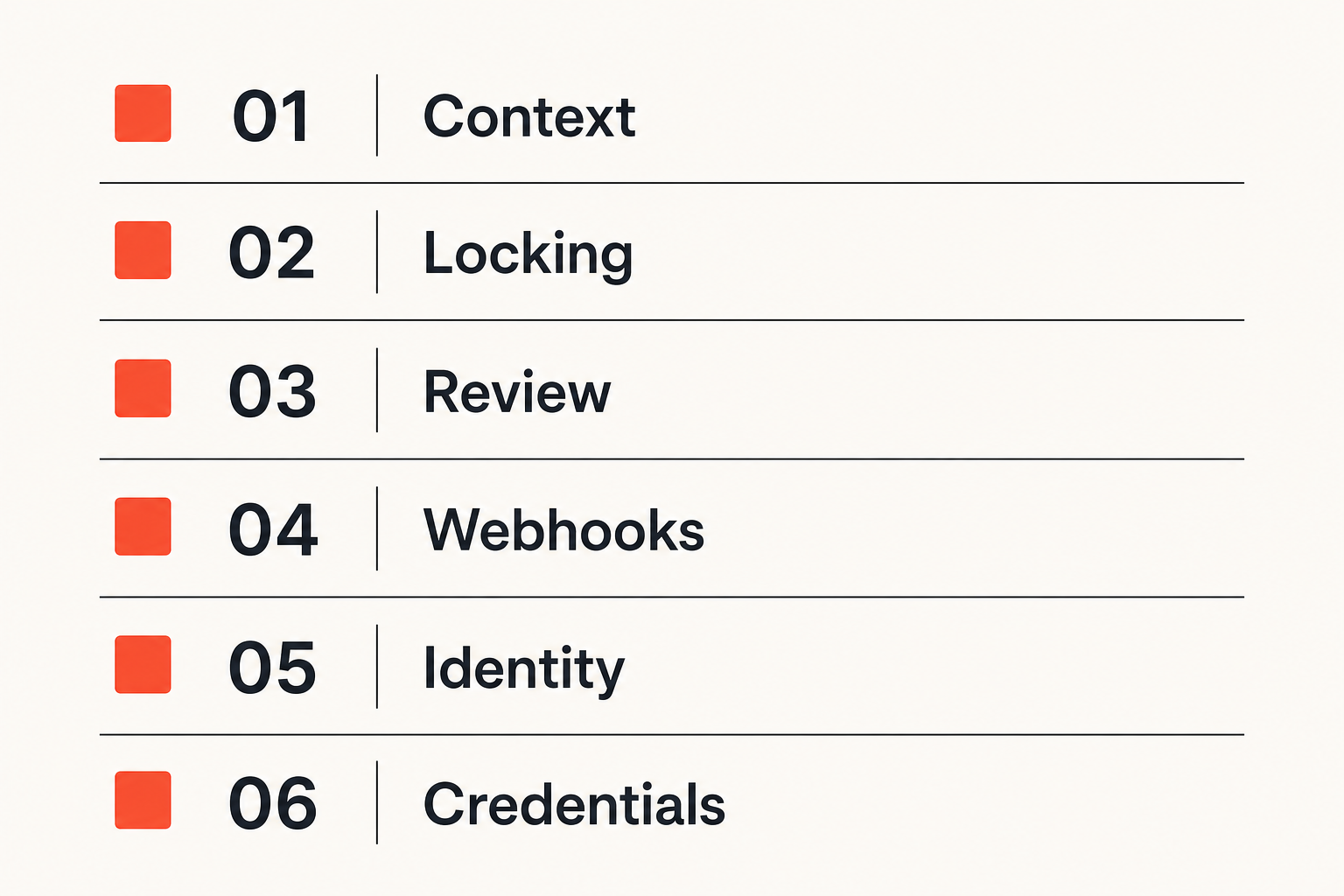
Bad agent task systems are easy to recognize. They look productive for a few weeks, then operators start adding manual spreadsheets, private Slack threads, and hidden dashboards to understand what is happening.
The visible symptom is noise. The underlying cause is missing workflow architecture.
Failure modes you will actually see
Common failure modes include:
- Agents claim tasks without enough context and generate low-quality output.
- Two agents work the same task because locking is weak.
- Tasks complete without required artifacts.
- Reviewers approve actions without seeing the evidence.
- Webhooks update stale tasks after cancellation.
- A bot account performs actions that should be attributed to a delegated agent.
- Operators cannot replay why a task moved from running to done.
- Sensitive credentials appear in comments, prompts, or event payloads.
- A workflow depends on a vendor-specific status that cannot be mapped elsewhere.
For credentialed workflows, the boundary matters. If agents need temporary access, design the workflow around scoped sharing and revocation rather than copying secrets into tickets; LogicSRC covers that surface through credential sharing primitives intended for interoperable agent and plugin systems.
How to debug the system
Debugging should start from the task event log. Ask:
- What was the task objective at creation time?
- Which actor claimed it?
- What tools were allowed at that state?
- Which external calls were made?
- Which artifacts were produced?
- Which policy approved the transition?
- Were any events replayed, duplicated, or delayed?
- Did the task finish, fail, cancel, or become superseded?
If you cannot answer those questions without reading chat history, your task tool is not yet an operational system.
Related reading from our network: even consumer workflow topics such as legal streaming setup run into state, account, device, privacy, and support boundaries; this AP Bio streaming workflow is a loose but useful reminder that the visible interface is rarely the whole system.
What works and what fails
The gap between a demo and a reliable agent workflow is usually boring engineering. That is good news. You do not need magic. You need clear contracts, conservative permissions, durable state, and observable transitions.
What works
What works is designing tasks as records of delegated work.
Strong patterns include:
- Typed task kinds instead of free-form objectives only
- Explicit state machines per workflow
- Scoped delegation per task, not permanent bot access
- Append-only event logs
- Artifact references instead of pasted blobs
- Review gates before irreversible actions
- Idempotency keys on external calls
- Operator dashboards that show blocked, stale, failed, and waiting states
- Schemas that can be shared across SDKs and plugins
Open source maintainers should pay special attention to schema stability. If you publish a plugin or agent framework, downstream developers will build assumptions around your task states. Treat those states like API surface.
What fails
What fails is hiding workflow inside prompts.
Weak patterns include:
- One generic task type for every kind of work
- Status columns with ambiguous meaning
- Bot users with broad permissions
- Comments used as structured data
- Review performed outside the task state machine
- Webhooks without idempotency or replay handling
- No distinction between requester, actor, and approver
- Tool calls that cannot be linked back to task state
- Vendor-specific automations that cannot be exported or mapped
The mistake teams make is optimizing for the first successful automation instead of the hundredth failure case. Production workflows are mostly edge cases eventually.
Choosing task management tools for agent ready teams
Choosing task management tools for agent systems is not a feature checklist exercise. Views, roadmaps, comments, and templates are table stakes. The deeper question is whether the tool can participate in an interoperable architecture.
You may still use an existing issue tracker. Many teams should. But you need to know whether it is the source of truth, a human-facing projection, or one participant in a larger task substrate.
Evaluation criteria
Use these criteria when evaluating a tool or deciding what to build:
| Question | Why it matters |
|---|---|
| Does it expose a stable API for tasks and transitions? | Agents need predictable state changes. |
| Can task states be customized with validation? | Workflows differ by risk and domain. |
| Are events available with replay or durable delivery? | Webhooks alone are often not enough. |
| Can permissions be scoped per action? | Agents should not inherit broad access. |
| Can artifacts be attached by reference? | Evidence should be durable and inspectable. |
| Are actors represented clearly? | Audit requires requester, agent, service, and approver identity. |
| Can it integrate with MCP servers or tool registries? | Agents need structured capabilities. |
| Can data be exported in useful formats? | Open systems should not trap operational history. |
If a tool is excellent for humans but weak on APIs and eventing, use it as a presentation layer. Do not force it to be the execution substrate.
Build buy or bridge
There are three sane options.
Build when task execution is core to your product, your states are domain-specific, and auditability is part of customer trust. This is common for agent platforms, security workflows, compliance systems, payment operations, and developer automation products.
Buy when your workflows are mostly human coordination and agent involvement is light. A mature tracker with good APIs may be enough.
Bridge when you need human UX from an existing tool but agent-grade state elsewhere. In this model, your internal task service owns the state machine and emits events, while the external tool shows status, comments, and approvals.
A useful way to think about it is this: buy the interface if it saves time, but own the contract if it defines your product behavior.
Where logicsrc.com fits
logicsrc.com is about open schemas, primitives, and conventions for coordination between humans, AI agents, plugins, payment systems, hosted products, events, credential sharing, MCP, and auditable workflows.
That matters because task management tools are becoming one surface area in a larger interoperability problem. A task might originate in a SaaS product, be claimed by an agent, call an MCP server, request a credential, wait for human approval, trigger a payment or notification, and emit audit events into another system.
Open coordination beats proprietary workflow islands
Proprietary workflow islands are comfortable until you need to cross a boundary. Then every integration becomes translation work. Task state becomes comments. Credentials become pasted secrets. Reviews become screenshots. Audit becomes best-effort reconstruction.
Open coordination does not mean every product must use the same database or UI. It means the important primitives are portable: identity, delegation, tasks, events, artifacts, credentials, review, and evidence.
The prior LogicSRC article on agent-ready OSINT tools makes the same point in an investigation context: wrappers around search are less important than provenance, permissions, schemas, review gates, and audit trails.
A practical adoption path
Start small:
- Pick one workflow where agents already assist humans.
- Define the task object and state machine.
- Separate requester, actor, approver, and resource owner.
- Add event emission for every transition.
- Move credentials and artifacts out of comments.
- Add review gates for risky actions.
- Publish the schema to SDK and plugin developers.
- Treat task transitions as API contracts.
This is how task management tools move from project tracking to interoperable agent coordination without pretending one vendor will own the whole workflow.
Task management tools in 2026 should not be judged only by how nicely they display work. Judge them by whether humans and agents can safely share work, preserve context, enforce permissions, and explain outcomes across system boundaries.
Try logicsrc.com
logicsrc.com is for developers and platform teams building interoperable AI agent systems, SDKs, plugins, and hosted products. Try logicsrc.com.