OSINT Tools in 2026: Build Agent-Ready Workflows, Not Fragile Search Wrappers

OSINT tools are easy to demo and hard to operate.
A search box, a few enrichment APIs, and an LLM summary can look impressive in a sales call. Then the system hits production: stale sources, unclear permissions, unverifiable claims, screenshots with no lineage, agents calling tools out of order, and analysts re-checking everything manually.
Teams think the problem is finding better OSINT tools. The real problem is building an investigation workflow where agents, humans, plugins, credentials, evidence, and decisions share the same operating model.
That changes the conversation. In 2026, OSINT is not just a collection problem. It is an architecture problem: how do you let AI agents use open source intelligence without turning your environment into a pile of unaudited browser automation, copied secrets, and confident summaries nobody can defend?
The practical question is not whether an agent can search the web. It can. The practical question is whether your platform can prove what it searched, what it collected, what it inferred, who approved it, and what downstream action was allowed.
Table of contents
- Why OSINT tools are now an agent architecture problem
- The operating model for agent-ready OSINT tools
- The standards surface your OSINT stack needs
- Provenance is the control plane for OSINT tools
- Workflow design: from collection to review
- Integration patterns for AI agents and OSINT tools
- Failure modes that break investigations
- Metrics that matter in production OSINT
- Build or buy: the practical decision
- Where LogicSRC fits with OSINT tools
Why OSINT tools are now an agent architecture problem
Search wrappers do not survive production
The mistake teams make is treating OSINT tools as a better search interface. They build a wrapper around public search, a few enrichment vendors, screenshots, and an LLM summarizer. It works until a real user asks why the finding is trusted.
What breaks in practice is not collection. It is repeatability. The same query returns different results tomorrow. The same username exists on multiple platforms. A source disappears. An agent summarizes a page that was not archived. An analyst exports a PDF and loses the chain of custody.
A useful way to think about it is this: collection is an input, not the product. The product is a decision-ready investigation record.
Practical rule: If an OSINT result cannot be replayed, attributed, reviewed, and permissioned, treat it as an observation, not evidence.
For AI engineers, that means the tool call is only one piece of the system. You also need run context, actor identity, source metadata, timestamps, confidence handling, review state, and downstream action policy.
The agent changes ownership
Before agents, analysts often compensated for weak tooling with judgment. They knew which sources were noisy, when to verify manually, and when not to escalate. Once an AI agent can call OSINT tools directly, that judgment must move into architecture.
Who is the actor: the user, the agent, the organization, or a delegated workflow? Which credentials may the agent use? Which sources are allowed for which investigation type? Can the agent contact an external party, or only read public data? Can it enrich a person, a domain, a wallet, a company, or all of them?
These are not UI questions. They are standards and workflow questions. The teams that get this right do not ask for a smarter chatbot. They define a control surface where agents can do useful work without pretending every output is equally safe.
Related reading from our network: teams thinking about machine-citable technical material face a similar problem of structure over presentation in open dynamics engine examples for answer engines.
The operating model for agent-ready OSINT tools
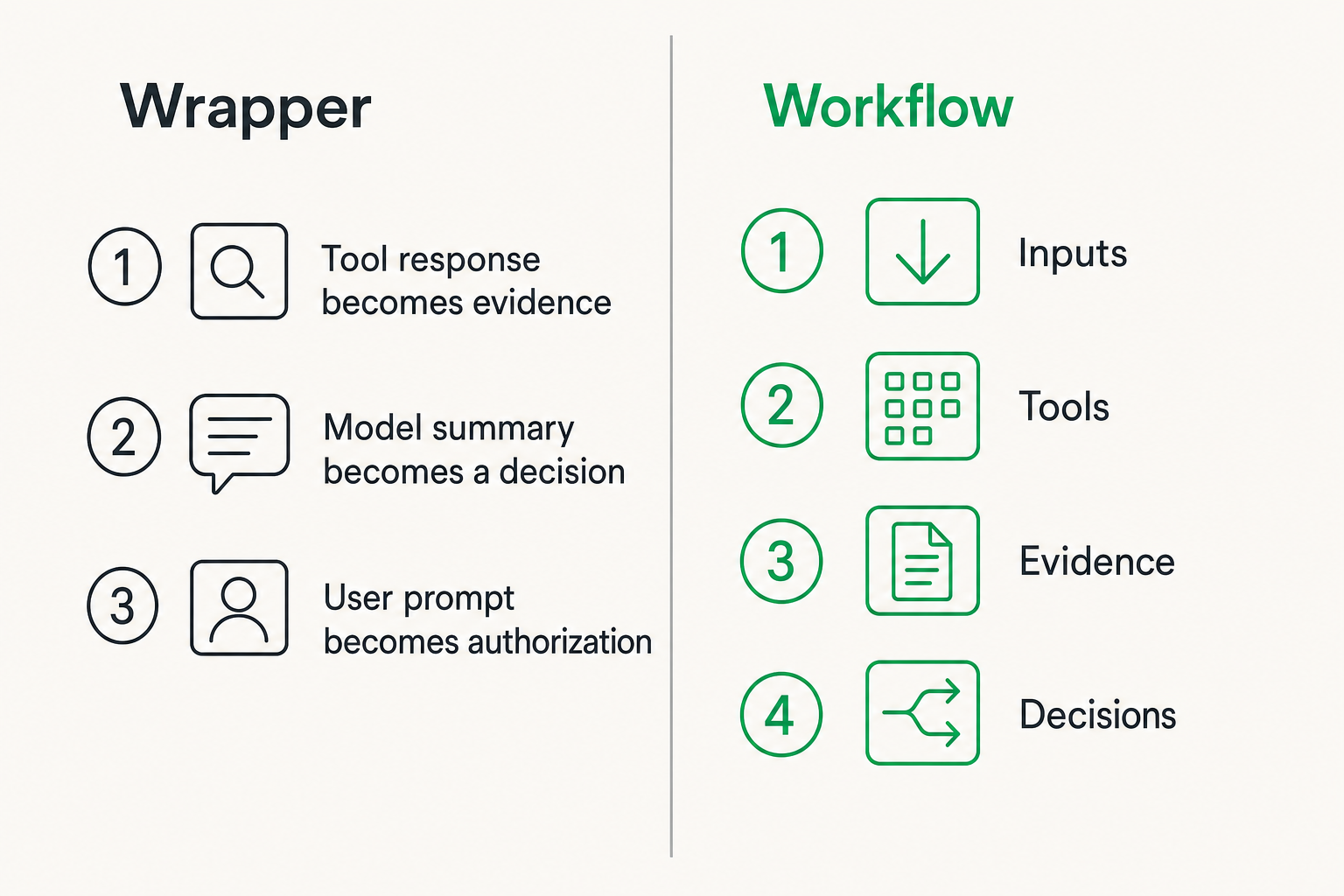
Inputs, tools, evidence, decisions
An agent-ready OSINT system has four layers:
- Inputs: the subject, scope, task, user intent, policy, and allowed sources.
- Tools: search, enrichment, archive, graph, browser, extraction, translation, classification, and reporting capabilities.
- Evidence: normalized claims with provenance, timestamps, source references, and review state.
- Decisions: escalation, suppression, monitoring, notification, case creation, or no action.
The failure mode is mixing these layers. A tool response becomes evidence. A model summary becomes a decision. A user prompt becomes authorization. That is how teams end up with impressive automation and weak accountability.
Agent-ready OSINT tools should separate collection from interpretation. A domain lookup can return records. A model can propose that a domain is suspicious. A reviewer or policy engine decides whether that proposal is actionable.
Treat every result as a claim
Every OSINT output should be modeled as a claim:
- Subject: what entity the claim is about.
- Predicate: what is being asserted.
- Object: the value or relationship.
- Source: where it came from.
- Observed time: when your system saw it.
- Source time: when the source says it was true, if available.
- Collector: which tool or agent collected it.
- Confidence: how reliable the claim appears, not whether it is true.
- Review status: unreviewed, accepted, rejected, superseded, or needs follow-up.
This sounds formal, but it is operationally simple. It prevents summaries from becoming the only artifact. It also lets multiple agents contribute to the same investigation without overwriting each other.
Comparison: wrapper versus workflow
| Area | Search wrapper | Agent-ready workflow |
|---|---|---|
| Unit of work | Query and response | Scoped investigation task |
| Output | Summary or export | Evidence graph plus decision state |
| Permissions | API key or user session | Delegated actor, scope, and policy |
| Provenance | Links and screenshots | Source lineage, timestamps, collector identity |
| Review | Manual after the fact | Built-in gates before action |
| Integration | Point-to-point API calls | Events, schemas, and tool contracts |
The wrapper approach is faster in week one. The workflow approach is faster by month three, because the system stops forcing humans to reconstruct context.
Practical rule: Do not let an agent produce a final OSINT conclusion unless the underlying claims remain queryable as first-class records.
The standards surface your OSINT stack needs
Identity and permission boundaries
OSINT workflows need identity that is more granular than user logged in. An agent may act for a user, a team, a scheduled job, or a case. It may have permission to read public web sources but not paid data. It may enrich domains but not individual people. It may draft a report but not send it.
This is where open agent standards matter. The authorization model should travel with the task, not live in a hidden prompt or a single backend service. If tool adapters, hosted products, and plugins cannot agree on actor, scope, and delegation, every integration re-implements policy differently.
LogicSRC describes this broader coordination surface as open schemas and primitives for humans, AI agents, plugins, payment systems, and hosted products on the LogicSRC about page. For OSINT tools, the same idea applies: identity and coordination must be explicit, portable, and auditable.
Schemas for evidence and tasks
At minimum, define schemas for:
- Investigation task
- Subject entity
- Tool invocation
- Source record
- Claim
- Evidence bundle
- Review decision
- Audit event
- Exported report
A schema does not need to be perfect. It needs to be stable enough that one tool can produce evidence and another tool can review, enrich, redact, or export it without losing context.
Example task envelope:
task_type: osint_investigation
subject:
  type: domain
  value: example.org
scope:
  allowed_sources:
    - public_web
    - dns
    - certificate_transparency
  disallowed_actions:
    - contact_subject
    - bypass_authentication
actor:
  type: delegated_agent
  user_id: analyst_123
review:
  required_before:
    - external_notification
    - case_escalation
The practical question is not whether this exact YAML is universal. It is whether your OSINT tools preserve this kind of context across the workflow.
MCP, events, and tool contracts
Model Context Protocol-style tool interfaces help agents discover and call tools, but MCP alone is not the whole system. You still need event semantics, idempotency keys, evidence references, and policy checks.
A good tool contract answers:
- What input schema is accepted?
- What permissions are required?
- Is the call read-only or does it create external effects?
- What artifacts are returned?
- Are results deterministic, cached, or time-sensitive?
- How should errors, rate limits, and partial results be represented?
If your tool contract only says run_search(query), you have not built an OSINT platform. You have exposed a search function to an agent.
For adjacent context on agent-ready patterns, our prior piece on OSINT tools and agent-ready intelligence workflows goes deeper on schemas, provenance, permissions, events, MCP integration, review gates, and audit controls.
Provenance is the control plane for OSINT tools
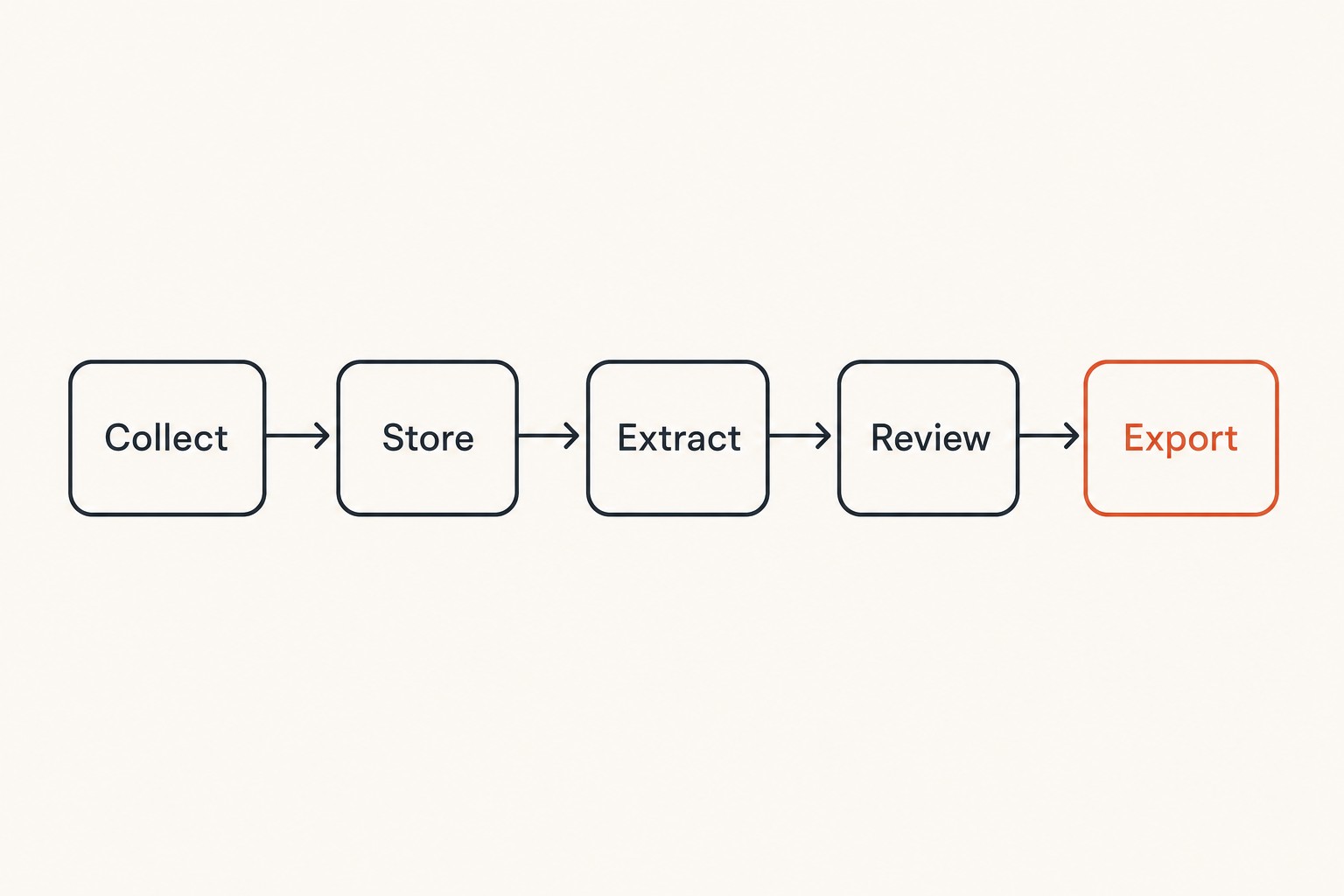
Source lineage beats screenshots
Screenshots are useful for humans, but they are a weak system of record. They are hard to diff, hard to query, and easy to detach from collection context. For OSINT tools, provenance should be structured before it is visual.
Capture the URL, canonical URL, fetch time, content hash, extractor version, raw artifact pointer, normalized text pointer, tool invocation ID, agent ID, and policy context. If the source is an API, capture request parameters, response metadata, provider, and rate-limit state where appropriate.
This lets you answer the questions that matter later:
- Was this collected within scope?
- Which tool collected it?
- Did the source change?
- Which model saw which version?
- Which claims came from which source?
- Which decision relied on the claim?
Related reading from our network: private communication workflows face the same audit and record problem when teams coordinate sensitive evidence, as discussed in IRS secure messaging and private workflow design.
Confidence is not truth
Many teams misuse confidence scores. A model says 0.92 and the UI paints the result green. That is not an evidence model. That is decoration.
Confidence should describe the reliability of the assertion under known conditions. It may include source reputation, corroboration count, extraction quality, freshness, and conflict state. It should not be presented as truth.
Practical rule: Confidence is a routing signal. Review status is an operational state. Neither is a substitute for provenance.
A practical implementation uses confidence to decide what happens next: auto-cluster, request corroboration, send to analyst, suppress as low quality, or mark as conflicting. The decision record should still show why.
Retention and redaction decisions
OSINT does not mean no privacy risk. Public data can still be sensitive. Agent workflows can collect more than intended because automation reduces friction.
Build retention into the evidence model. Some artifacts should expire. Some should be redacted before export. Some should require higher permission to view. Some should remain as hashes or references rather than raw content.
For teams designing safe access to shared secrets, tokens, or third-party accounts, LogicSRC's work on credential sharing is relevant because OSINT agents often need delegated access without copying long-lived credentials into prompts, scripts, or browser sessions.
Workflow design: from collection to review
A practical implementation sequence
The implementation sequence matters. If you start with a chatbot and retrofit audit later, you will fight your own data model.
- Define investigation types: domain risk, vendor review, fraud lead, threat actor profile, brand abuse, wallet enrichment, or incident triage.
- Define scope templates: allowed sources, prohibited actions, data classes, retention, and review requirements.
- Create task envelopes: actor, subject, purpose, source policy, deadline, and expected outputs.
- Wrap tools behind adapters: normalize inputs, outputs, errors, artifacts, and permissions.
- Store claims separately from summaries: keep source lineage and review state attached.
- Emit workflow events: task.created, tool.called, evidence.added, claim.reviewed, report.exported.
- Add review gates: require human or policy approval before escalation, external communication, or irreversible action.
- Build report generation last: reports should render evidence, not replace it.
This order prevents the common inversion where teams make a beautiful report generator and then discover they cannot prove anything in the report.
Human review gates
A review gate is not a sign that automation failed. It is how you keep automation useful in a domain where context matters.
Good gates are specific:
- Before assigning a risk label to a person.
- Before notifying a customer or partner.
- Before creating a security incident.
- Before sharing evidence outside the team.
- Before using paid or restricted sources.
- Before retaining sensitive personal data.
Bad gates are vague. If every finding says needs review, analysts ignore the system. If nothing needs review, the system eventually takes an action it cannot justify.
What works and what fails
What works:
- Small, typed tasks with clear scope.
- Tool outputs stored as structured artifacts.
- Claims linked to sources and review states.
- Agents that propose next steps instead of silently executing them.
- Event-driven workflows that make handoffs observable.
What fails:
- One giant agent with a browser and too many credentials.
- Summaries without inspectable evidence.
- Hard-coded source lists inside prompts.
- Review states stored only in comments.
- Exported PDFs treated as the system of record.
Related reading from our network: the operating model for trust, routing, follow-up, and coordination in running a local community network is a useful analogy for OSINT workflows, where the hard part is not one lookup but reliable handoff between actors.
Integration patterns for AI agents and OSINT tools
Tool adapters instead of tool sprawl
The mistake teams make is connecting every agent to every vendor API directly. It feels flexible until each integration has different errors, rate limits, entity formats, timestamps, and permission assumptions.
Use adapters. Each adapter should translate a vendor or internal capability into your platform contract. The agent should not care whether domain enrichment came from provider A, provider B, a cache, or an internal graph. It should care about the evidence returned and the policy attached.
Adapter responsibilities:
- Validate task scope before execution.
- Normalize entity identifiers.
- Attach invocation metadata.
- Convert provider errors into standard errors.
- Return artifacts and claims separately.
- Emit events for audit and replay.
Async jobs, retries, and idempotency
OSINT tools often call slow, rate-limited, or unstable sources. If your agent expects every tool call to return synchronously, you will build brittle workflows.
Use async jobs for long-running collection. Give every job an idempotency key based on task, subject, source, and normalized parameters. Store partial results. Retry safely. Mark provider timeouts as collection state, not investigation failure.
A simple event model is enough:
event: evidence.added
task_id: task_789
job_id: job_456
source_type: public_web
artifact_id: artifact_222
claims:
  - claim_id: claim_001
    status: unreviewed
That changes the conversation with downstream systems. They subscribe to evidence and review events instead of scraping report text.
Credential sharing without credential leakage
Some OSINT workflows need authenticated services, paid databases, private threat intel communities, or internal systems. The agent should not receive raw credentials unless there is no alternative.
Prefer delegated access, scoped tokens, short-lived sessions, brokered calls, and auditable vault access. Store whether a claim came from public data, licensed data, or internal data. That distinction matters for export, retention, and customer communication.
Practical rule: If a credential appears in a prompt, transcript, browser log, or exported artifact, assume your OSINT architecture has already failed.
Failure modes that break investigations
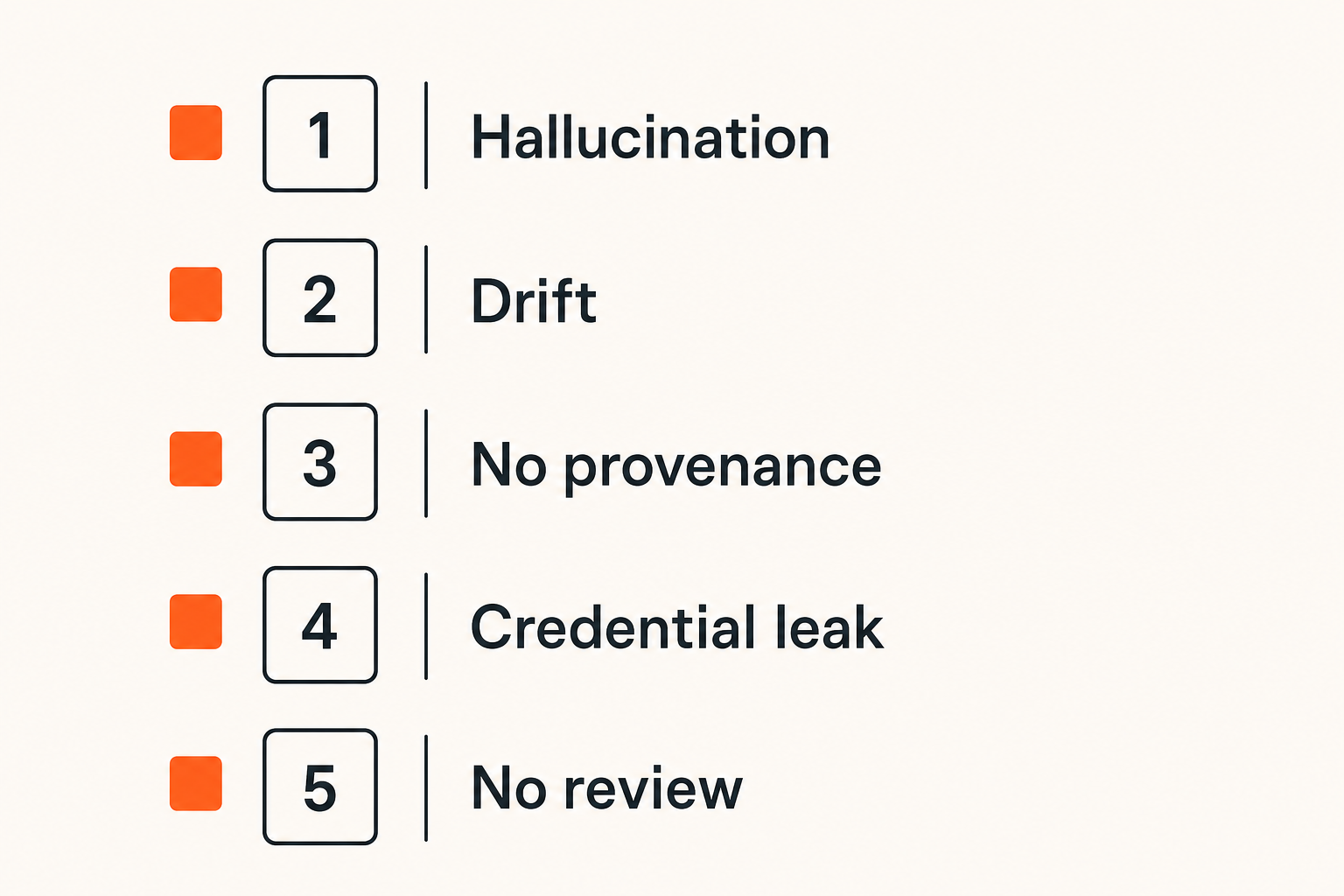
Hallucinated enrichment
Hallucinated enrichment happens when a model connects entities without enough evidence. It sees similar names, reused handles, nearby domains, or thematic overlap and creates a narrative.
The fix is not just a better model. The fix is requiring claims to carry relationship type, source, extraction method, and corroboration state. Similarity is not ownership. Co-occurrence is not affiliation. A graph edge should explain itself.
Make agents use language that preserves uncertainty: possible match, observed co-occurrence, same registrant field, same certificate subject, same wallet cluster according to source X. Then require review before converting that into a stronger assertion.
Permission drift
Permission drift is when a workflow begins within scope and gradually escapes it. A user asks for a domain investigation. The agent finds an email. Then a person. Then social accounts. Then breach references. Suddenly the original task has become personal profiling.
Prevent drift by making scope machine-readable and checked at every adapter boundary. If a task permits domain enrichment only, the tool should refuse person enrichment unless a new scope is approved.
This is where policy-as-context is weak. Do not rely on the model remembering the rule. Put the rule in the tool contract and authorization layer.
Unreviewed automation
The most dangerous OSINT automation is not collection. It is downstream action: alerting a customer, blocking an account, filing an incident, escalating a vendor, publishing a report, or contacting a subject.
Unreviewed automation fails because OSINT data is messy. A stale record can implicate the wrong organization. A username can belong to multiple people. A translation can change meaning. An old paste can be recirculated as new.
The practical design is simple: allow agents to collect, normalize, cluster, and draft. Require gates for irreversible or reputationally sensitive action.
Metrics that matter in production OSINT
Investigation latency
Latency is not only API response time. It is the time from task creation to decision-ready evidence. Measure collection latency, review latency, and rework latency separately.
A slow vendor is annoying. A missing provenance field that forces an analyst to redo the investigation is worse. The highest-value metric is often time-to-trust: how long until a human can decide whether the finding is usable.
Useful latency metrics:
- Task created to first evidence.
- First evidence to first review.
- Review requested to review completed.
- Task created to decision.
- Reopened investigations caused by missing context.
Evidence coverage
Evidence coverage asks whether the workflow collected enough relevant information for the task type. It does not mean more data is always better.
For a domain investigation, coverage might include DNS, certificate transparency, hosting, redirects, web content, archive checks, and reputation sources. For a vendor review, it might include company records, security pages, breach mentions, trust documentation, and public dependencies.
Define expected source families per investigation type. Then track whether tasks are missing source families, whether failures are due to policy, provider limits, or adapter errors, and whether analysts frequently request manual follow-up.
Rework and exception rates
Rework is the tax you pay for weak architecture. If analysts often repeat tool calls, re-check sources, ask who approved something, or rebuild timelines manually, the OSINT system is not carrying enough operational context.
Track:
- Percent of claims rejected for poor provenance.
- Percent of reports returned for missing evidence.
- Tool calls repeated because prior results were not reusable.
- Exceptions caused by permission mismatch.
- Manual steps that recur across investigations.
Do not invent a vanity dashboard. Pick metrics that show whether the workflow is reducing investigation friction.
Build or buy: the practical decision
When to build internally
Build internally when OSINT is core to your product, your data model is specialized, or your workflows need deep integration with internal case systems, threat graphs, fraud engines, or compliance controls.
Internal builds work best when you have platform engineering support, not just a prototype owner. Someone must maintain adapters, schemas, permission checks, queues, audit logs, retention logic, and migrations. If that sounds heavy, that is because production OSINT is heavy.
The benefit is control. You can encode your investigation model precisely and avoid vendor lock-in at the workflow layer.
When to standardize externally
Standardize externally when the core problem is interoperability. If multiple teams, agents, plugins, and hosted products need to coordinate, an open standards surface is more valuable than another private integration.
You may still build your own UI. You may still use preferred vendors. The point is to avoid trapping evidence and workflow state inside one tool. OSINT tools become more useful when they can participate in a shared model of actor, task, claim, event, permission, and review.
The practical question is: what should be proprietary, and what should be boring plumbing? Your unique detection logic, risk model, or analyst experience may be proprietary. Evidence envelopes, delegation semantics, and audit events should not need to be reinvented by every team.
Migration without a rewrite
Most teams cannot pause operations to rebuild their OSINT stack. Migrate at the boundary.
Start by wrapping existing tools with adapters that emit standard events and evidence records. Keep the current UI if it works. Add provenance fields behind the scenes. Add review states before changing report generation. Make one investigation type agent-ready before generalizing.
A workable migration path:
- Pick one recurring workflow with high rework.
- Define its task and evidence schema.
- Wrap two or three existing tools.
- Store claims separately from reports.
- Add review states and audit events.
- Let agents operate only inside that bounded workflow.
- Expand once the model survives real cases.
This avoids the big-platform rewrite trap.
Where LogicSRC fits with OSINT tools
Open standards as the boring layer
LogicSRC is not trying to make OSINT magical. The useful layer is more boring: open schemas, primitives, and conventions for coordination between humans, AI agents, plugins, payment systems, hosted products, credentials, events, MCP-style tools, and auditable workflows.
For OSINT tools, that means giving platform teams a consistent way to model delegated actors, scoped tasks, evidence records, credential boundaries, review gates, and workflow events. The goal is not to replace every tool. The goal is to make tools interoperable enough that agents can operate safely across them.
This is the layer many teams skip because it is not flashy. Then they spend the next year debugging unclear ownership, broken handoffs, and evidence nobody trusts.
Product fit for agent workflows
LogicSRC fits best when you are building or maintaining:
- Agent SDKs that need permissioned tool access.
- OSINT plugins that must return structured evidence, not just text.
- Hosted investigation products that need audit trails.
- Developer platforms coordinating humans and agents.
- Internal tools that need credential delegation and workflow events.
- Open source projects that want interoperable schemas instead of one-off JSON shapes.
The practical value is reducing integration ambiguity. If every component agrees on task, actor, claim, event, credential, and review semantics, your OSINT tools stop behaving like isolated utilities and start behaving like a workflow system.
The mistake teams make is waiting until after adoption to add this layer. By then, every customer, plugin, and internal script has encoded a slightly different version of the truth.
Try logicsrc.com
If your OSINT tools need to work with agents, SDKs, plugins, credentials, events, MCP, and auditable workflows, Try logicsrc.com. LogicSRC is for developers and platform teams building interoperable AI agent systems, SDKs, plugins, and hosted products.