OSINT Tools in 2026: Architecture Patterns for Agent-Ready Intelligence Workflows

Most OSINT tools fail at the exact point where teams start trusting them. The demo looks useful: query a domain, enrich an entity, summarize a profile, export a report. Then production arrives. Sources disagree. Evidence gets stale. Agents retry the same lookup. Nobody knows which credential was used, which finding was reviewed, or whether the system is allowed to take the next step.
Teams think the problem is finding more data. The real problem is building a workflow that can preserve context, permissions, provenance, and review boundaries while multiple humans, AI agents, plugins, and systems touch the same intelligence object.
That changes the conversation. OSINT tools in 2026 are not just search boxes, scrapers, browser extensions, or enrichment APIs. They are coordination systems. The practical question is how to design them so an agent can use them without turning open-source intelligence into an unauditable pile of screenshots, cached pages, and fragile summaries.
A useful way to think about it is this: if an analyst cannot explain where a claim came from, when it was observed, who or what accessed it, and what decision it triggered, the tool is not production-ready. It might be useful. It is not operational infrastructure.
Table of contents
- Why OSINT tools are now an agent architecture problem
- The OSINT tools stack: from source access to decisions
- Build around provenance, not screenshots
- Permissions and credential boundaries for agentic OSINT
- Event-driven workflows beat scrape-and-dump pipelines
- MCP and open standards: make OSINT tools composable
- What breaks when OSINT tools are implemented badly
- A practical implementation workflow for agent-ready OSINT tools
- What works, what fails, and how to measure it
- Where logicsrc.com fits in an OSINT tools architecture
Why OSINT tools are now an agent architecture problem
The search box is not the system
The mistake teams make is treating OSINT as retrieval. They wire a few sources into a UI, add an LLM summary, and call it an intelligence workflow. That can help a single analyst move faster. It does not solve the system problem.
A real workflow has state. An entity has aliases. A claim has evidence. A source has access rules. A finding has confidence. A decision has an owner. An agent action has permissions. A report has an audit trail. When those pieces live in separate tabs, prompt logs, spreadsheets, and chat threads, the organization does not have OSINT infrastructure. It has assisted browsing.
For developer tool builders, the important shift is from result pages to interoperable objects. The OSINT tool should not just return text. It should return structured observations, source references, collection metadata, permission context, and suggested next actions that another system can safely consume.
Practical rule: if an OSINT result cannot be replayed, cited, expired, challenged, and reviewed, do not let an autonomous agent act on it.
Why 2026 changes the requirements
AI agents have made the weak parts of OSINT tooling more visible. An analyst might notice that a source is dubious or that a scraped page is stale. An agent will often move forward unless the workflow encodes those constraints.
This is why open standards matter. The problem is not whether a model can summarize a page. The problem is whether different agents, SDKs, hosted products, and plugins can coordinate around the same intelligence object without losing the operational context that makes the result safe to use.
If you are building in this space, the architecture has to assume multiple actors: a collector agent, an enrichment service, a review queue, a case management tool, a reporting agent, and a human approver. They need shared contracts. They need machine-readable boundaries. They need events, not copy-pasted findings.
The operator view of OSINT
Operators care less about novelty and more about whether a workflow survives production pressure. Can the system tell me which source produced this finding? Can I revoke a credential without breaking every agent? Can I suppress noisy observations? Can I prove that a human approved a sensitive action?
That changes how you evaluate OSINT tools. The question is not which one has the longest list of sources. The question is which one fits into a governed workflow where evidence can move safely from collection to interpretation to action.
Related reading from our network: teams thinking about how AI systems cite technical material face similar content-structure issues in example pages answer engines can actually cite.
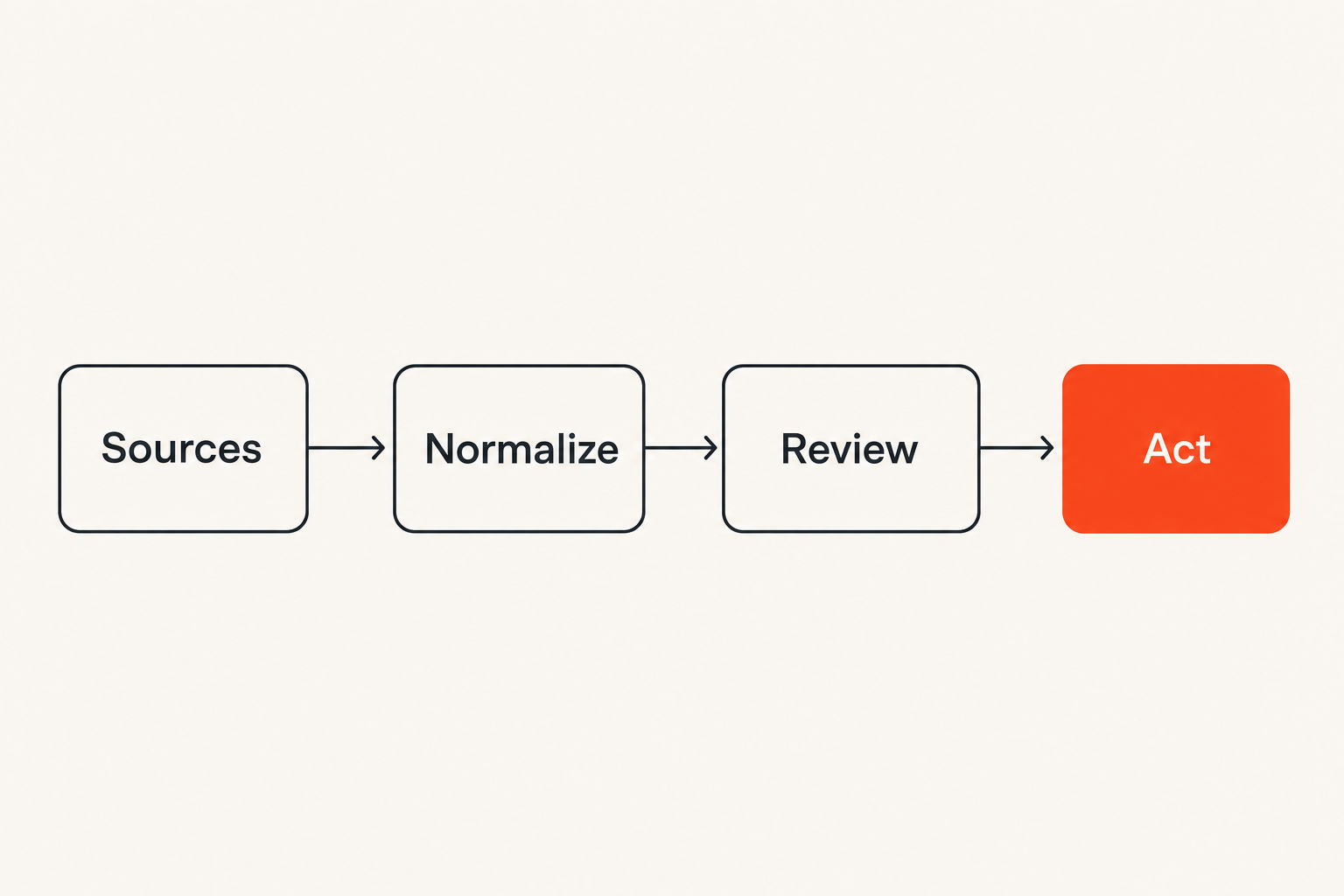
The OSINT tools stack: from source access to decisions
Layer 1: sources and collectors
Every OSINT architecture starts with sources: public web pages, registries, social profiles, DNS records, code repositories, breach corpuses, package metadata, certificate transparency logs, paste sites, threat feeds, app stores, and niche databases. The collector layer handles access, rate limits, retries, parsing, and change detection.
What breaks in practice is that teams mix source access with analysis. A scraper returns a paragraph. An enrichment API returns a risk score. A browser extension captures a page. None of them agree on source identity, timestamps, or confidence. Later, an agent sees three pieces of text and treats them as equivalent.
The collector layer should produce observations, not conclusions. Keep the raw source reference, collection timestamp, access method, parser version, and any constraints attached to the observation.
Layer 2: normalization and entity resolution
Normalization turns messy observations into shared objects. A domain, company, wallet, email address, handle, package name, IP address, person, repository, or certificate should have an internal identity with links to evidence.
Entity resolution is where many OSINT tools quietly create risk. Two handles look similar, so the system merges them. A company name matches, so the agent treats it as the same organization. A stale profile is tied to a current person. The model summarizes the combined object and the error becomes harder to detect.
The safe pattern is to separate candidate links from confirmed links. Store why the link was proposed. Store who or what confirmed it. Store what evidence would invalidate it.
Layer 3: workflow, review, and action
The final layer is where OSINT becomes operational. A finding can open a case, notify a maintainer, enrich a ticket, block a transaction, create a report, request human approval, or trigger another agent.
This layer needs explicit action contracts. An agent that can search public records should not automatically be able to contact a target, publish a report, or modify a customer account. The workflow engine needs to know which actions are informational, which are sensitive, and which require human review.
A comparison is useful:
| Approach | Looks good in demo | Breaks in production | Better pattern |
|---|---|---|---|
| Search wrapper | Fast answers | No provenance or state | Structured observations |
| LLM-only summary | Readable output | Weak citations and stale claims | Evidence-linked summaries |
| Source-specific scripts | Quick integration | Hard to replace or audit | Adapter contracts |
| Manual review after the fact | Flexible | Review cannot stop bad actions | Review gates before action |
| Shared API key | Simple setup | No actor-level accountability | Scoped credentials |
Build around provenance, not screenshots
What provenance needs to capture
Provenance is not a footnote. It is the control plane for trust. At minimum, each observation should carry:
- Source name and source type
- Source URL or stable reference when legally and operationally appropriate
- Collection timestamp and observed timestamp if different
- Collector identity, including agent, plugin, or human operator
- Parser or model version used to extract fields
- Access credential or permission class, not necessarily the secret itself
- Raw artifact pointer, hash, or immutable capture reference
- Confidence, review status, and expiration policy
This is not bureaucracy. It is how you prevent a summary from becoming detached from reality. It also lets downstream tools decide what to do. A report generator may accept unreviewed observations for drafting. A blocking system should require reviewed evidence with a defined confidence threshold.
How agents should cite evidence
Agent citations should be structural, not decorative. A citation should point to an evidence object, not just paste a link in markdown. The difference matters when the page changes, access is revoked, or the same claim appears in multiple sources.
A practical evidence object might look like this in a schema-first system:
evidence_id: ev_7x9
entity_id: domain_example
claim: domain resolves to suspicious infrastructure
source_type: dns
observed_at: 2026-08-07T12:30:00Z
collector: agent_dns_lookup_v3
artifact_hash: sha256:...
review_status: pending
expires_at: 2026-08-14T12:30:00Z
The exact fields will vary. The point is that the agent should cite the evidence ID and the claim should remain inspectable after the model output is forgotten.
Staleness is a first-class field
OSINT data decays. DNS changes. Profiles are deleted. Packages are transferred. Wallet labels shift. A person changes jobs. A leaked credential is rotated. If staleness is not encoded, the system will quietly reuse old context.
Practical rule: every observation should have an expiration policy before it has an automation policy.
Some evidence should expire in hours. Some can remain useful for months. Some should never be used for automated action without revalidation. Make this explicit. Agents are good at chaining steps, but they are not naturally good at knowing when old evidence should stop mattering.
Permissions and credential boundaries for agentic OSINT
Separate identity from capability
In agentic OSINT, identity answers who or what is acting. Capability answers what that actor is allowed to do. Do not collapse them into one API key.
A collector agent may read public DNS data. A paid enrichment adapter may query a commercial source. A human analyst may approve sensitive correlation. A reporting agent may generate a draft but not publish it. These are different capabilities and should be represented as different grants.
This matters because the blast radius of an OSINT system is not only data exposure. It is also bad action. A misconfigured agent that can enrich, correlate, notify, and publish has too much authority.
Design credential sharing as a policy surface
Many teams start with shared secrets because it is easier. Then they add agents. Then they add plugins. Then nobody can answer which tool accessed which source under which terms.
Credential sharing needs a policy layer: scoped access, time-boxed grants, approval requirements, revocation, and audit logs. LogicSRC covers this coordination problem as part of its standards surface for credential sharing, which is directly relevant when AI agents need controlled access to source-specific tools without leaking long-lived secrets across the stack.
The key design move is to avoid giving agents raw credentials whenever possible. Give them mediated capabilities. The agent requests an action. The policy layer decides whether that action is allowed, under which identity, and with what audit record.
Human approval is part of the API
Human review should not be an email thread outside the system. It should be represented as an event, a state transition, and a permission boundary.
For example, an agent may propose that two entities are linked. The workflow can mark the link as candidate. A reviewer approves it. Only then can downstream workflows treat the link as confirmed. That review event should include reviewer identity, timestamp, scope, and rationale.
The mistake teams make is treating human approval as a UI feature. In an agent workflow, approval is an API primitive.
Event-driven workflows beat scrape-and-dump pipelines
Why polling becomes operational debt
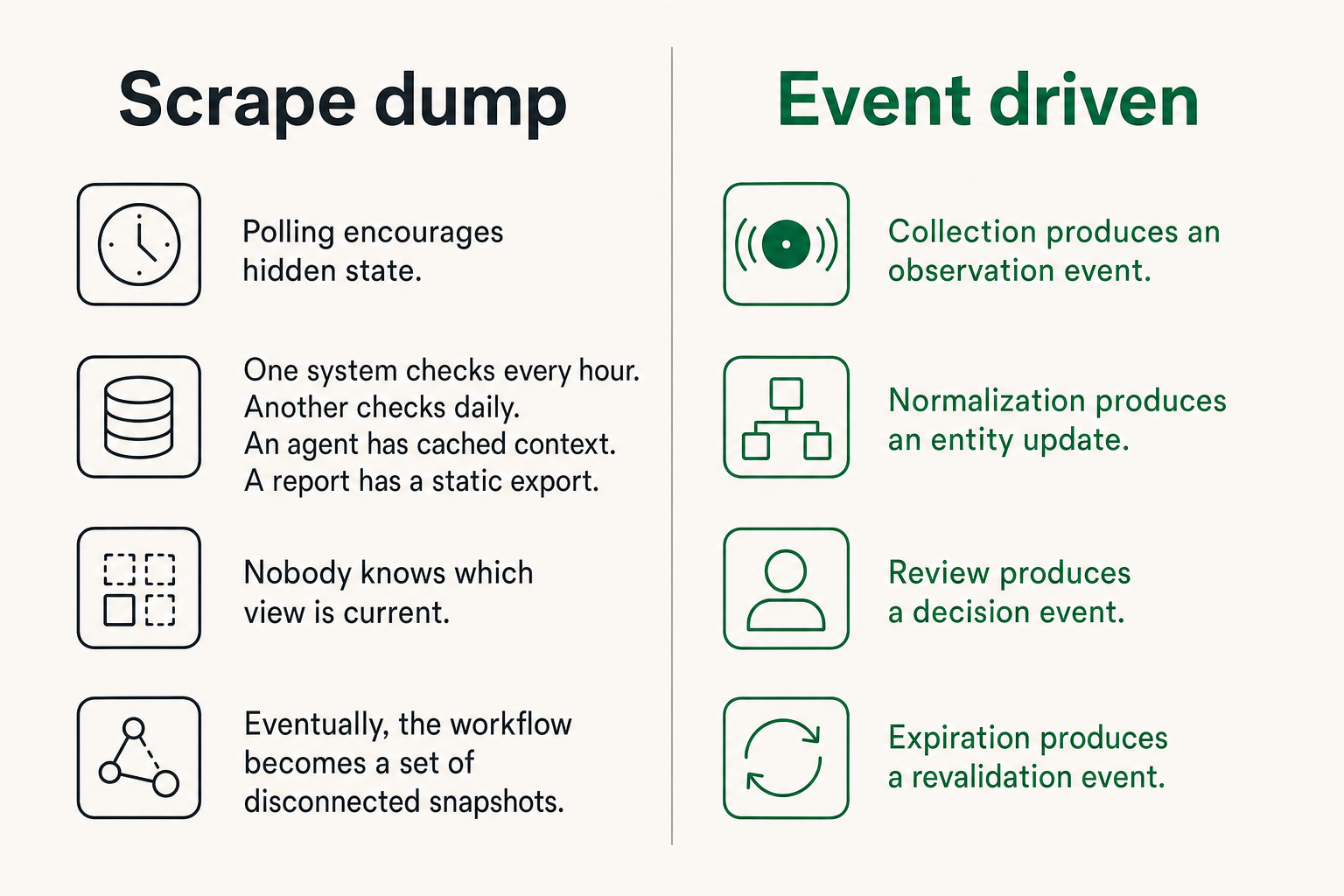
A scrape-and-dump pipeline is easy to build. Run a collector, write rows to a database, let analysts or agents query it later. This works until you need freshness, suppression, review, retries, deduplication, or cross-tool coordination.
Polling encourages hidden state. One system checks every hour. Another checks daily. An agent has cached context. A report has a static export. Nobody knows which view is current. Eventually, the workflow becomes a set of disconnected snapshots.
Event-driven OSINT tools work differently. Collection produces an observation event. Normalization produces an entity update. Review produces a decision event. Expiration produces a revalidation event. Downstream systems subscribe to meaningful changes instead of repeatedly asking whether anything changed.
Events create an audit trail
Events make the system explain itself. A case did not magically receive a risk score. It received observations, correlations, review decisions, and actions over time.
A minimal event model could include:
source.observedwhen a collector records evidenceentity.candidate_linkedwhen resolution proposes a relationshipevidence.review_requestedwhen confidence or policy requires a humanevidence.reviewedwhen a reviewer accepts, rejects, or annotates itaction.proposedwhen an agent recommends a downstream stepaction.approvedoraction.deniedwhen the workflow decidesobservation.expiredwhen evidence must be refreshed
This is not overengineering. It is how you make automation reversible, inspectable, and safe enough to connect to real products.
Idempotency matters outside payments too
OSINT workflows need idempotency because agents retry. Webhooks retry. Collectors retry. Users click twice. Network calls fail halfway through. If the same observation or action gets duplicated, the system can inflate confidence or trigger duplicate work.
Borrow from payment and infrastructure design: use idempotency keys for collection jobs, action proposals, review requests, and outbound notifications. Related reading from our network: payment teams face the same retry and reconciliation issue in crypto checkout architecture, even though the domain is different.
Practical rule: if an OSINT action has operational impact, make it idempotent, reviewable, and attributable before you make it autonomous.
MCP and open standards: make OSINT tools composable
Expose capabilities, not internal implementation
MCP and adjacent agent standards are useful because they shift integration from bespoke glue code toward capability contracts. An OSINT tool can expose actions such as search domain records, fetch repository metadata, resolve entity candidates, request review, or generate evidence-linked summary.
Do not expose your internal database as an agent playground. Expose constrained capabilities with typed inputs and outputs. The agent should not need to know which vendor powers enrichment or which queue stores review tasks. It should know the contract, permission requirements, expected output, and failure modes.
This is where the prior architecture work pays off. If your tool already has evidence objects, review states, and event contracts, making it agent-accessible is manageable. If your tool only has a text summary endpoint, MCP will make the weakness easier to automate.
Schema contracts are more important than prompts
Prompts are useful, but they are not a contract. A prompt can ask the model to cite sources. A schema can require evidence references. A prompt can ask for caution. A policy can prevent an unreviewed finding from triggering an action.
For agent-ready OSINT tools, the important schemas are not only input and output fields. You also need schemas for:
- Evidence objects
- Entity identifiers and aliases
- Confidence and review status
- Credential grants and capability scopes
- Action proposals and approval outcomes
- Event envelopes and correlation IDs
- Expiration and revalidation policies
LogicSRC frames this as an open coordination surface for humans, agents, plugins, payments, events, credentials, and workflows; the broader project context is summarized on the LogicSRC about page.
Treat plugins as replaceable adapters
An OSINT system should not collapse when one source changes pricing, terms, rate limits, response shape, or availability. Treat collectors and enrichment providers as adapters behind stable contracts.
That means the rest of the system consumes normalized observations, not vendor-specific payloads. It also means your workflow can compare sources, suppress a broken adapter, and replace one provider without rewriting every downstream agent.
The mistake teams make is optimizing for the fastest first integration. That is fine for a prototype. In production, the maintainable boundary is the contract between source adapters and intelligence objects.
What breaks when OSINT tools are implemented badly
Noise moves downstream
Bad OSINT architecture does not eliminate noise. It exports noise to every connected system. Analysts get bigger queues. Agents produce longer summaries. Case tools fill with low-confidence findings. Dashboards look busy but decisions do not improve.
Noise often comes from missing state. The system cannot tell that an observation is duplicate, stale, contradicted, or previously rejected. So it keeps resurfacing the same weak signal. The analyst learns to ignore the tool. The agent keeps processing it anyway.
The fix is not only better ranking. It is lifecycle management: observed, normalized, deduplicated, reviewed, suppressed, expired, refreshed, or escalated.
Summaries become false authority
LLM summaries are helpful when they sit on top of evidence. They are dangerous when they replace evidence. A clean paragraph can hide uncertainty, source conflicts, and missing context.
A useful summary should include evidence references, confidence, unresolved questions, and suggested next checks. It should distinguish observed facts from inferred conclusions. It should also degrade gracefully: if the evidence is stale or unreviewed, the summary should say so in machine-readable form, not only in prose.
Related reading from our network: SaaS buyers see a similar failure pattern when polished interfaces hide broken workflows, which is the core point in software gore workflow buying guide.
Ownership disappears between tools
A common failure mode is orphaned responsibility. The OSINT tool found something. The agent summarized it. The case tool stored it. The analyst glanced at it. The downstream system acted. When something goes wrong, nobody owns the decision chain.
Ownership has to be part of the workflow. Each state transition should have an actor. Each action should have an approver or an automation policy. Each policy should have an owner. This is operationally boring and absolutely necessary.
A practical implementation workflow for agent-ready OSINT tools
Step 1: define intelligence objects
Start by defining the objects your system will carry. Avoid beginning with vendors or prompts. A practical first set is:
- Entity: the thing being investigated, such as domain, person, organization, wallet, repository, package, IP, or handle.
- Observation: a source-backed piece of evidence about an entity.
- Claim: an interpretation derived from one or more observations.
- Relationship: a proposed or confirmed link between entities.
- Review: a human or policy decision about evidence, claims, or actions.
- Action proposal: a suggested downstream step with required permissions.
- Audit event: the immutable record of what happened.
Keep these objects small and explicit. You can always add fields later. It is harder to recover provenance after you let free-form summaries become your primary data model.
Step 2: map actions to trust levels
Next, classify what the system can do. A simple trust map is enough to start:
| Trust level | Example actions | Required controls |
|---|---|---|
| Informational | Search, enrich, summarize | Source provenance and logging |
| Preparatory | Draft report, propose link | Evidence references and confidence |
| Sensitive | Contact party, publish report, flag account | Human approval and policy check |
| High impact | Block access, notify customer, trigger enforcement | Multi-party review and audit record |
This table forces the right conversation. You are not asking whether agents are good or bad. You are deciding which actions can be automated under which evidence and approval constraints.
Step 3: ship the smallest auditable loop
Do not try to automate the full intelligence lifecycle in the first release. Ship one auditable loop:
- Collect evidence from one or two sources.
- Normalize it into an observation object.
- Link it to an entity.
- Generate a summary that cites evidence IDs.
- Request review for one sensitive claim type.
- Emit an event when the review is completed.
- Allow one downstream action only after approval.
Then test the failure paths. Source unavailable. Duplicate event. Stale evidence. Reviewer rejects claim. Credential revoked. Agent retries. Parser changes. If the workflow survives these boring cases, it has a chance in production.
The earlier LogicSRC article on agent-ready OSINT workflows goes deeper on building these loops without turning the product into another fragile search wrapper.
What works, what fails, and how to measure it
What works in production
What works is usually unglamorous:
- Typed evidence objects instead of free-form findings
- Source adapters behind stable contracts
- Explicit review states and expiration policies
- Event-driven handoffs between tools
- Scoped capabilities for agents and plugins
- Idempotent actions and correlation IDs
- Human approval represented as workflow state
- Summaries that preserve citations and uncertainty
These patterns make the system easier to operate. They also make it easier to replace pieces. You can swap a source provider, add a new agent, or change a review policy without rebuilding the entire OSINT product.
What fails repeatedly
The recurring failures are equally predictable:
- Building around screenshots and exports
- Treating LLM output as the record of truth
- Giving agents broad credentials too early
- Merging entities without reviewable evidence
- Allowing stale observations to trigger actions
- Hiding human approval outside the workflow
- Integrating every source directly into every agent
- Measuring volume instead of decision quality
The most expensive version of this failure is when the tool appears successful. It produces more findings, more reports, and more alerts. But the team cannot trust the output enough to automate decisions, so humans become the integration layer.
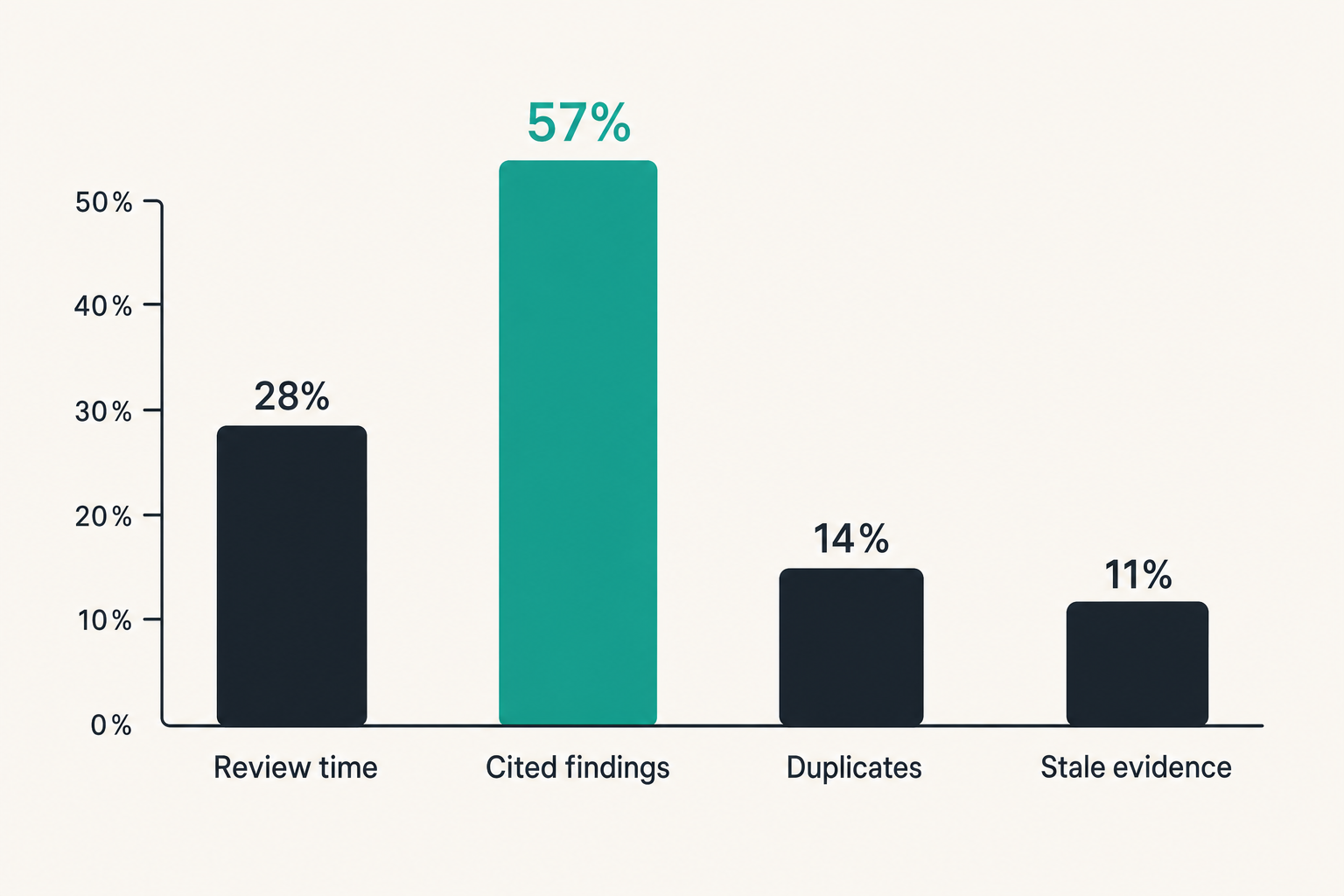
Useful operating metrics
Avoid vanity metrics like total sources connected or total pages processed. Useful metrics answer whether the workflow is becoming safer and faster:
- Time from observation to reviewed decision
- Percentage of findings with evidence references
- Duplicate observation rate by source
- Stale evidence used in summaries or actions
- Review rejection rate by agent or adapter
- Credential scope violations or denied requests
- Number of downstream actions blocked by policy
- Mean time to replace a broken source adapter
These metrics are not perfect, but they reveal whether your architecture is reducing operational uncertainty or just generating more text.
Practical rule: measure the health of the decision pipeline, not the size of the data pile.
Where logicsrc.com fits in an OSINT tools architecture
The standards surface OSINT teams need
OSINT teams building with agents need more than another data source. They need conventions for identity, coordination, events, credential boundaries, plugin interoperability, MCP surfaces, and auditable workflows. That is the layer where open standards become practical.
LogicSRC is positioned around that standards surface. The goal is not to own every source or every agent. The goal is to make the handoffs between humans, AI agents, plugins, payment systems, hosted products, credentials, and events more explicit and interoperable.
For OSINT tools, that means you can treat collection, enrichment, review, and action as coordinated workflow primitives instead of isolated product features.
When LogicSRC is a good fit
LogicSRC is a good fit when your team is building developer-facing infrastructure and needs OSINT capabilities to participate in broader agent systems. Examples include:
- An MCP-enabled OSINT server that exposes scoped investigation capabilities
- A security product that needs evidence-linked agent summaries
- A developer platform that wants plugin actions with auditable permissions
- An open source tool that needs stable schemas for entities and evidence
- A hosted workflow that moves findings through review and approval gates
It is less useful if all you need is a one-off search script for a single analyst. The value appears when multiple systems need to coordinate safely around the same intelligence workflow.
Try logicsrc.com
You are writing for developers and platform teams building interoperable AI agent systems, SDKs, plugins, and hosted products. If your OSINT tools need open coordination primitives for agents, credentials, events, MCP, and auditable workflows, Try logicsrc.com.