OSINT Tools in 2026: Build Agent-Ready Intelligence Workflows, Not Fragile Search Wrappers

OSINT tools are easy to demo and hard to operate. A developer can wrap a search API, add a summarizer, and produce a useful-looking report in a weekend. Then a real investigation starts, a source changes, an agent loses context, a customer asks why a conclusion was reached, and the system has no durable answer.
Teams think the problem is better collection. The real problem is controlled coordination between sources, agents, humans, credentials, evidence, and downstream systems.
That changes the conversation. The practical question is not whether an AI agent can browse public data. It is whether your OSINT workflow can preserve provenance, enforce permissions, support review, emit useful events, and survive retries, partial failures, and audits.
In 2026, osint tools are no longer just analyst utilities. They are becoming embedded capabilities inside security platforms, fraud systems, research products, compliance workflows, developer tooling, and hosted agent environments. If you build them like a prompt plus a scraper, the integration debt arrives fast.
Table of contents
- OSINT tools are an agent workflow problem
- The architecture baseline for OSINT tools in 2026
- Identity, permissions, and credential sharing
- Provenance is the control plane
- Workflow design for agent-assisted investigation
- Integrating OSINT tools with MCP, SDKs, and plugins
- What breaks when OSINT tools are implemented badly
- Evaluation and metrics for OSINT tools
- Security, privacy, and legal boundaries
- Product fit: LogicSRC as an open coordination surface
- Closing checklist for agent-ready OSINT tools
OSINT tools are an agent workflow problem
OSINT tools used to be judged by how many sources they could query. That still matters, but it is no longer enough. Once agents enter the workflow, every source lookup becomes part of a larger chain: who requested it, under what authority, with what prompt, using which credentials, producing which evidence, and triggering which action.
We previously framed this as building agent-ready intelligence workflows, and the same lesson keeps showing up in production: the tool surface is smaller than the operational surface.
The search box is not the system
A search box returns results. An investigation system preserves context. That distinction is where many OSINT products get into trouble.
A user asks for an assessment of a domain, wallet, company, handle, package, or identity. The agent collects public signals, normalizes them, clusters related entities, drafts a conclusion, and perhaps recommends an action. If you cannot replay the chain from request to evidence to output, you do not have an operational tool. You have an attractive interface around temporary text.
The mistake teams make is assuming the LLM response is the artifact. It is not. The artifact is the structured investigation record: inputs, sources, confidence, decisions, human approvals, emitted events, and any downstream state changes.
Practical rule: Treat every OSINT result as a workflow state transition, not as a blob of text to paste into a report.
What an agent-ready OSINT tool must preserve
An agent-ready OSINT system should preserve at least six things:
- Request intent: what the user or system asked the agent to investigate.
- Scope: which sources, jurisdictions, identities, credentials, and actions were allowed.
- Evidence: raw observations, normalized entities, timestamps, and source references.
- Reasoning boundaries: what the agent inferred versus what the source directly showed.
- Review state: what was automatically accepted, what required human approval, and who approved it.
- Downstream effects: tickets, alerts, blocks, enrichment records, notifications, or API writes.
This is why OSINT architecture belongs in the same conversation as agent standards, event schemas, and identity boundaries. The intelligence output is only useful if other tools can trust, inspect, and act on it.
The architecture baseline for OSINT tools in 2026
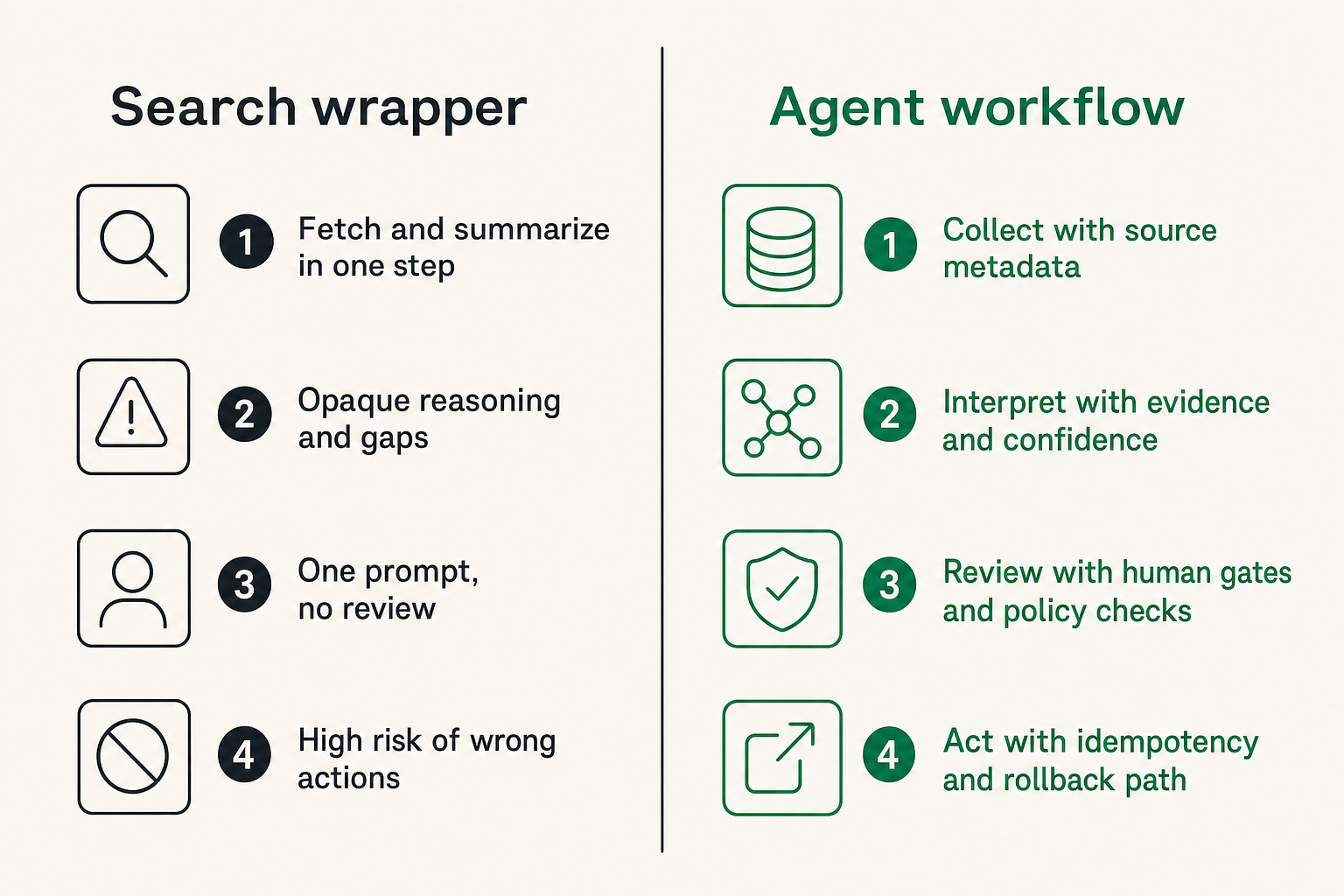
The baseline architecture for modern osint tools is not complicated, but it does require discipline. You need separation between collection, interpretation, and action. If those concerns collapse into one prompt chain, the system becomes hard to secure and nearly impossible to debug.
A useful way to think about it is a pipeline with durable checkpoints. Each checkpoint creates an object that another component can inspect without needing to rerun the entire investigation.
Separate collection, interpretation, and action
Collection is about acquiring observations. Interpretation is about turning observations into claims. Action is about changing something outside the investigation record.
Those steps have different risk profiles:
| Layer | Job | Typical failure | Control needed |
|---|---|---|---|
| Collection | Fetch public or permissioned signals | Missing, stale, or rate-limited data | Source metadata and retry policy |
| Interpretation | Cluster entities and infer meaning | Hallucinated relationships or overconfidence | Evidence links and confidence fields |
| Review | Decide whether output is acceptable | Rubber-stamp approvals | Human gates and policy checks |
| Action | Emit tickets, blocks, labels, or notifications | Wrong system state change | Idempotency and rollback path |
The practical question is where you draw the boundary between automation and authority. Agents can do a lot of the work, but they should not silently inherit the right to take every action that a human analyst can take.
Related reading from our network: teams evaluating SaaS workflow quality face a similar problem of hidden integration debt, which is why this guide to spotting broken workflows before rollout is relevant even outside OSINT.
Model evidence as state, not text
Text summaries are useful for humans. They are a poor primary storage format for machines.
Instead of storing only a generated paragraph, store evidence objects with fields such as:
evidence_id: ev_01j9_domain_tls
subject:
  type: domain
  value: example.org
source:
  type: public_web
  name: certificate_transparency
observed_at: 2026-08-06T14:22:00Z
claim:
  type: observed_certificate
  value: issued_certificate_for_domain
confidence: observed
raw_ref: blob://investigations/123/source/ct-log.json
agent_run: run_8x42
This does not remove the LLM. It gives the LLM better material to work with and gives the platform a record that can be inspected later. If the final answer changes, the evidence record can remain stable.
Practical rule: Let the model write summaries from structured evidence. Do not let the summary become the only evidence.
Identity, permissions, and credential sharing
OSINT workflows often begin with public data, but they rarely stay purely public. A platform may query paid data providers, internal enrichment services, private customer datasets, threat feeds, code hosting APIs, payment records, or ticketing systems. That introduces identity and credential boundaries.
The mistake teams make is giving agents broad service credentials because it is faster than designing scope. It is faster until a plugin calls the wrong endpoint, a customer asks for isolation guarantees, or a maintainer needs to rotate access without breaking every workflow.
Agents need scoped authority
An agent should not be an invisible superuser. It should operate under a delegated authority that can be explained.
At minimum, define:
- Actor: user, service, agent, plugin, or scheduled workflow.
- Principal: the account or organization on whose behalf the action runs.
- Scope: allowed sources, tools, queries, and write actions.
- Duration: when authority expires.
- Review requirement: which actions require human approval.
- Audit target: where the decision and output are recorded.
This becomes especially important when OSINT tools are embedded in customer-facing products. The agent might perform enrichment for one tenant while using shared infrastructure. Without explicit authority, multi-tenant isolation becomes a promise enforced by convention rather than architecture.
Credential sharing must be explicit and reversible
Credential sharing is not just a password vault problem. It is a workflow coordination problem. Agents, plugins, and hosted products need to know when credentials may be used, for what purpose, and how to revoke them without destroying the rest of the system.
If your OSINT tool calls external APIs, paid feeds, customer accounts, or internal services, design credential handoff as an auditable primitive. LogicSRC’s credential sharing surface is relevant here because agent workflows need portable conventions for delegated access, not one-off secrets passed through environment variables.
A good credential-sharing model answers these questions:
- Who granted access?
- Which agent or workflow may use it?
- Which sources or methods are allowed?
- Can the credential be exchanged, proxied, or only invoked?
- What event is emitted when it is used?
- How is access revoked?
Practical rule: If an agent uses a credential, the credential use should be visible as an event in the investigation timeline.
Provenance is the control plane
Provenance is not a compliance afterthought. In agent-assisted OSINT, provenance is the control plane that lets humans and systems decide whether to trust an output.
A generated conclusion without provenance is fragile. It may be correct, but it cannot be defended, reviewed, or safely reused. In practical terms, provenance is what allows your product to say: this claim came from these sources, transformed through these steps, under this policy, at this time.
Capture source context at ingestion
Source context is more than a URL. Public pages change. APIs return partial data. Feeds have coverage gaps. Search results are personalized, localized, or time-sensitive. Screenshots and snippets may not be enough.
Capture source context such as:
- Retrieval time.
- Source type and provider.
- Query parameters or normalized lookup key.
- HTTP status or API response metadata.
- Content hash or blob reference.
- Parser version.
- Rate-limit or partial-result indicators.
- Terms or policy class if relevant.
This does not mean hoarding everything forever. It means storing enough context to explain the result and reproduce the decision path when needed.
Make transformations inspectable
Agent workflows transform data constantly. They extract entities, merge identities, assign labels, generate confidence scores, and draft summaries. Each transformation should leave an inspectable trail.
A minimal transformation record might include:
transform_id: tr_01j9_entity_merge
input_refs:
  - ev_01j9_profile_a
  - ev_01j9_repo_owner
operation: entity_resolution
model: resolver_v4
output:
  entity_id: ent_77
  relationship: likely_same_operator
confidence: medium
review_required: true
What breaks in practice is not the first run. It is the second analyst, second tenant, second model version, or second regulator asking why a relationship was inferred. If your system cannot answer without rerunning prompts, provenance is not durable enough.
Related reading from our network: answer engines have similar citation pressure, and this article on building citable technical example pages is a useful adjacent pattern for making machine-consumed content traceable.
Workflow design for agent-assisted investigation
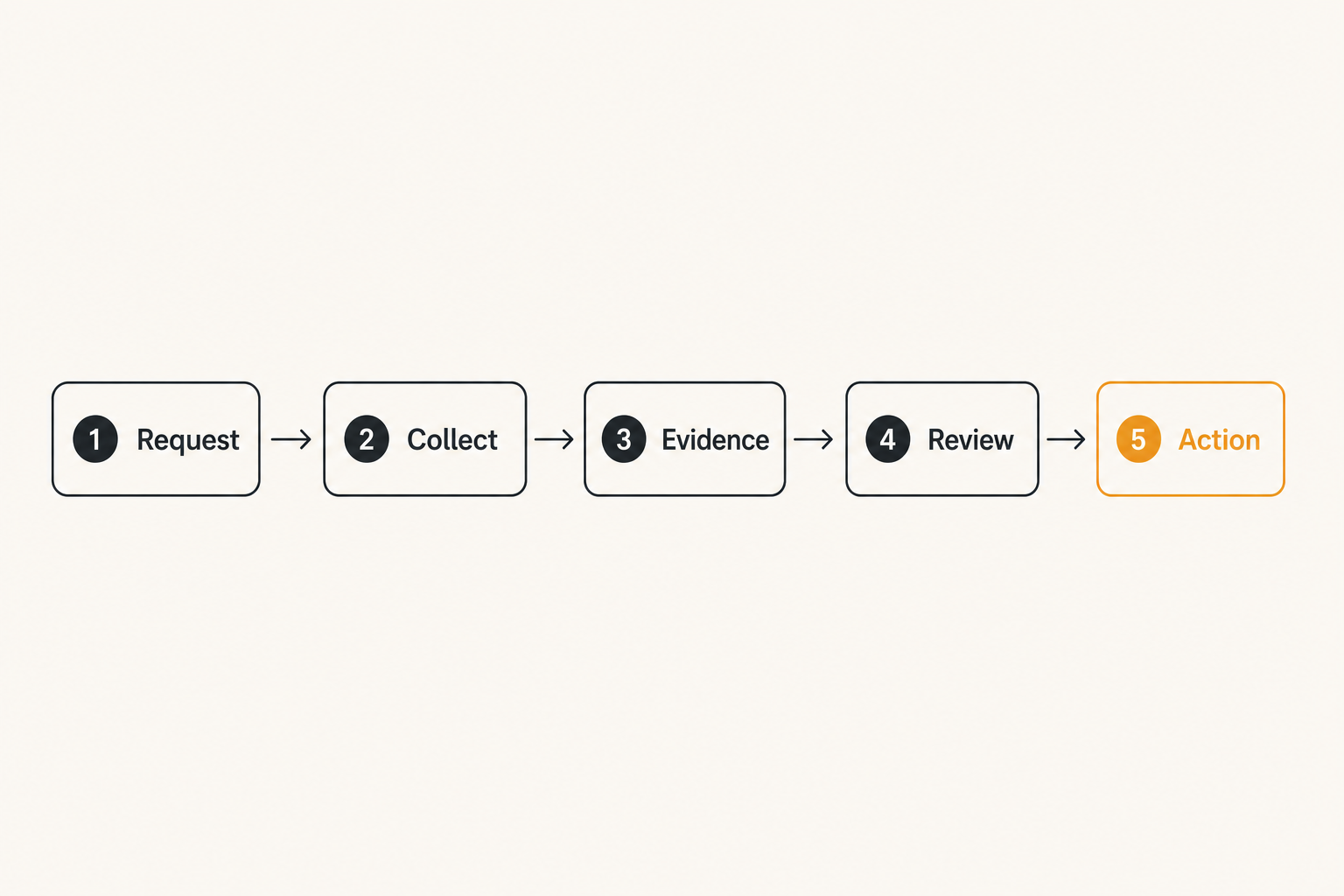
A workable OSINT workflow is boring in the right ways. It has predictable states, explicit gates, retries, and audit records. The agent may be sophisticated, but the workflow should be legible.
The goal is not to slow the agent down. The goal is to prevent the agent from turning ambiguous evidence into irreversible action without context.
A practical implementation sequence
A simple implementation sequence looks like this:
- Define investigation types. Examples: domain risk review, vendor screening, wallet enrichment, package maintainer review, identity correlation, incident enrichment.
- Define allowed sources per type. Include rate limits, credentials, retention class, and whether the source may be queried automatically.
- Create evidence schemas. Separate raw observations from normalized entities and generated summaries.
- Create policy gates. Decide which claims, confidence levels, or action types require human review.
- Build agent tools around those schemas. The agent should call typed tools, not improvise hidden scraping behavior.
- Emit lifecycle events. Include started, source queried, evidence created, claim generated, review requested, review completed, action emitted, and workflow closed.
- Persist audit state. Store enough data to reconstruct the investigation without trusting model memory.
- Add evaluation cases. Test known benign, malicious, ambiguous, stale, conflicting, and source-failure scenarios.
This sequence is not glamorous. It is what keeps the system maintainable after the prototype stage.
Where humans stay in the loop
Human review should not be random. It should be triggered by policy.
Good review triggers include:
- Low-confidence entity resolution.
- Conflicting sources.
- First-time use of a sensitive credential.
- Proposed write action to a customer-visible system.
- Recommendation to block, report, de-rank, escalate, or notify.
- Investigation involving protected or sensitive categories.
- Output that will be shared outside the originating team.
The pattern is not human versus agent. The pattern is agent prepares, policy routes, human decides when authority is required, and the system records the decision.
Integrating OSINT tools with MCP, SDKs, and plugins
Once OSINT capabilities are exposed to agents, they need stable interfaces. MCP servers, SDKs, plugin systems, and hosted tools all need a way to describe what can be called, what the inputs mean, what comes back, and what state changed.
This is where open standards matter. A one-off integration is fine for a demo. A platform ecosystem needs shared conventions.
Use schemas before adapters
Adapters are necessary, but schemas should come first. If every source wrapper returns a different shape, the agent layer becomes a pile of brittle translation prompts.
Define canonical objects such as:
- Subject: domain, handle, company, person, package, wallet, repository, IP, document, credential, service.
- Observation: a source-backed fact or record.
- Claim: an interpretation derived from observations.
- Evidence bundle: a grouped set of observations and claims for review.
- Review decision: approval, rejection, escalation, or request for more evidence.
- Action request: proposed downstream state change.
- Audit event: durable record of actor, authority, time, and effect.
Then write adapters to map provider-specific data into these objects. The agent should interact with the stable objects. Providers can change behind the boundary.
Design events for downstream systems
OSINT tools become more valuable when they emit events that other systems can consume. A security platform may open an incident. A fraud system may update a risk score. A developer tool may annotate a package. A compliance workflow may request manual review.
Useful events are small, typed, and idempotent:
event_type: osint.review_requested
event_id: evt_01j9_review
subject_id: ent_domain_example_org
investigation_id: inv_123
reason: conflicting_sources
required_role: analyst
created_at: 2026-08-06T15:10:00Z
idempotency_key: inv_123:review:conflicting_sources
Do not emit vague events like analysis_complete with a giant blob attached. Downstream systems need to know what changed and whether they have already processed it.
Related reading from our network: SOC teams deal with the same trigger-to-action problem at endpoint scale, and this piece on fleet response architecture is a useful comparison for event ownership and response boundaries.
What breaks when OSINT tools are implemented badly
Bad OSINT architecture does not usually fail loudly on day one. It fails through slow operational drag: unclear conclusions, duplicated investigations, untrusted automation, hard-to-debug integrations, and customers who do not believe the output.
The expensive failures are rarely caused by one bad model answer. They come from systems that cannot explain, constrain, or repair the workflow around that answer.
Common failure modes
The common failure modes are predictable:
- Prompt-only provenance: the final summary references sources, but the platform did not store evidence objects.
- Shared superuser credentials: every workflow uses the same API token with unclear scope.
- No idempotency: retries create duplicate tickets, labels, alerts, or reports.
- Silent source drift: parser changes or provider coverage shifts without detection.
- No review semantics: human approval happens in chat and never becomes structured state.
- Entity merge errors: the system links two subjects and later cannot unwind the relationship.
- Overloaded confidence: one score mixes source quality, model certainty, and business risk.
- Unclear ownership: engineering owns the tool, analysts own the outcome, no one owns the workflow boundary.
Each of these can be fixed architecturally, but not by adding another summarization prompt.
What works and what fails
| Area | What fails | What works |
|---|---|---|
| Source access | Hardcoded tokens and hidden scraping | Scoped credentials and source policies |
| Evidence | Free-form notes | Structured observations with raw references |
| Agent behavior | One broad tool that can do anything | Typed tools with explicit capabilities |
| Review | Approvals in Slack only | Review decisions persisted as workflow state |
| Actions | Direct writes from model output | Action requests with idempotency and gates |
| Audits | Reconstruct from logs manually | Investigation timeline as a first-class object |
The mistake teams make is treating these as enterprise features to add later. They are reliability features. If the tool is used by agents, they belong in the first serious version.
Evaluation and metrics for OSINT tools
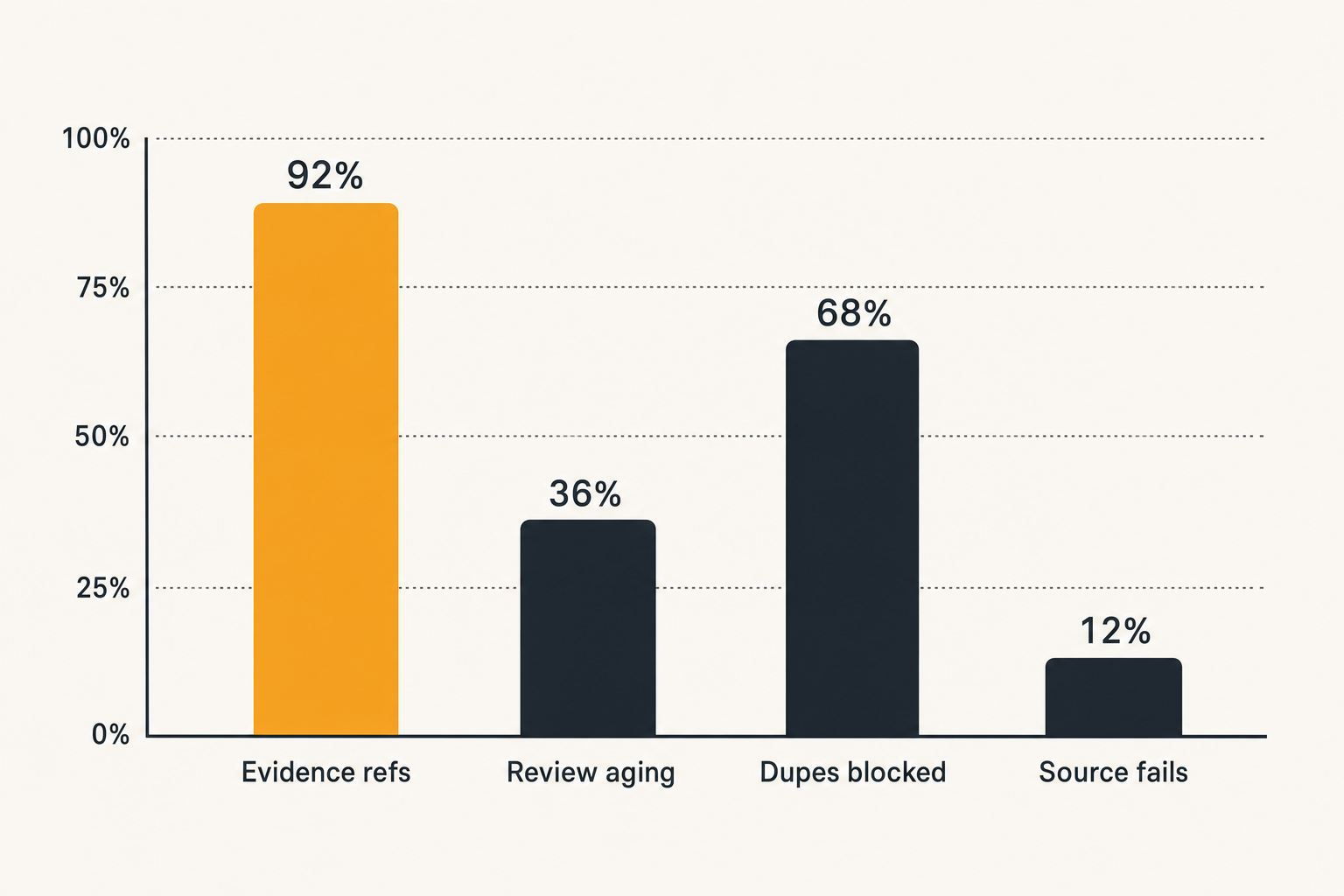
Evaluation should focus on workflow outcomes, not just model quality. A model can produce a fluent answer while the system fails to capture source context, preserve authority, or trigger review.
For OSINT tools, the right metrics are operational. They tell you whether the workflow is becoming faster, safer, and easier to trust.
Measure workflow outcomes
Useful measures include:
- Investigation completion rate by type.
- Percentage of outputs with complete evidence references.
- Review queue volume and aging.
- Rate of conflicting-source cases.
- Duplicate downstream actions prevented by idempotency.
- Time from request to reviewed conclusion.
- Percentage of claims later corrected or withdrawn.
- Source failure rate by provider and parser version.
- Credential usage events by scope and workflow.
Avoid vanity metrics such as number of sources queried. More sources can mean better coverage, or it can mean more noise and higher cost. The metric only matters when tied to decision quality and operational impact.
Validate with adversarial examples
OSINT systems need adversarial and messy test cases. Clean examples make every architecture look good.
Build fixtures for:
- Stale public pages.
- Conflicting registry records.
- Same-name identity collisions.
- Deleted or changed source material.
- Rate-limited APIs.
- Provider partial outages.
- Poisoned content designed for agents to quote.
- Ambiguous affiliations.
- Benign entities with suspicious-looking infrastructure.
- Malicious entities with sparse public evidence.
Then evaluate the full workflow. Did the agent overstate the conclusion? Did the system preserve the uncertainty? Did it request review? Did it avoid irreversible action? Did it produce a useful audit trail?
Practical rule: Test OSINT tools against ambiguity, not just known-good and known-bad examples.
Security, privacy, and legal boundaries
OSINT does not mean collect everything. Public availability is not the same thing as operational appropriateness. Platform teams need boundaries that are encoded into the product rather than left to individual analyst judgment every time.
This is especially true when agents automate collection. A human might notice that a query is drifting into a sensitive category. An agent may simply continue unless the workflow constrains it.
Reduce collection by default
Data minimization is an architecture choice. Collect only what the investigation type needs, and classify evidence as it enters the system.
A practical classification model might include:
- Public technical signal.
- Public organizational signal.
- Paid provider signal.
- Customer-provided signal.
- Sensitive personal signal.
- Internal operational signal.
- Restricted or prohibited signal.
Once classified, evidence can be routed through retention, access, and redaction policies. This is much easier than trying to clean up unclassified blobs later.
Build retention and redaction into the product
Retention should not be a cron job someone adds after launch. It should be attached to the evidence lifecycle.
Define retention at the object level:
retention:
  class: customer_osint_evidence
  retain_for_days: 90
  redaction_required: true
  export_allowed: false
  deletion_event: osint.evidence_deleted
Redaction should preserve auditability where possible. You may need to delete source content while retaining metadata that a source was queried, a review occurred, and an action was or was not taken. The point is not to keep everything. The point is to keep the workflow explainable within your policy constraints.
Product fit: LogicSRC as an open coordination surface
LogicSRC is relevant when OSINT tools are becoming part of a larger agent ecosystem. The problem is not one more connector. The problem is shared coordination across identities, agents, plugins, credentials, payments, events, and auditable workflows.
You can think of LogicSRC as an open standards surface rather than a replacement for your model, database, queue, or OSINT provider. It helps define how workflow objects move between systems.
Where open standards help
Open standards help when multiple parties need to understand the same workflow state. That includes platform teams, plugin authors, SDK maintainers, hosted product builders, and open source communities.
In OSINT workflows, useful shared surfaces include:
- Agent identity and delegated authority.
- Credential exchange and revocation semantics.
- Evidence and claim schemas.
- Review request and decision events.
- Audit timeline conventions.
- Tool capability descriptors.
- MCP-compatible action boundaries.
The team behind LogicSRC focuses on open schemas, primitives, and conventions for coordination between humans, AI agents, plugins, payment systems, and hosted products. That is the layer many OSINT systems end up reinventing under pressure.
When LogicSRC is the right layer
LogicSRC is a fit when you are building an OSINT capability that must interoperate with other tools or agents, especially if you need auditable credential use, structured events, and portable workflow conventions.
It is less useful if you only need a private script for one analyst. But once your tool becomes a platform feature, an SDK capability, a hosted agent action, or a plugin exposed to third parties, coordination semantics matter.
Good candidates include:
- Developer tools that enrich packages, repositories, maintainers, or domains.
- Security products that need agent-assisted investigation with review gates.
- Fraud and abuse systems that combine public signals with internal evidence.
- Research platforms that need source traceability and export controls.
- Open source agent frameworks that need standard tool and event semantics.
The value is not magic automation. It is reducing the amount of one-off glue required to make agents, humans, and systems agree on what happened.
Closing checklist for agent-ready OSINT tools
OSINT tools in 2026 need to be designed as operational systems. The search interface matters, but it is not the architecture. The durable product is the workflow around collection, evidence, interpretation, review, action, and audit.
If you are building in this space, use the checklist below before you ship beyond a prototype.
Ship the workflow, not the demo
Before launch, verify that your system can answer these questions:
- What investigation type is being run?
- Which actor and authority started it?
- Which sources were allowed and queried?
- What evidence was created?
- Which claims were inferred rather than observed?
- What confidence and uncertainty were preserved?
- Which credentials were used?
- Which human reviews occurred?
- Which downstream events or actions were emitted?
- Can the workflow be replayed, corrected, or audited?
- Can sensitive evidence expire without destroying the investigation timeline?
If the answer is no, the demo may still impress people. The product will create operational debt.
The practical path is straightforward: typed schemas, scoped authority, durable provenance, explicit review, idempotent events, and open coordination surfaces. That is how OSINT tools become safe building blocks for AI agents instead of fragile wrappers around search.
Try logicsrc.com
You are writing for developers and platform teams building interoperable AI agent systems, SDKs, plugins, and hosted products. Build OSINT tools on open coordination primitives, not hidden glue. Try logicsrc.com.