OSINT Tools in 2026: Build Agent-Ready Intelligence Workflows, Not Another Search Box

Most teams adopting osint tools in 2026 start with the wrong question. They ask which scraper, search interface, enrichment API, or graph database has the most sources. Then they bolt an agent on top and call it automation.
That works until the first real investigation. An agent pulls conflicting records. A plugin uses credentials it should not have. A report cites a stale source. A maintainer cannot reproduce why a lead was escalated. Legal asks where the data came from, and the answer is a pile of logs across five tools.
Teams think the problem is finding more data. The real problem is turning open-source intelligence into a governed workflow that agents, humans, plugins, and hosted products can share without losing provenance, permissions, or accountability.
That changes the conversation. OSINT tools are not just search utilities. They are coordination systems. The practical question is how to design them so AI agents can collect, enrich, reason, hand off, and audit intelligence without turning every workflow into an untrusted black box.
Table of contents
- Why osint tools are now an agent architecture problem
- What osint tools must do before agents touch them
- A capability model for agent-ready osint tools
- Identity, permissions, and credential boundaries
- The osint tools workflow that survives production
- Data quality, provenance, and evidence chains
- Integrating osint tools with MCP, plugins, and event streams
- What breaks when osint automation is implemented badly
- What works and what fails in real teams
- Where logicsrc.com fits in open OSINT agent workflows
Why osint tools are now an agent architecture problem
The interface is not the system
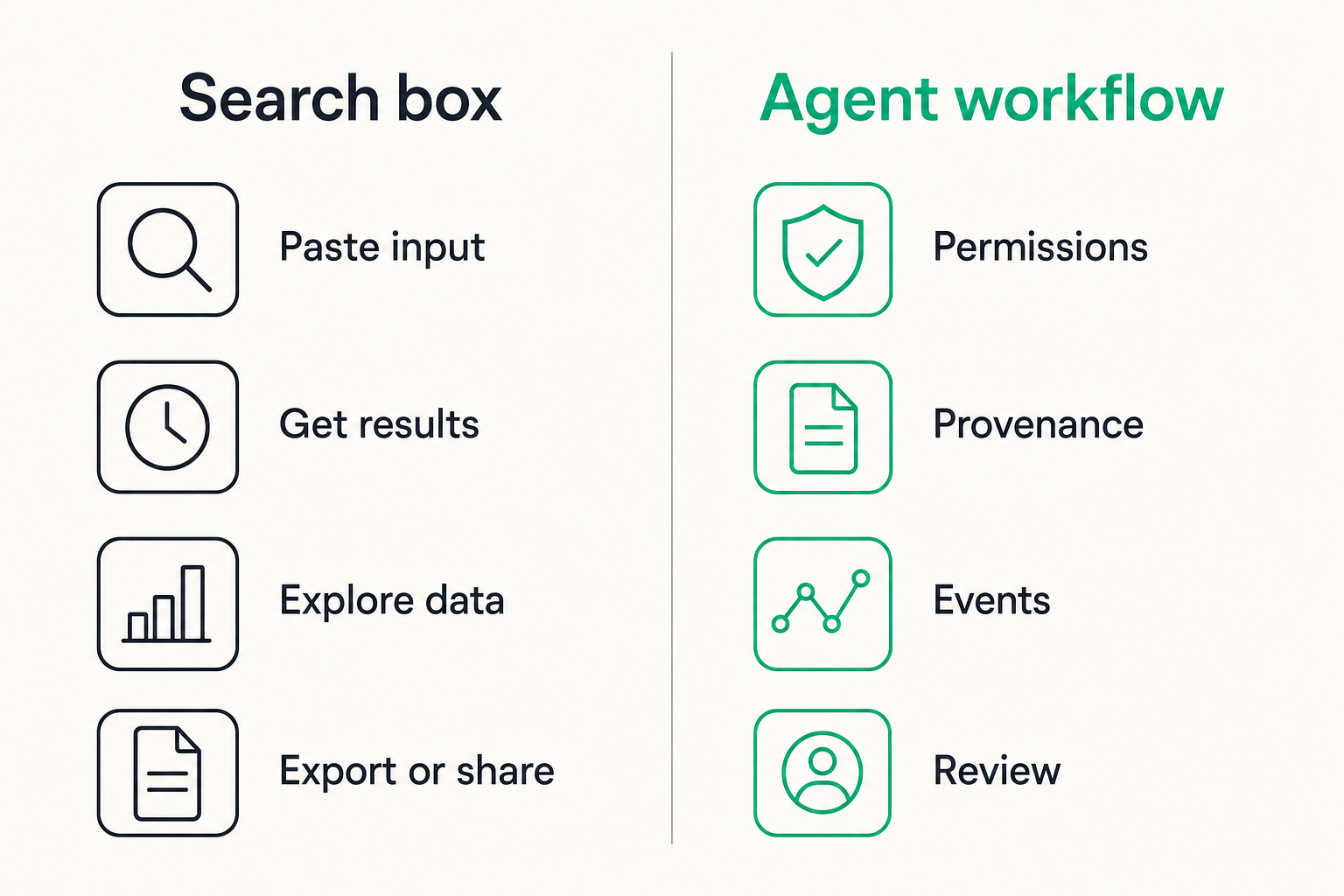
A useful way to think about it is this: every OSINT product has a visible layer and an operational layer. The visible layer is the search form, graph canvas, enrichment result, browser extension, or report builder. The operational layer is source policy, credential use, rate limiting, evidence capture, review status, escalation, and audit.
The mistake teams make is optimizing the visible layer first. They evaluate osint tools by how quickly an analyst can paste an email, domain, wallet address, handle, or IP address and get something interesting back. That matters, but it is not enough once agents are involved.
An AI agent does not just click a button. It chains tools. It retries. It summarizes. It decides whether one result justifies another query. It may call a plugin inside an IDE, a Slack bot, a case-management system, or a hosted enrichment service. If the surrounding architecture does not capture intent, permissions, and provenance, the workflow becomes fast and fragile.
Practical rule: Treat every OSINT result as an event with source, actor, purpose, timestamp, confidence, and allowed downstream use. If you cannot record those fields, you cannot safely automate the workflow.
This is why osint tools are becoming an agent standards problem. The important question is not whether a model can read a web page. It is whether the workflow can prove what was read, why it was read, who authorized it, what changed, and which derived conclusions were produced.
Agentic collection changes the failure model
Human analysts usually fail slowly. They forget to record a source, copy the wrong value, or over-trust a weak signal. Agents fail differently. They can repeat a mistake across hundreds of entities, over-collect data outside the task, or produce clean-looking summaries from messy evidence.
In production, the worst failures are not dramatic. They are subtle:
- The agent merges two people with similar handles.
- A plugin enriches a domain using an API key meant for a different tenant.
- A summary cites a cached page but omits the cache timestamp.
- A case owner cannot see which tool produced a risk score.
- A downstream action is triggered from an unreviewed enrichment.
These are not model problems alone. They are workflow problems. The agent needs boundaries, the tool needs contracts, and the system needs a durable record.
Related reading from our network: teams evaluating workflow-heavy SaaS face similar hidden integration debt, and the same pattern shows up in broken SaaS workflows that look fine during demos.
What osint tools must do before agents touch them
Normalize sources before enrichment
Before an agent enriches anything, your system needs a source model. Without it, every result becomes a blob. That blob might be useful to a human in the moment, but it is hard for another tool to verify later.
At minimum, normalize source records around:
- Source type: website, API, registry, forum, code host, blockchain explorer, paste, archive, social profile, commercial dataset.
- Collection method: direct fetch, API call, user upload, browser capture, webhook, scheduled sync.
- Access conditions: public, authenticated, paid, user-provided, tenant-restricted, license-restricted.
- Stability: live page, archived copy, volatile search result, structured registry record.
- Allowed use: internal triage, customer report, law enforcement packet, automated scoring, blocked from export.
This sounds bureaucratic until you need to explain why an agent used a source. Then it becomes the difference between an auditable workflow and a pile of screenshots.
A lightweight source object can be simple:
source_id: src_domain_registry_001
source_type: registry
access: public
collection_method: api
license_scope: internal_review
retention_days: 180
requires_human_review: false
The practical question is not whether this is the perfect schema. It is whether every tool call can attach a source object consistently enough that another system can reason about it.
Separate discovery, collection, and analysis
Many osint tools blur three different jobs:
- Discovery asks what might be relevant.
- Collection captures evidence from a source.
- Analysis interprets what the evidence means.
Agents make this separation more important, not less. If an agent discovers ten possible profiles, collection should not automatically pull every associated detail. If collection finds a breach mention, analysis should not automatically escalate without confidence, context, and review policy.
Practical rule: Discovery can be broad, collection should be scoped, and analysis should be explainable. Do not let one agent step silently promote itself into the next.
A clean architecture gives each phase its own input and output schema. Discovery returns candidates. Collection returns observations. Analysis returns claims. Review returns decisions. That separation prevents the common mistake where an enrichment result is treated as a verified conclusion.
A capability model for agent-ready osint tools
Expose tools as constrained capabilities
For AI engineers, the most useful pattern is to expose OSINT functions as capabilities rather than monolithic tools. A capability is a small, named action with explicit inputs, outputs, permissions, cost, and review requirements.
For example:
| Capability | Input | Output | Risk | Human review |
|---|---|---|---|---|
| Resolve domain registration | Domain | Registry observation | Low | Usually no |
| Search public code mentions | Email or token pattern | Candidate references | Medium | Sometimes |
| Capture webpage evidence | URL | Snapshot artifact | Medium | Yes for reporting |
| Enrich person profile | Handle plus context | Candidate identity links | High | Yes |
| Generate case summary | Evidence set | Draft narrative | High | Always |
This table is more useful than a feature list. It tells the agent what it may do and tells the platform where to enforce policy.
The mistake teams make is giving an agent a generic browser, a generic search tool, and a generic database write permission. That feels flexible. It also makes it difficult to know whether a bad output came from bad retrieval, bad interpretation, or bad persistence.
A better interface is narrow:
capability: capture_public_webpage
inputs:
  url: required
  case_id: required
  purpose: required
outputs:
  artifact_id: required
  fetched_at: required
  content_hash: required
  source_policy: required
requires:
  permission: osint.collect.public_web
  review: report_export
Use schemas as contracts, not documentation
Schemas are often written after the fact, as a way to document how a tool behaves. In agent workflows, that is backwards. The schema is the contract that lets the agent, plugin, host application, and audit layer coordinate.
Good schemas define:
- Accepted entity types and validation rules.
- Required purpose fields for sensitive searches.
- Output confidence and evidence references.
- Error states that agents can handle safely.
- Retention and redaction flags.
- Review gates before downstream action.
A schema should make unsafe ambiguity harder. If a lookup accepts an email address, does it accept personal emails, corporate emails, hashed emails, or all of them? If it returns related handles, are those verified links or candidates? If it returns a score, what evidence supports it?
For teams building open source osint tools, schemas are also how you avoid locking the whole workflow to one UI. A command-line tool, IDE plugin, hosted dashboard, and agent runtime can all share the same contract.
This is adjacent to editor-native automation. In our previous post on vim tools and agent workflows, the same lesson applies: the reliable system is not the interface, it is the permissioned workflow behind the interface.
Identity, permissions, and credential boundaries
Do not give agents shared analyst credentials
What breaks in practice is credential ownership. Teams connect osint tools to an agent by reusing an analyst API key, a shared service account, or a browser session. It is convenient for a prototype and dangerous for production.
Shared credentials destroy accountability. They also make it hard to enforce purpose limits. If an agent uses the same account for security triage, fraud review, customer support, and research, every query looks the same from the provider side and from your own audit layer.
A production design needs separate identities for:
- Human operators.
- Agent runtimes.
- Tool connectors.
- Tenant contexts.
- Scheduled jobs.
- External plugins.
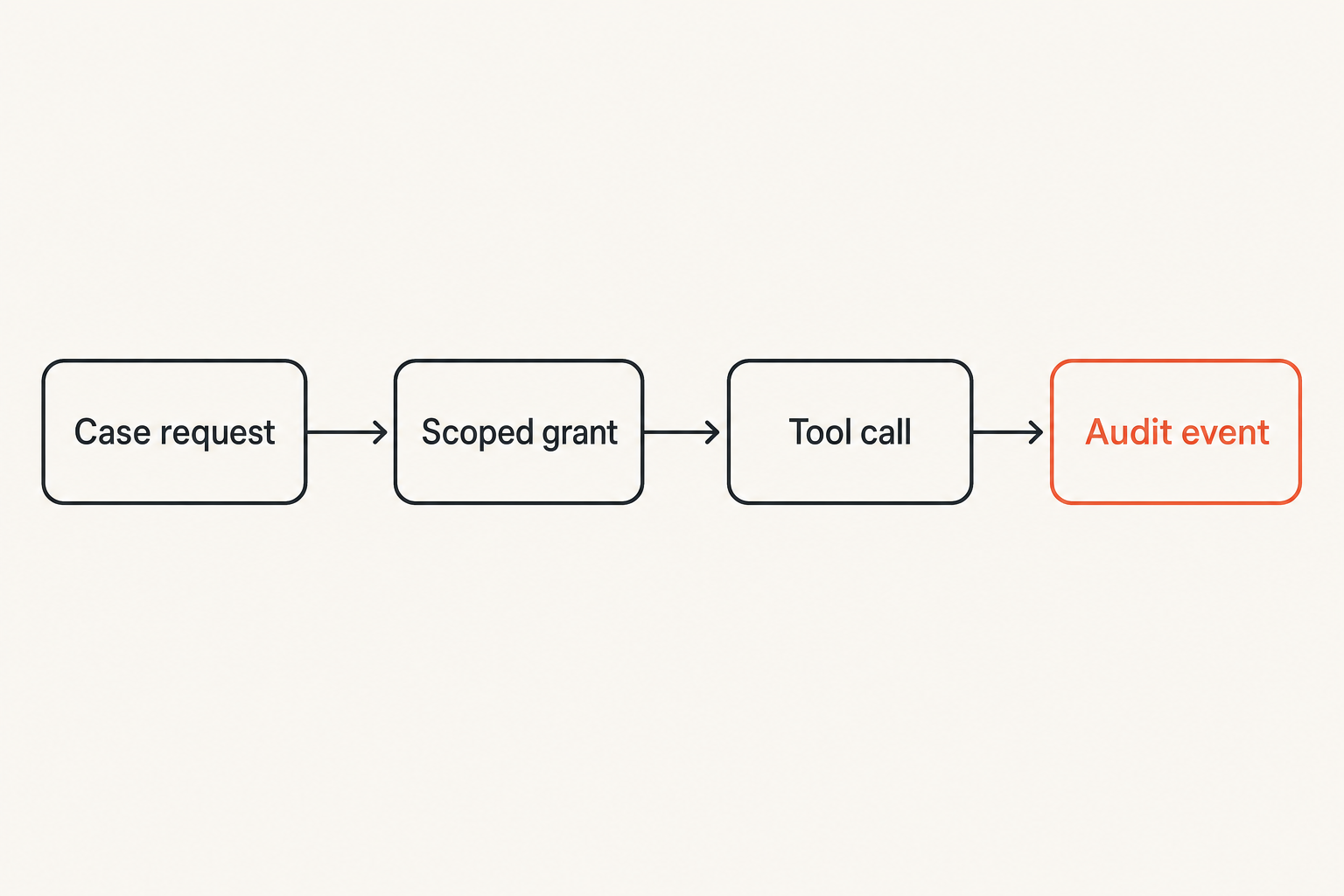
Those identities do not need to be heavyweight, but they must be distinguishable. Every event should answer: who initiated the action, which agent or tool performed it, under which tenant or case, and under which permission grant.
Credential sharing is especially tricky when agents need temporary access to paid OSINT APIs, private repositories, customer-provided datasets, or investigation-specific evidence. Use scoped grants with expiration and purpose binding. LogicSRC covers this class of problem as open coordination between agents, plugins, and products, including patterns for credential sharing that avoid turning every integration into a permanent secret handoff.
Make authorization visible in every event
Authorization should not be hidden inside middleware. Agents need to see the result of authorization decisions so they can choose safe next steps.
A denied query should return a structured response:
status: denied
reason: missing_case_purpose
required_permission: osint.collect.profile_enrichment
safe_next_steps:
  - request_case_owner_approval
  - collect_public_domain_records
That is better than a generic 403. The agent can explain the block, ask for approval, or use a lower-risk capability.
Practical rule: If an agent cannot explain why a tool call was allowed or denied, your permission model is not part of the workflow. It is just infrastructure trivia.
This also helps humans. Case owners can review not only what the agent found, but what it tried to do and why certain paths were blocked.
The osint tools workflow that survives production
A reference implementation sequence
A durable OSINT agent workflow does not need to be complicated. It needs clear state transitions. Start with one entity type, one case type, and one review path.
- Create a case with purpose, owner, tenant, retention policy, and allowed source classes.
- Submit an entity such as a domain, handle, wallet, email, IP address, package name, or company name.
- Run discovery capabilities that return candidates, not conclusions.
- Select candidates automatically only when matching rules are explicit and low risk.
- Collect evidence using scoped source policies and content hashes.
- Store observations separately from claims.
- Ask the agent to generate hypotheses with evidence references.
- Route high-impact claims to human review.
- Publish a summary only after review status is attached.
- Emit events for every step so downstream tools can reconcile state.
This sequence is intentionally boring. Boring is good. It gives developers clear contracts and gives operators a workflow they can debug.
A useful implementation detail is to model the case as a state machine:
case_state: analysis_pending
allowed_transitions:
  - discovery_pending
  - collection_pending
  - human_review_required
  - approved_for_export
  - closed
blocked_if:
  - missing_source_policy
  - unreviewed_high_risk_claim
  - expired_credential_grant
Related reading from our network: publishing teams have a parallel problem when automation creates drafts faster than review systems can govern them, which is why blog content automation needs workflow architecture, not just generation speed.
Where humans stay in the loop
Human review should not mean humans manually redo the whole investigation. It should mean humans approve specific transitions with enough context to make the decision quickly.
Keep humans in the loop for:
- Identity linkage involving people.
- High-impact risk labels.
- Customer-facing reports.
- Escalation to enforcement, blocking, or outreach.
- Evidence collected from ambiguous or unstable sources.
- Any action using credentials outside the default source policy.
Do not route every low-risk enrichment to a human. That just creates review fatigue. The goal is not to slow down the workflow. The goal is to make consequential steps inspectable.
Data quality, provenance, and evidence chains
Store claims separately from observations
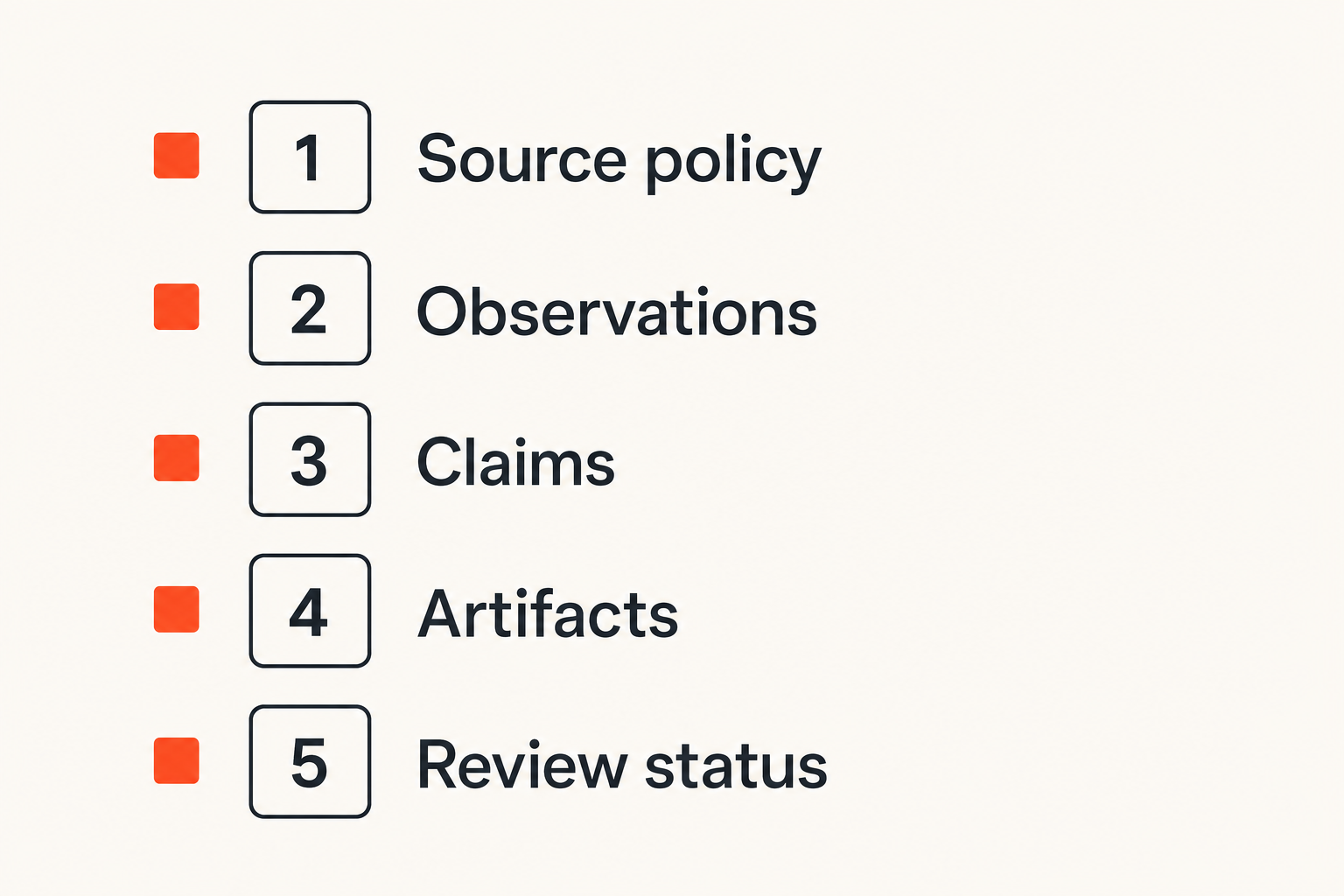
This is one of the most important design decisions in osint tools for agents. An observation is what was found. A claim is what the system believes it means.
Observation:
observation_type: domain_record
entity: example.net
registrar: sample_registrar
observed_at: 2026-08-05T10:30:00Z
source_id: src_domain_registry_001
artifact_hash: sha256_sample
Claim:
claim_type: likely_related_to_campaign
subject: example.net
confidence: medium
evidence:
  - obs_123
  - obs_456
review_status: human_review_required
If you collapse those into one record, your system cannot unwind bad reasoning. When new evidence arrives, you need to update claims without rewriting history. When an analyst disagrees, you need to preserve the observation and revise the interpretation.
Agents are especially prone to mixing observations and claims because language makes everything look declarative. A summary might say a domain is connected to a threat actor, when the evidence only shows similar infrastructure. Your data model should force that distinction.
Treat screenshots and summaries as derived artifacts
Screenshots, PDFs, model summaries, vector chunks, transcripts, and graph visualizations are derived artifacts. They can be useful, but they should point back to primary observations.
Derived artifacts need metadata:
- Created by which tool or model.
- Based on which observations.
- Generated at what time.
- With which prompt, template, or transformation.
- Approved for which audience.
- Redacted under which policy.
This is not only for compliance. It improves engineering quality. When an agent summary is wrong, developers can inspect whether retrieval failed, transformation failed, or reasoning failed.
Integrating osint tools with MCP, plugins, and event streams
MCP is a boundary, not a permission model
MCP and similar tool protocols are useful because they give agents a standard way to discover and call tools. But a protocol boundary is not the same thing as a security model or governance layer.
If an MCP server exposes broad osint tools with weak descriptions, the agent still has too much freedom. If the server does not attach source policy, tenant context, and review requirements to outputs, the host application still has to guess what happened.
A better design is to expose narrow capabilities through MCP and enforce policy behind them. The capability description should tell the agent what the tool is for, what input it accepts, what output it returns, what it costs, what permission it requires, and what review state applies.
For open source maintainers, this also keeps contributions manageable. Instead of accepting a giant integration that does everything, you can accept small capabilities with testable schemas.
Event streams make handoffs inspectable
Agents are only one participant. A complete OSINT workflow might involve a browser extension, queue worker, enrichment service, reviewer dashboard, notification bot, billing system, and report exporter. Event streams let those systems share state without pretending one UI owns the truth.
Useful events include:
- case.created
- entity.submitted
- discovery.completed
- observation.collected
- claim.generated
- review.requested
- review.approved
- export.generated
- credential.grant.expired
Each event should include actor, tenant, case, tool, capability, source policy, and correlation ID. That gives platform teams a way to trace a result from the original task through every automated and human step.
This is also where open standards matter. If every vendor invents its own event shape, teams spend their time writing adapters instead of improving investigations.
What breaks when osint automation is implemented badly
Failure modes that look like productivity
Bad OSINT automation often looks successful at first. More entities enriched. More summaries generated. More alerts created. More graphs populated. The problem is that volume hides quality issues.
Common failure modes include:
- Over-collection: agents gather more data than the task allows.
- Source confusion: paid, public, cached, and user-provided data are mixed without labels.
- Identity drift: candidate links become treated as verified identity matches.
- Permission flattening: every tool call runs under one broad service account.
- Irreproducible summaries: generated reports cannot be traced back to evidence.
- Review bypass: low-confidence claims trigger high-impact actions.
- Cost leakage: agents repeat expensive enrichments because idempotency is missing.
- Tenant bleed: shared caches expose results across customer boundaries.
The mistake teams make is measuring automation by throughput before they measure trust. Throughput is only useful when the outputs are traceable.
Operational symptoms to watch
You can usually detect a weak OSINT architecture before a serious incident. Look for these symptoms:
- Analysts ask which source produced a finding and nobody knows.
- Engineers cannot replay a failed agent run.
- Reviewers approve reports by reading prose instead of evidence links.
- API bills spike after retry storms.
- Different tools disagree about case status.
- Cached enrichments appear in the wrong tenant context.
- Agents keep asking for broader permissions.
- Exported reports require manual cleanup every time.
When these symptoms appear, adding another dashboard will not fix the system. You need better state, schemas, events, and ownership.
What works and what fails in real teams
What works
Teams that succeed with osint tools tend to make a few practical choices early:
- They define entity schemas before adding sources.
- They keep discovery, collection, analysis, and review separate.
- They expose small capabilities instead of generic super-tools.
- They record source policy with every observation.
- They use scoped credentials and expiring grants.
- They model review as a state transition, not a comment thread.
- They make event logs readable by humans and machines.
- They test agent behavior against denied permissions and ambiguous evidence.
The key is not building a perfect intelligence platform from day one. The key is preventing early shortcuts from becoming permanent architecture.
A simple readiness checklist helps:
| Question | Good answer | Bad answer |
|---|---|---|
| Can we replay an agent investigation | Yes, from events and artifacts | Only by reading chat logs |
| Can we separate evidence from claims | Yes, different records | No, everything is a summary |
| Can we revoke a tool grant | Yes, scoped and expiring | No, shared API key |
| Can reviewers inspect source policy | Yes, shown per finding | No, hidden in connector config |
| Can tenants be isolated | Yes, cache and events scoped | No, global enrichment cache |
What fails
What fails is usually the opposite:
- A generic browser agent with no source contracts.
- A graph database filled with untyped relationships.
- A report generator that cites no observation IDs.
- A shared API key copied into multiple plugins.
- A workflow where review means someone reacts with approved in chat.
- A cache that ignores tenant, purpose, or retention policy.
- A plugin ecosystem where each tool invents its own event format.
Related reading from our network: independent builders run into the same channel and ownership tradeoffs when they rely too heavily on one platform, which is why freelance websites should be treated as one channel in a broader stack, not the whole operating model.
This is the same architectural lesson. A tool can be useful and still be the wrong center of gravity. Build the workflow so components can change.
Where logicsrc.com fits in open OSINT agent workflows
Use open coordination primitives
LogicSRC is built around open schemas, primitives, and conventions for coordination between humans, AI agents, plugins, payment systems, and hosted products. For osint tools, that matters because the workflow crosses boundaries: agent runtimes, MCP servers, credential grants, event streams, review states, and product UIs.
The product fit is not that one platform should own every OSINT source. That would repeat the same vendor-lock problem in a different form. The useful layer is coordination: identity, authorization context, capability contracts, events, credential sharing, and auditable transitions.
You can read more about the coordination surface on the LogicSRC about page, but the short version is straightforward: agent systems need shared primitives if they are going to interoperate without losing control.
For an OSINT workflow, those primitives can define:
- Which actor requested a lookup.
- Which agent executed it.
- Which capability was called.
- Which credential grant was used.
- Which source policy applied.
- Which observations were produced.
- Which claims require review.
- Which events downstream tools can trust.
That is the layer many teams try to reconstruct independently inside each plugin. It works for one demo. It breaks across products.
Start with the smallest trustworthy workflow
Do not start by integrating every OSINT source. Start with one workflow that must be trustworthy.
For example, build domain investigation for a platform abuse team:
- Case owner submits a domain and purpose.
- Agent runs public registry and DNS discovery.
- Tool captures observations with source policy and hashes.
- Agent proposes related infrastructure as claims.
- Reviewer approves or rejects high-impact claims.
- Exporter generates a report with evidence references.
- Event stream updates the case system and audit log.
Once that works, add source classes and entity types. The architecture should not change every time you add a tool. If it does, you are not building an OSINT workflow. You are wiring together one-off integrations.
OSINT tools in 2026 need to be agent-ready, but agent-ready does not mean letting a model search everything. It means giving agents narrow capabilities, clear identity, scoped permissions, durable evidence, and events that humans and systems can audit.
Try logicsrc.com
You are writing for developers and platform teams building interoperable AI agent systems, SDKs, plugins, and hosted products. Try logicsrc.com.