Vim Tools in 2026: Build Editor-Native Agent Workflows That Survive Real Operations

Most teams treat vim tools as a productivity layer: a command palette, a plugin bundle, a few keymaps, maybe an AI completion pane. That works until the editor starts doing real work on behalf of a developer.
In 2026, vim tools are no longer just local convenience scripts. They can trigger agents, modify repositories, call MCP servers, request credentials, open pull requests, invoke payment or deployment workflows, and emit events into hosted products. The UI still looks like Vim or Neovim. The risk surface does not.
Teams think the problem is choosing the best plugin. The real problem is designing an editor-native agent architecture with clear permissions, reliable state, auditable actions, and workflows that survive outside one developer laptop.
That changes the conversation. The practical question is not whether vim tools can make engineers faster. The practical question is whether the work they initiate can be trusted, replayed, reviewed, and integrated with the rest of the platform.
Table of contents
- Why vim tools became an agent architecture problem
- Define the action boundary before choosing plugins
- Design vim tools around workflow state
- Permission and identity are the real control plane
- Events make vim tools interoperable
- MCP and open standards need stricter contracts
- Implementation sequence for production-ready vim tools
- Common failure modes when vim tools are implemented badly
- What works and what fails
- Product fit for open agent systems
Why vim tools became an agent architecture problem

The editor is now an execution surface
Vim used to be a place where developers edited text and ran local commands. Modern vim tools can do much more: ask an LLM to rewrite a function, inspect diagnostics, call repository services, generate tests, run migrations, query documentation, or hand work to an external agent.
That means the editor is no longer just an interface. It is an execution surface.
The mistake teams make is treating editor automation as harmless because the UI is familiar. A familiar UI does not reduce the blast radius of an action. If a vim command can read files, call a model, invoke a remote tool, and write back to the repository, it needs the same architecture discipline as any other automation surface.
Practical rule: If a vim tool can change source, call an external service, or request credentials, treat it as a workflow participant, not a plugin preference.
Local speed creates platform risk
Local tools are optimized for speed. Platform systems are optimized for consistency, policy, and recovery. Agentic vim tools sit between those two worlds, which is exactly where messy failures happen.
A developer may approve an agent patch from inside Neovim. The patch may be correct. But the platform still needs to know what was requested, what files were read, what tool version generated the change, what credentials were used, which human approved it, and whether the same action can be replayed in CI.
Without that record, the team has speed but no operational context.
What changed in 2026
The shift is not that Vim suddenly became popular again. Vim has always had power users. The shift is that AI agents now use editor context as input and editor commands as triggers.
A useful way to think about it is this: vim tools are becoming one of the front doors into agent workflows. They sit near the developer, the repository, the terminal, and the mental model of the task. That makes them valuable. It also makes them dangerous when they are disconnected from identity, audit, and standards.
For a deeper adjacent walkthrough of production editor workflows, the prior LogicSRC article on vim tools for agent workflows covers the same problem from the perspective of operator-safe automation.
Define the action boundary before choosing plugins
Separate suggestions from actions
The first architecture decision is simple: decide what counts as a suggestion and what counts as an action.
A suggestion is advisory. It proposes a diff, explains an error, drafts a test, or summarizes a file. An action changes system state. It writes a file, opens a pull request, runs a command, calls a remote service, updates an issue, requests a secret, or triggers a deployment.
Many teams blur this line. The plugin starts as autocomplete. Then it gets a command to apply edits. Then it learns how to run tests. Then it gets a GitHub token. At that point, the original security assumption is gone.
Practical rule: Suggestions can be lightweight. Actions need contracts, permissions, state, and logs.
Make every agent action explicit
An agent action should have a name, an input schema, an output schema, a permission requirement, and an audit event. If that sounds heavy for a vim command, the command is probably doing more than the team admits.
A weak command looks like this:
command: AgentFix
behavior: ask model to fix current buffer
A stronger contract looks like this:
action: source.patch.propose
version: 1
inputs:
  repo: string
  branch: string
  files: list
  issue_context: string
outputs:
  patch_id: string
  files_changed: list
  test_plan: string
permissions:
  read: repo.files
  write: workspace.patch
approval:
  required_for: apply_patch
The stronger version is not bureaucracy. It gives the platform something to validate.
Use schemas as the contract
Schemas are how vim tools become interoperable with agents, hosted products, and CI systems. Without schemas, every integration becomes a custom parser for plugin behavior.
The practical question is: can another system understand what the editor asked for without running the editor? If the answer is no, the workflow is trapped in local state.
Schemas should describe at least:
- action name and version
- actor identity
- repository and workspace context
- files or resources accessed
- requested tool capabilities
- approval state
- resulting artifacts
- error category
Related reading from our network: teams thinking about discoverability and structured paths may find ant colony optimization algorithms for AEO crawl paths useful as an adjacent model for how small local signals become system-level routing decisions.
Design vim tools around workflow state
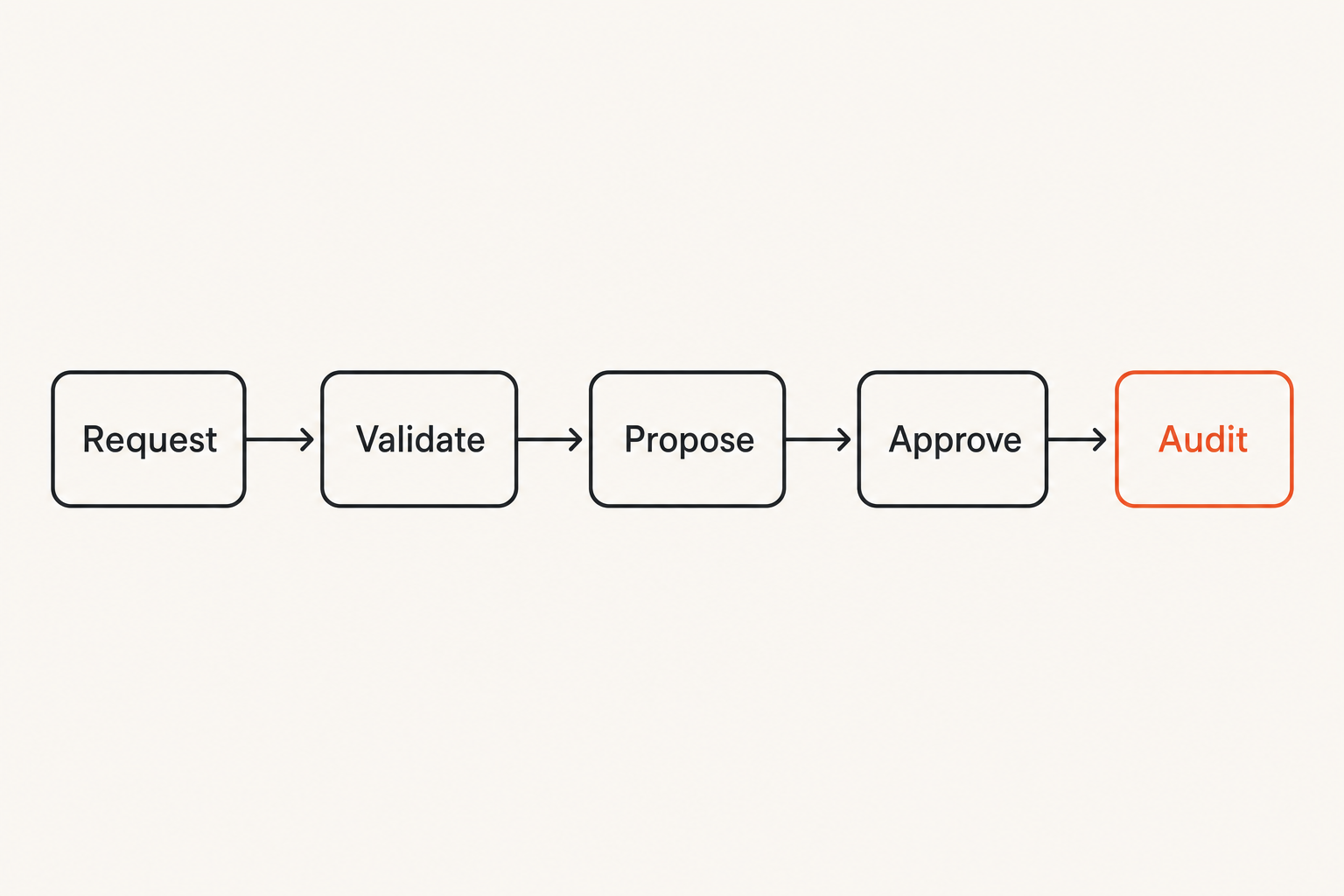
The missing state machine
What breaks in practice is not usually the first happy-path command. It is the second attempt, the partial failure, the interrupted model call, the stale buffer, or the developer who applies half the generated patch and then asks the agent to continue.
Most vim tools are command-oriented. Production workflows are state-oriented.
A reliable editor-native agent workflow needs states like:
- requested
- validated
- proposed
- reviewed
- applied
- tested
- submitted
- failed
- canceled
Without states, the tool cannot answer basic operational questions. Did the agent propose the patch or apply it? Did tests run before or after manual edits? Was the failure caused by the model, the tool server, the repository, or the user canceling the operation?
Idempotency belongs in developer tools too
Idempotency is not just for payment APIs. It belongs anywhere retries happen. Agentic vim tools retry constantly: model calls time out, MCP servers restart, files change, buffers drift, and network services return temporary errors.
If an editor command sends the same request twice, the system should not create two issues, apply two patches, or open duplicate pull requests. Use an idempotency key derived from the action, workspace, actor, and intent.
idempotency_key: sha256(actor + repo + branch + action + intent_hash)
retry_policy:
  max_attempts: 3
  safe_to_retry: true
  duplicate_behavior: return_existing_result
Practical rule: Any vim tool that calls a remote agent should have idempotency semantics before it has a retry button.
A minimal workflow model
You do not need a giant orchestration engine to start. You need a small state model that can survive editor restarts and remote failures.
A minimal record can be stored locally and mirrored to a platform event stream:
workflow_id: wf_01jz_editor_patch
actor: user_123
surface: neovim
workspace: repo_slug
state: proposed
action: source.patch.propose
inputs_hash: h_abc123
artifacts:
  patch: patch_789
  summary: artifact_456
approvals:
  human_review: pending
The important part is not the exact format. The important part is that the workflow exists independently of the Vim buffer.
Permission and identity are the real control plane
Do not hide identity inside editor config
Editor config is convenient. It is also a bad place to hide authority. If a vim tool reads a long-lived token from a dotfile and hands it to an agent, the platform has lost control over identity.
Identity should be explicit at the action layer. The system should know whether the actor is a human developer, a local assistant, a remote agent, a CI worker, or a delegated service. It should also know when one actor is acting on behalf of another.
This is where open coordination primitives matter. LogicSRC covers patterns for credential sharing because agent systems need ways to delegate access without turning every editor plugin into a secret manager.
Scope credentials to tasks
The everything token problem is common: one token can read repositories, write issues, create pull requests, call cloud APIs, and trigger deployment jobs. It is easy to install and hard to govern.
Instead, issue task-scoped access:
- read current repository files
- write proposed patch artifact
- run test command in sandbox
- create pull request only after approval
- expire after workflow completion
The token should be boring. The policy around the token should be precise.
Human approval should be modeled, not implied
A developer pressing a key in Vim is not always enough approval. Sometimes it is. Sometimes the action requires a second review, a policy check, or a different role.
Approval should be part of the workflow model:
approval:
  required: true
  actor: user_123
  method: editor_confirm
  timestamp: 2026-07-17T14:22:00Z
  scope: apply_patch_only
This prevents later confusion. The team can see exactly what was approved and what was not.
Related reading from our network: payment teams face similar boundary problems around authority and settlement, and crypto checkout architecture for high-risk merchants is a useful parallel for thinking about state, trust, and reconciliation.
Events make vim tools interoperable
Emit facts, not chat logs
Many AI tools produce chat transcripts. Chat logs are useful for debugging, but they are not enough for operations. Platforms need facts.
Good events are structured:
event: agent.action.completed
workflow_id: wf_01jz_editor_patch
action: source.patch.propose
actor: user_123
surface: neovim
status: success
artifacts:
  - patch_789
Bad events are vague:
event: assistant_done
message: fixed it
The second event may be human-readable, but it is not operationally useful.
Map editor events to platform events
A vim tool can emit local events, but those events should map to platform-level concepts. Otherwise, every plugin creates its own language.
Use a consistent event vocabulary:
- agent.action.requested
- agent.action.validated
- agent.artifact.created
- human.approval.granted
- source.patch.applied
- test.run.completed
- workflow.failed
Once events are normalized, other systems can subscribe. CI can pick up proposed patches. Security tools can inspect credential requests. Hosted products can show workflow history. Maintainers can audit who approved what.
Keep events useful for audits
Audits do not need every token of model output. They need enough context to reconstruct the action.
Keep:
- actor and delegated actor
- action and version
- input hashes
- resource identifiers
- approval records
- tool versions
- artifact references
- error categories
Avoid storing unnecessary secrets, full prompt dumps, or sensitive source content unless policy requires it. Auditability is not the same as dumping everything into a log sink.
MCP and open standards need stricter contracts
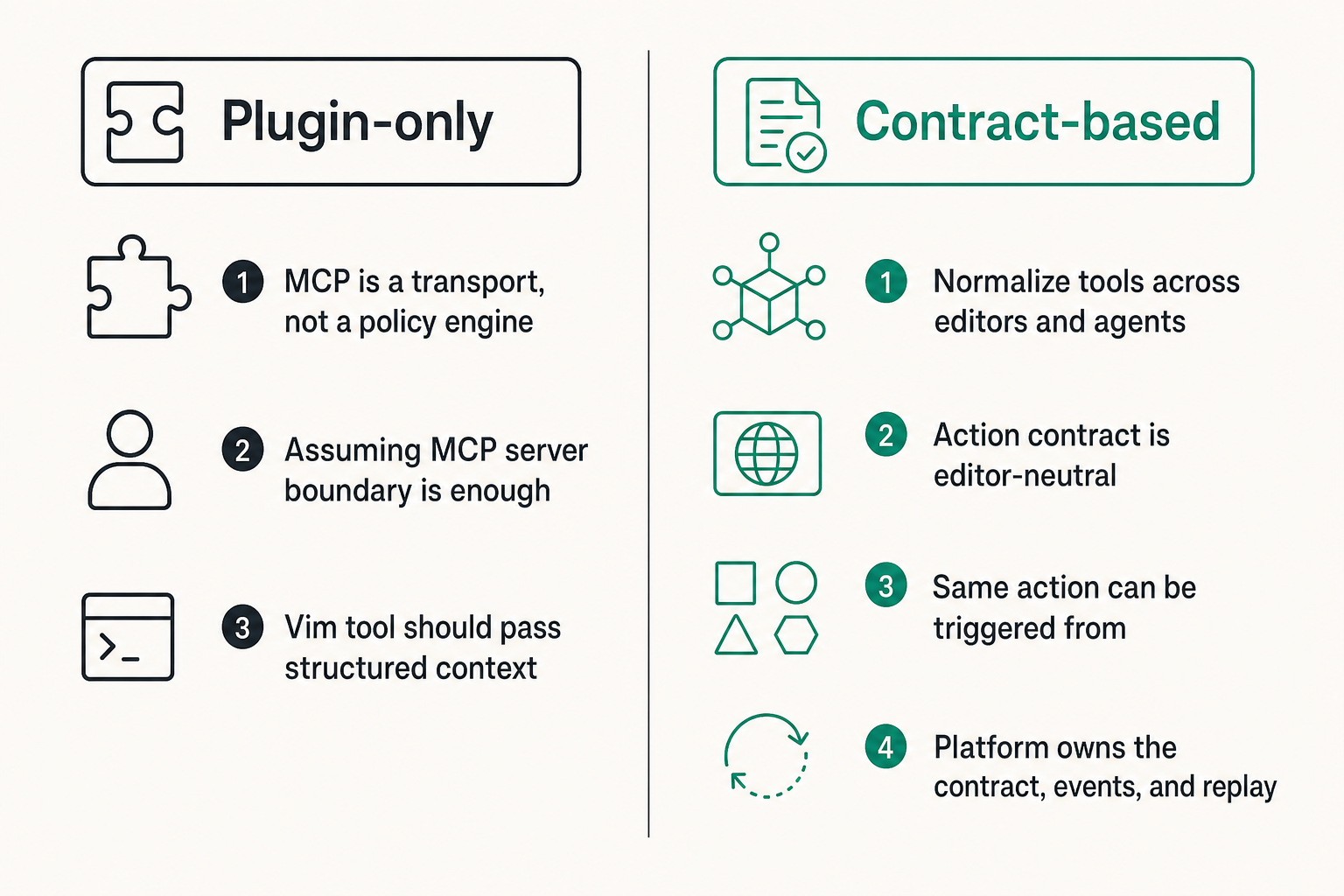
MCP is a transport, not a policy engine
MCP made it easier for agents to call tools through a common interface. That is useful. It does not automatically solve permissions, identity, event semantics, approvals, or audit retention.
The mistake teams make is assuming an MCP server boundary is enough. It is not. An MCP server can expose a tool, but the platform still needs to decide who may call it, with what inputs, under which workflow state, and with what recovery behavior.
A vim tool calling an MCP server should pass structured context, not just a prompt and some file contents.
mcp_call:
  tool: repo.propose_patch
  actor: user_123
  surface: neovim
  workflow_id: wf_01jz_editor_patch
  permissions:
    - repo.read
    - patch.write
  approval_state: pending
Normalize tools across editors and agents
Not every developer uses Vim. Some use VS Code, JetBrains, terminal agents, browser-based IDEs, or hosted coding environments. If the workflow only works inside one Vim plugin, the architecture is too narrow.
The action contract should be editor-neutral. Vim should be one client of the workflow, not the owner of the workflow.
That means the same action can be triggered from:
- Neovim command
- CLI command
- web dashboard
- CI job
- remote coding agent
- issue tracker automation
The editor provides context and ergonomics. The platform owns the contract.
Version the contract, not just the plugin
Plugins change quickly. Agent behavior changes even faster. If you only version the plugin, you still cannot reason about the action semantics.
Version the action contract separately:
action: source.patch.propose
contract_version: 2
client:
  name: nvim-agent-bridge
  version: 0.9.4
model:
  provider: configured_by_policy
  policy_ref: coding-agent-standard
This lets you evolve the Vim client without breaking downstream systems that depend on the workflow contract.
Implementation sequence for production-ready vim tools
Step 1: inventory existing commands
Start by listing every editor command that can touch source, shell, network, credentials, or external systems. Do not begin by replacing tools. Begin by understanding what already exists.
A simple inventory table is enough:
| Command | State change | External call | Credential use | Audit needed |
|---|---|---|---|---|
| propose patch | yes | yes | no | yes |
| apply patch | yes | no | no | yes |
| run tests | maybe | no | no | yes |
| open PR | yes | yes | yes | yes |
| explain code | no | yes | no | maybe |
This forces the team to separate convenience commands from workflow actions.
Step 2: wrap actions with contracts
For each action, define a contract before changing behavior. The wrapper can be thin. The point is to create a stable interface.
A practical sequence:
- Name the action using a domain-oriented convention.
- Define required inputs and allowed outputs.
- Attach actor identity and workspace context.
- Check permission before execution.
- Emit requested, completed, or failed events.
- Store artifacts outside the transient editor buffer.
- Return a human-readable result to Vim.
This sequence keeps the editor fast while moving governance into the workflow layer.
Step 3: add validation and replay
Validation should happen before the action runs and after it completes. Input validation prevents obviously unsafe calls. Output validation ensures the result matches the contract.
Replay is the test of whether your architecture is real. Can a workflow be replayed in a sandbox from its recorded inputs and artifacts? Can CI reproduce the test command? Can another developer inspect the proposed patch without the original Vim session?
If not, the tool is still local automation, not a production workflow.
Related reading from our network: independent operators building AI-assisted service stacks face similar channel dependency issues, and Fiverr alternatives for sellers is an adjacent look at how workflows break when the operating system is trapped inside one interface.
Common failure modes when vim tools are implemented badly
The invisible automation problem
Invisible automation feels good until something goes wrong. A developer types a command, the agent edits files, tests run, a PR appears, and nobody can explain the chain later.
The failure is not that automation happened. The failure is that the automation left no durable operational record.
What breaks:
- maintainers cannot review the source of a change
- security teams cannot see which tools accessed files
- CI cannot reproduce the context
- support cannot explain unexpected behavior
- agents cannot coordinate across surfaces
The everything token problem
The fastest setup guide often says: create a token, paste it into config, install the plugin. That is fine for a prototype. It is reckless for shared engineering systems.
Everything tokens create unclear ownership. If an agent opens a pull request using a human token, did the human do it, did the agent do it, or did the plugin do it? If the token leaks, what can it access? If the developer leaves, what breaks?
The fix is not more warnings. The fix is scoped delegation, expiration, and action-level authorization.
The local-only success problem
A vim workflow can succeed locally while failing as a platform workflow. The patch applies in one workspace but not another. The test command depends on local environment variables. The agent reads files that are ignored in CI. The plugin version changes behavior without a contract version.
Local-only success is the enemy of interoperability.
Practical rule: If a vim tool cannot produce an artifact that another system can validate, it is not ready to be part of an agent workflow.
What works and what fails
What works in production
Production-ready vim tools usually have boring architecture:
- explicit action names
- small input and output schemas
- task-scoped permissions
- durable workflow IDs
- structured events
- artifact storage
- approval records
- retry and idempotency behavior
- editor-neutral contracts
None of this prevents a good Vim experience. It makes the experience safer because the risky work happens through defined boundaries.
What fails after the demo
Demos reward magic. Operations punish ambiguity.
The setups that fail usually depend on:
- prompt-only tool behavior
- hidden credentials
- unlogged file access
- plugin-specific state
- no replay path
- no contract versions
- unclear human approval
- remote actions triggered from local assumptions
The first week looks impressive. The third incident review looks different.
A comparison operators can use
| Area | Demo-grade vim tools | Production-ready vim tools |
|---|---|---|
| Action model | Commands and prompts | Versioned contracts |
| Identity | Local user config | Actor and delegation model |
| Credentials | Long-lived tokens | Task-scoped access |
| State | Buffer and plugin memory | Durable workflow records |
| Events | Chat logs or none | Structured platform events |
| Approval | Implied keypress | Modeled approval scope |
| Recovery | Rerun and hope | Idempotent retry and replay |
| Interoperability | Vim-specific | Editor-neutral action surface |
The practical question is not which side sounds more elegant. The question is which side you want to debug after an agent modifies production-adjacent code.
Product fit for open agent systems
Where LogicSRC fits
LogicSRC is about open schemas, primitives, and conventions for coordination between humans, AI agents, plugins, payment systems, and hosted products. Vim tools fit that surface because they are becoming a coordination point between the developer and the agent runtime.
The goal is not to replace Vim plugins. The goal is to make the actions behind those plugins understandable to other systems.
A LogicSRC-style approach asks:
- What is the action contract?
- Who is the actor?
- What authority was delegated?
- What event should be emitted?
- What artifact was created?
- What approval was granted?
- Can another system validate the result?
Teams building agent standards, SDKs, plugins, and hosted products can use the broader LogicSRC coordination surface to think about editor-native workflows as part of a larger interoperable system.
How to adopt without rewriting your editor stack
You do not need to throw away existing vim tools. Start by wrapping the commands that matter.
A practical migration path:
- Leave local-only suggestions alone.
- Identify commands that change state or call remote systems.
- Add action names and workflow IDs.
- Emit structured events for those actions.
- Move credentials out of editor config.
- Add approval scopes for write operations.
- Mirror artifacts to a system outside the buffer.
- Make the same contract callable from CLI or CI.
If your team needs help designing standards-compatible agent workflows, SDK surfaces, or plugin contracts, hire LogicSRC for focused architecture work around interoperable AI systems.
The closing point is simple: vim tools are useful because they sit where developers already work. They become reliable when the architecture behind them treats actions, identity, state, and events as first-class platform concerns.
Try logicsrc.com
LogicSRC is for developers and platform teams building interoperable AI agent systems, SDKs, plugins, and hosted products. Try logicsrc.com.