Apple Developer Program Architecture for Open AI Agent Standards in 2026

The apple developer program looks simple until an AI agent product hits production. You can enroll, create certificates, ship a TestFlight build, and still have no durable answer for agent identity, user consent, plugin permissions, event logs, or rollback.
Teams think the problem is App Store distribution. The real problem is turning Apple trust primitives into an architecture that works with open AI agent standards, SDKs, plugins, hosted tools, and audit trails.
That changes the conversation. The practical question is not whether your app can be signed. It is whether every action taken by an agent through your Apple-distributed product can be attributed, constrained, reviewed, retried, and explained.
In 2026, that matters because agent products are no longer single apps. They are front ends, extensions, local runtimes, cloud orchestrators, MCP servers, credential brokers, payment flows, and event pipelines. The Apple Developer Program is one boundary in that system. Treat it like a workflow layer, not a paperwork task.
Table of contents
- Why the apple developer program is an architecture decision
- The production model: signing, entitlements, identity, and events
- Map Apple workflows to AI agent standards
- Build an agent-ready app and extension architecture
- Implement CI/CD without weakening trust
- Privacy, permissions, and credential sharing
- Events, webhooks, and MCP coordination
- Common failure modes in Apple Developer Program implementations
- Operational checklist for 2026 teams
- Where logicsrc.com fits in the workflow
Why the apple developer program is an architecture decision
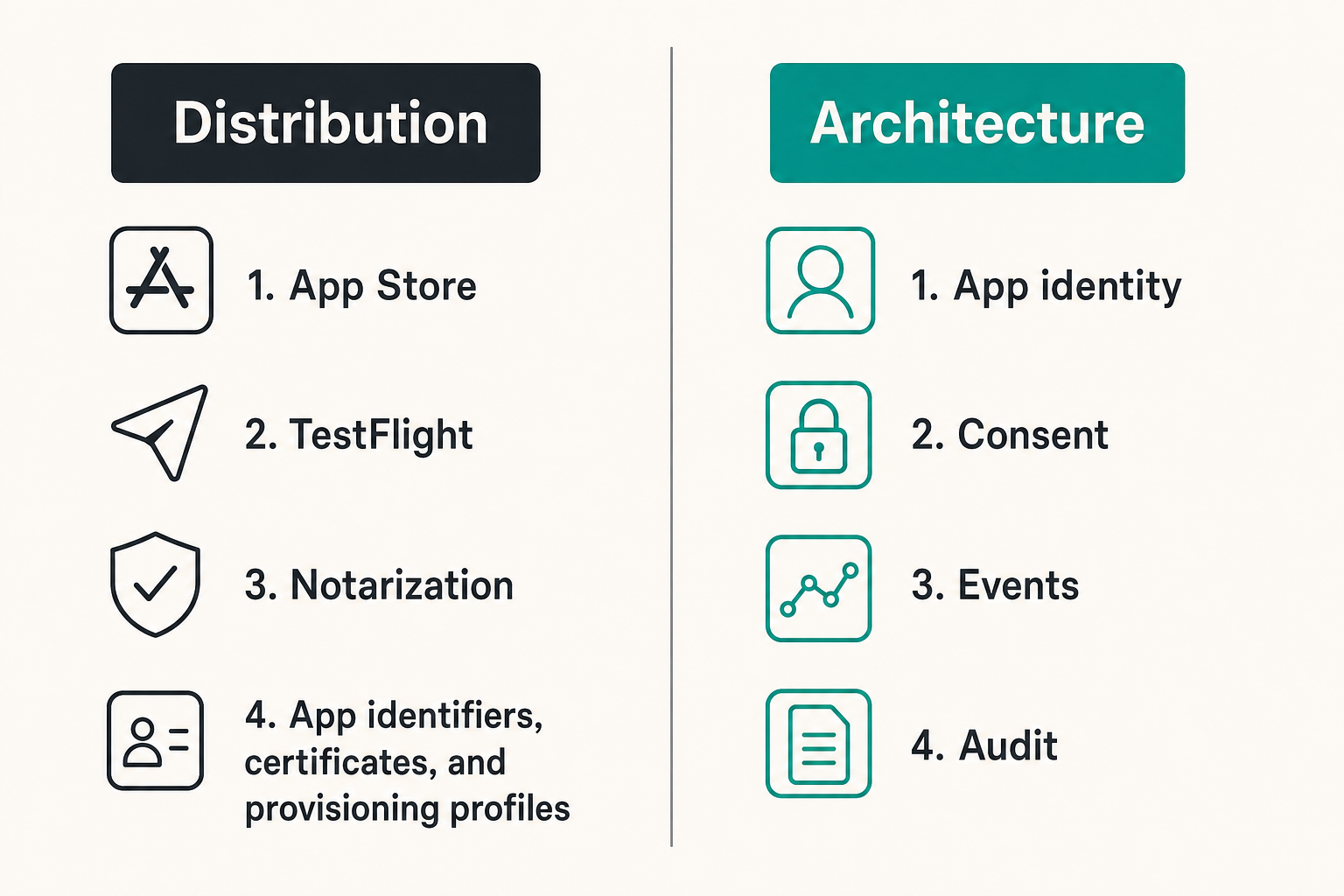
The mistake teams make is treating the Apple Developer Program as a late-stage release task. Someone creates the account, someone else handles certificates, and the product team assumes the rest is App Store metadata.
For a normal consumer app, that may be messy but survivable. For an AI agent product, it creates hidden coupling. Your app identity, signing process, entitlement model, privacy disclosures, server events, and plugin behavior all become part of the same trust chain.
A useful way to think about it is this: Apple gives you a governed distribution and execution boundary. Open agent standards give you coordination beyond that boundary. Production architecture is the bridge between the two.
If you want the deeper Apple-specific buildout, our earlier guide on Apple Developer Program architecture for AI agent products covers signing, entitlements, privacy, CI/CD, and trust workflows in more detail. This article focuses on how that boundary maps to open agent standards.
Distribution is only the visible layer
The App Store, TestFlight, notarization, app identifiers, certificates, and provisioning profiles are visible because they block releases. When something breaks, the build fails or a reviewer rejects the submission.
What is less visible is the runtime model your team accidentally creates:
- Which backend is allowed to issue agent tasks?
- Which local extension can execute user-approved actions?
- Which plugin can request credentials?
- Which events are durable enough for audit?
- Which failures can be retried safely?
- Which action needs human confirmation?
These are not Apple-only questions. They are agent platform questions. But the Apple Developer Program creates the signed app identity users see, the entitlements the OS enforces, and the review surface your product must explain.
Practical rule: Do not design the agent workflow after App Store submission. Design the reviewable workflow first, then map it to Apple capabilities.
Agent products add a trust problem
An agent product can do more than render a UI. It may read a calendar, draft a response, call a tool, operate on files, start a payment, query a private database, or delegate work to another service.
That turns every permission into an operational question. If an iOS app asks for access to files, contacts, photos, notifications, location, or network services, the prompt is only one part of the contract. Your agent orchestration layer also needs to know what was approved, what was denied, what was delegated, and what must never be attempted again without new consent.
The real trust problem is continuity. Users grant permissions in one context, agents operate in another, and logs are inspected later by support, compliance, or security.
If your architecture cannot connect those moments, the product becomes hard to debug and harder to defend.
The production model: signing, entitlements, identity, and events
The Apple Developer Program gives you production primitives, not a full agent governance system. The engineering job is to bind those primitives to your agent runtime instead of leaving them isolated in release tooling.
Here is the practical mapping.
| Apple primitive | What it controls | Agent architecture concern | Failure if ignored |
|---|---|---|---|
| Team ID | Organization identity | Tenant and issuer mapping | Ambiguous ownership |
| Bundle ID | App or extension identity | Client capability boundary | Tools over-trust the app |
| Certificates | Build and distribution trust | Supply chain integrity | Unreviewed builds ship |
| Provisioning profiles | Device and entitlement binding | Environment separation | Dev privileges leak to prod |
| Entitlements | OS-level capabilities | Runtime permission contracts | Agent can request unsafe actions |
| App Review metadata | User-facing explanation | Consent and disclosure | Rejection or user distrust |
| Privacy nutrition labels | Data collection disclosure | Data minimization model | Logs exceed declared behavior |
Treat signing as supply chain control
Signing is not just a release gate. It is how your organization asserts that this binary, extension, helper, or package came from an authorized pipeline.
For agent products, signing should answer three questions:
- Which source revision produced this artifact?
- Which CI workflow signed it?
- Which runtime capabilities did the artifact receive?
If your answers live in three disconnected tools, you do not have a production trust model. You have a release ritual.
A minimal signing record should include:
- repository and commit hash
- build workflow identifier
- Apple team and bundle identifiers
- certificate reference, not private key material
- provisioning profile reference
- entitlement manifest hash
- release channel such as internal, TestFlight, App Store, enterprise, or notarized
- deployment timestamp
This record should be queryable by support and automation. When an agent action causes a dispute, you need to know which binary and which capability set were active.
Entitlements are runtime contracts
Entitlements are often treated as toggles needed to unlock APIs. That is too loose for agent systems.
An entitlement should be reflected in the agent capability model. If the app has access to a class of local resources, the agent layer should represent that access explicitly. If the entitlement is absent, the agent should not discover or advertise tools that depend on it.
A simple capability object can look like this:
{
  "capability": "local_file_read",
  "issuer": "apple_app_bundle",
  "bundle_id": "com.example.agentapp",
  "environment": "production",
  "requires_user_confirmation": true,
  "allowed_tools": ["summarize_file", "extract_metadata"],
  "denied_tools": ["upload_file", "delete_file"]
}
The exact schema can vary. The important part is that entitlements become machine-readable inputs to agent routing, not tribal knowledge in a release checklist.
Practical rule: If an entitlement changes, treat it like an API contract change. Review downstream tools, prompts, policies, tests, and event schemas.
Map Apple workflows to AI agent standards
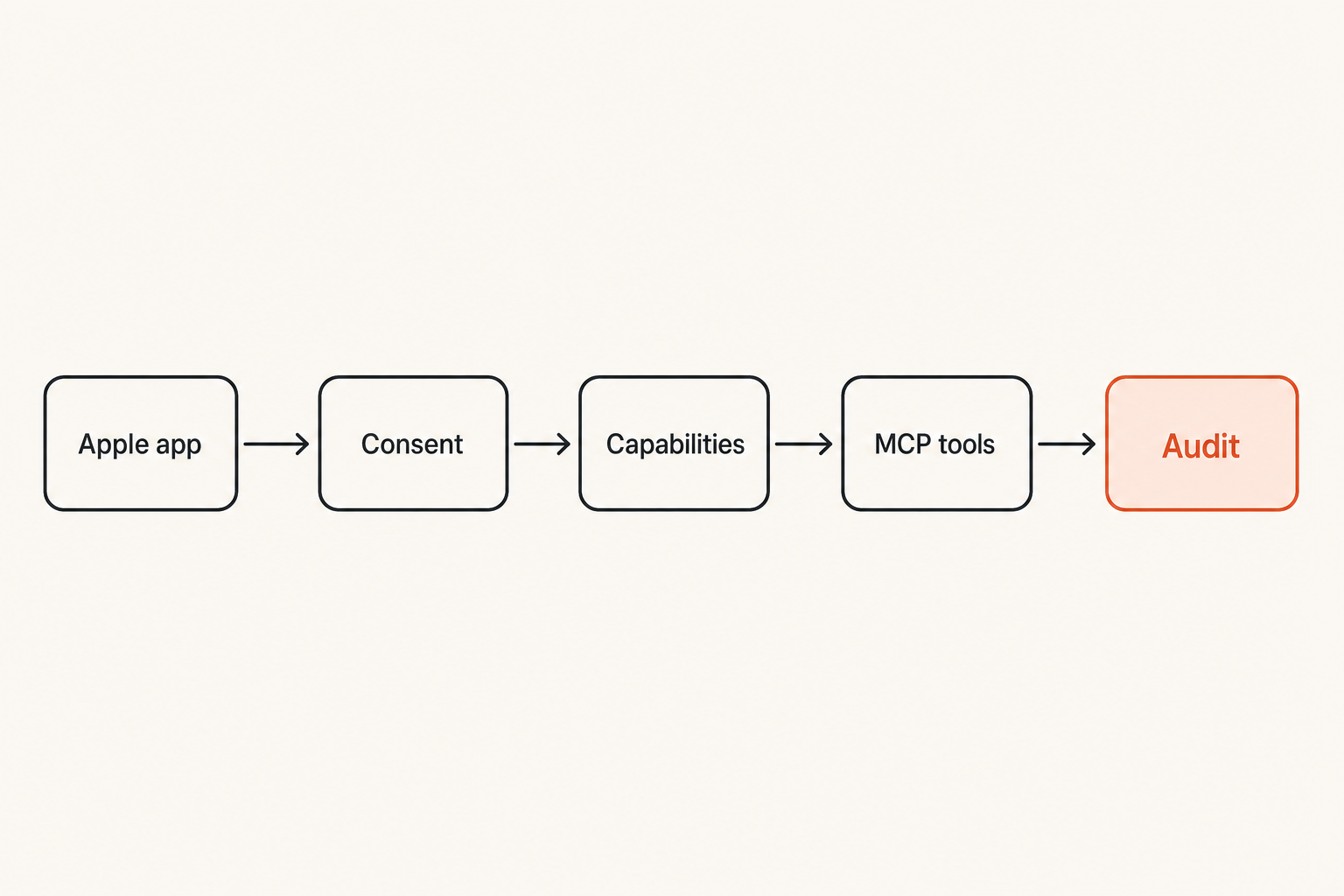
Open AI agent standards are useful when they make behavior portable and inspectable. They are not a magic layer that removes platform responsibility.
The practical question is where to standardize and where to accept Apple-specific boundaries. Many teams get this backward. They standardize superficial messages and leave permissions, events, credentials, and identity as custom glue.
That produces integrations that demo well and fail in production.
Where open standards fit
Open standards should describe coordination across systems:
- agent identity and delegation
- tool discovery and invocation
- MCP server capabilities
- event envelopes
- credential references
- consent receipts
- audit trails
- payment or settlement references
- human review gates
- revocation and expiration
These are the surfaces where an agent platform needs interoperability. The local Apple app may initiate a task, but another service may execute it, another agent may review it, and a hosted product may store the result.
For example, an app can expose a local action as a tool, but the tool should not be described only by Swift code. It should have a schema that another agent runtime can understand:
{
  "tool": "draft_reply",
  "input_schema": "reply_request.v1",
  "requires": ["message_read", "user_confirmation"],
  "side_effect": "creates_draft",
  "approval_mode": "before_execution",
  "event_output": "agent.action.completed.v1"
}
That changes the conversation. The app is no longer a sealed UI. It becomes one participant in a coordinated workflow.
Where Apple remains the boundary
Some boundaries should not be abstracted away.
Apple still governs:
- app identity and bundle ownership
- OS permissions and prompts
- entitlement enforcement
- App Store review and policy interpretation
- sandbox behavior
- local user trust signals
- device-level privacy controls
Your open agent layer should respect those boundaries instead of pretending they do not exist. If a device permission is denied, the agent should receive a structured denial, not a vague tool failure. If an action requires App Review disclosure, the workflow should include a reviewable explanation.
Related reading from our network: teams working on technical discoverability face a similar standards problem in content form; Optimization SciPy for AEO is a useful adjacent look at making technical pages structured enough for machine interpretation.
Build an agent-ready app and extension architecture
An agent-ready Apple product should be split by responsibility. The UI is not the runtime. The runtime is not the policy engine. The policy engine is not the audit log. What breaks in practice is combining all of those into one app process and hoping prompts will keep it safe.
A practical architecture usually has five layers:
- Apple client app or extension
- local capability adapter
- agent policy and consent layer
- tool or MCP coordination layer
- durable event and audit service
This sequence keeps Apple-specific constraints near the device while making coordination portable.
Separate user interface from agent runtime
The UI should explain, request, and confirm. It should not be the only place where agent policy lives.
For example, if a user approves an agent to summarize a document, the approval should be captured as a consent receipt that the runtime can evaluate later:
- user ID or pseudonymous subject reference
- app bundle and version
- capability requested
- tool or action identifier
- scope and expiration
- approval timestamp
- human-readable disclosure shown
- revocation path
The app presents the disclosure. The runtime enforces the receipt. The audit layer stores the event.
This separation matters when you add a Mac app, iOS extension, web dashboard, or hosted integration. You do not want each client to invent its own trust model.
Design for reviewable actions
Agent actions fall into different risk classes. Treating them all the same is the fastest path to either dangerous automation or unusable confirmation spam.
A useful classification:
| Action type | Example | Default handling |
|---|---|---|
| Read-only | summarize a note | allow within granted scope |
| Drafting | prepare an email | create draft, require review before send |
| Local change | rename files | require confirmation and reversible log |
| External side effect | send message, create ticket | require explicit approval |
| Financial or legal | initiate payment, accept terms | require strong confirmation and audit |
| Credential use | call private API | require scoped token and event record |
Practical rule: Classify agent actions by side effect, not by implementation difficulty. A simple API call can be high-risk if it changes something outside the app.
Related reading from our network: the details are very different, but checkout teams face the same state-and-confirmation problem; a Wayfair coupon workflow only works when totals, exclusions, retries, and final confirmation are treated as separate states.
Implement CI/CD without weakening trust
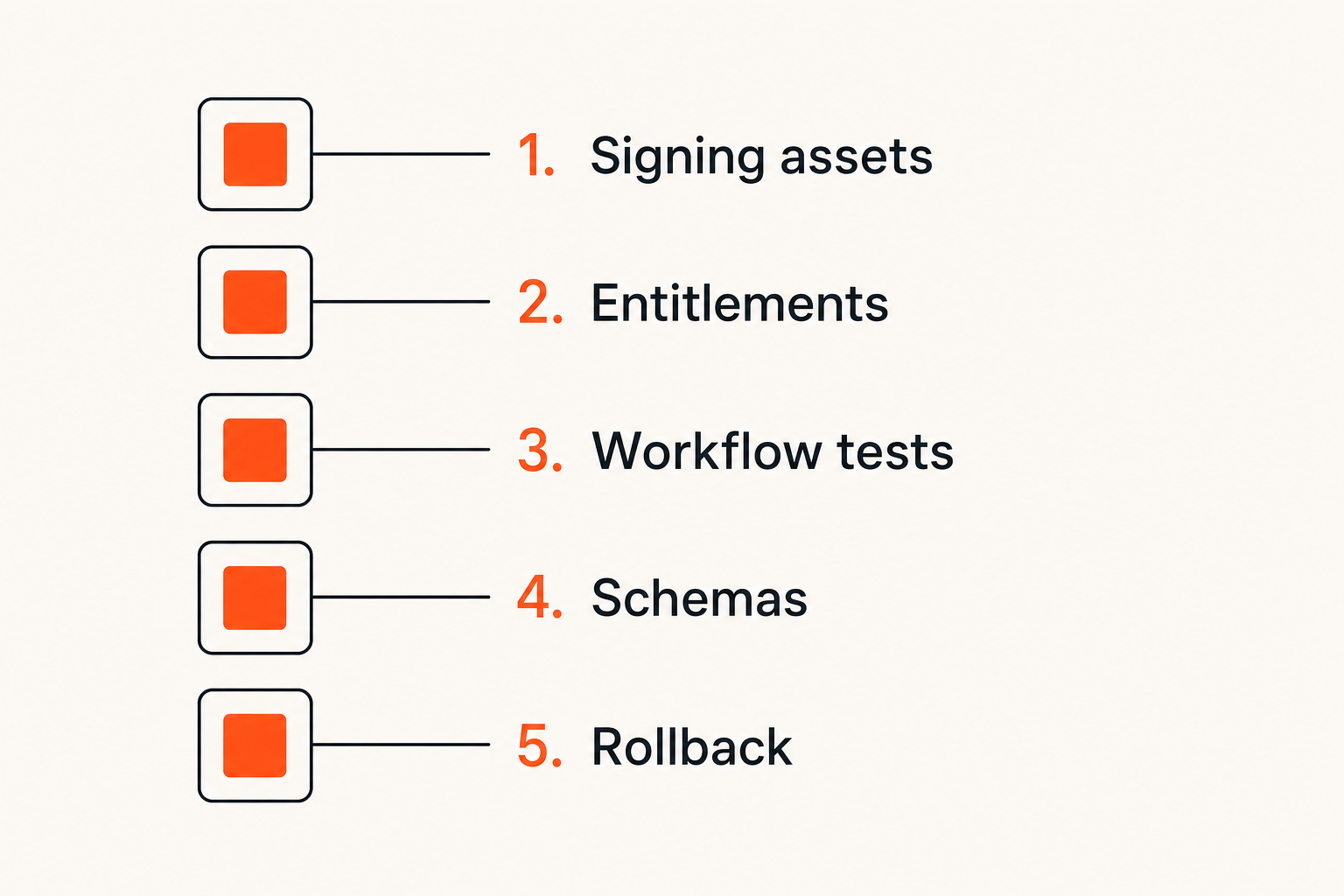
CI/CD is where Apple Developer Program hygiene often collapses. The build team wants speed. The security team wants control. The product team wants TestFlight builds. The founder wants a demo on a device before the investor call.
The mistake teams make is solving that pressure by spreading Apple credentials across laptops and CI systems. That may get the build out. It also destroys accountability.
Certificates, profiles, and secrets
Treat Apple signing assets as production secrets. The private key is not a convenience file. Provisioning profiles are not harmless attachments. App Store Connect API keys are not generic CI variables.
A workable model:
- Store signing assets in a controlled secret manager.
- Grant CI access through short-lived or tightly scoped credentials.
- Separate development, staging, TestFlight, and production profiles.
- Record which workflow accessed which asset.
- Rotate credentials when team membership changes.
- Prevent local production signing unless there is an explicit break-glass path.
This is not bureaucracy. It is how you preserve the chain between source, build, signature, deployment, and runtime action.
Release promotion and rollback
Agent products need release promotion that considers workflow compatibility, not just app version numbers.
Before promoting a build, verify:
- entitlement manifest matches expected capabilities
- tool schemas are backward compatible
- event schemas are accepted by the backend
- consent receipts still validate
- MCP servers advertise expected tools
- old clients receive safe degradation
- rollback does not strand in-flight agent tasks
A numbered implementation sequence helps:
- Build the app from a tagged commit in CI.
- Generate an entitlement and capability manifest.
- Sign using environment-specific assets.
- Publish to internal testers or TestFlight.
- Run automated agent workflow tests against the signed artifact.
- Validate privacy prompts, consent receipts, and event emission.
- Promote only after backend schemas and clients agree.
- Keep rollback instructions tied to workflow versions, not only binary versions.
Related reading from our network: SSE streaming for dashboards is a different domain, but it shows the same operator lesson: status events need clear ordering and resilient client behavior, or dashboards lie during failures.
Privacy, permissions, and credential sharing
The Apple Developer Program forces you to declare and explain privacy behavior. Agent systems force you to enforce it across tools, plugins, and hosted services.
Those two requirements should share a model. If App Review sees one story, the user sees another, and the agent runtime follows a third, you have an architecture problem.
Minimize scopes at every boundary
Permission minimization is not just asking for fewer OS prompts. It is reducing blast radius at every layer:
- Apple OS permission
- app entitlement
- local adapter scope
- agent tool permission
- backend token scope
- third-party plugin scope
- event log visibility
- support access
For credential movement across agents and plugins, use references and scoped grants rather than copying secrets into prompts or logs. LogicSRC covers this pattern through credential sharing primitives that are meant to keep coordination explicit without turning secrets into chat context.
A minimal credential reference should identify what can be done, not expose the credential itself:
{
  "credential_ref": "cred_01h...",
  "scope": ["read:ticket", "write:draft"],
  "subject": "user_123",
  "audience": "support_agent_runtime",
  "expires_at": "2026-08-17T22:00:00Z",
  "requires_human_approval": true
}
Log consent without leaking secrets
Audit logs are only useful if they can be read. They are only safe if they do not become a second data leak.
For agent workflows, log:
- who or what requested the action
- which app and version initiated it
- which permission or credential reference was used
- which user-facing disclosure was shown
- whether the action was approved, denied, expired, or revoked
- which external system received a call
- correlation IDs for support and incident response
Do not log:
- raw tokens
- private keys
- full prompt contents when unnecessary
- personal data outside the declared purpose
- file contents unless explicitly required
- unredacted third-party responses
Practical rule: Log the proof of authority, not the secret that provided authority.
Events, webhooks, and MCP coordination
Open agent standards only work if events are reliable. A beautifully described tool is not enough. You need to know when it was called, what it attempted, what state changed, and whether the caller can safely retry.
For Apple-distributed products, events connect local actions to cloud coordination. They also help support answer the uncomfortable question: what did the agent actually do?
Normalize app events for agents
Use a small set of durable event types rather than inventing one-off logs for every feature.
A practical event taxonomy:
| Event | Purpose |
|---|---|
| agent.task.requested | User or system asked an agent to do work |
| agent.consent.granted | User approved a scoped action |
| agent.consent.denied | User rejected or revoked approval |
| agent.tool.invoked | A tool or MCP operation started |
| agent.action.completed | Work completed with an outcome |
| agent.action.failed | Work failed and may need retry or review |
| agent.credential.used | A scoped credential reference was used |
| agent.review.required | Human review is required before side effect |
Each event should include a correlation ID, actor, subject, environment, app identity, schema version, and idempotency key where relevant.
Make retries and idempotency boring
What breaks in practice is not the happy path. It is duplicate sends, partial failures, offline devices, stale permissions, and users who revoke access halfway through a workflow.
For side-effecting agent actions:
- require idempotency keys
- store attempted action records before external calls
- distinguish retryable and terminal failures
- expire approvals
- re-check consent before execution, not only at planning time
- make human review resumable
- emit completion events even when the result is denial
MCP tools and plugin APIs should follow the same discipline. Tool calls need schemas, but they also need state transitions. If a tool can create, delete, purchase, publish, or send, it needs replay protection.
Common failure modes in Apple Developer Program implementations
The Apple Developer Program is not the problem. The problem is using it as a silo.
Many teams create a working app, a working agent backend, and a working plugin system. Then production exposes the gaps between them.
What fails
Common failures include:
- Certificates are managed by one person with no rotation plan.
- Development entitlements accidentally become assumed production capabilities.
- App Review disclosures do not match actual agent behavior.
- Tool schemas describe inputs but not side effects.
- Permissions are checked in the UI but not enforced in the backend.
- Agent prompts contain credentials or sensitive user context.
- TestFlight builds use backend production credentials.
- Audit logs capture raw data instead of references.
- Webhooks retry without idempotency keys.
- Support cannot reconstruct which app version performed an action.
These failures are not exotic. They are normal when distribution, identity, consent, and orchestration are owned by separate teams with separate models.
What works
What works is boring alignment.
- Apple app identity maps to agent client identity.
- Entitlements map to capability manifests.
- Consent prompts map to durable receipts.
- Tool invocations map to event schemas.
- Credentials move by reference, not by prompt text.
- CI signing records map to releases.
- Human review gates map to side-effect classes.
- Rollback plans include agent workflow versions.
The comparison is straightforward:
| Weak implementation | Production-ready implementation |
|---|---|
| App signing lives in CI only | Signing metadata feeds audit and support |
| Permissions are UI prompts | Permissions become runtime policy inputs |
| Agent tools are informal functions | Tools have schemas, side-effect classes, and events |
| Credentials are copied into context | Credentials are scoped references with expiration |
| Logs are debug text | Logs are structured evidence |
| Rollback means previous binary | Rollback includes schemas, policies, and tasks |
Practical rule: If support cannot explain an agent action from logs without asking engineering to grep three systems, the workflow is not production-ready.
Operational checklist for 2026 teams
An Apple-distributed AI agent product needs a launch checklist that covers platform, agent, privacy, and operations. Keep it short enough to run, but strict enough to catch architectural drift.
This is the checklist I would use before letting an agent product operate on real user data or real external systems.
Pre-launch workflow
Do these before App Store submission or broad TestFlight access:
- Confirm Apple team ownership and bundle ID strategy.
- Define app, extension, and backend identities.
- Create environment-specific signing profiles.
- Generate entitlement manifests from source control.
- Map entitlements to agent capabilities.
- Classify all tools by side effect.
- Define consent receipts and revocation behavior.
- Verify privacy disclosures against actual data flows.
- Test offline, denial, retry, and revoked-permission paths.
- Validate event schemas against backend consumers.
- Run signed-build agent workflow tests.
- Document support procedures for disputed actions.
The mistake teams make is reviewing only the app binary. Review the workflow. The app is just the signed surface.
Post-launch workflow
After launch, watch for drift:
- New entitlement requested without updated capability manifest
- New tool added without side-effect classification
- New plugin integrated without consent and credential scope review
- New event emitted without schema ownership
- New app version released without agent compatibility tests
- New support category indicating users do not understand automation
- New backend path bypassing client permission assumptions
Post-launch operations should include regular review of signing assets, access control, App Store metadata, privacy labels, tool schemas, and event retention.
If a user revokes permission on the device, your backend should not continue operating as if consent still exists. If an app version is pulled, your orchestration layer should understand whether in-flight tasks from that version are still valid.
Where logicsrc.com fits in the workflow
LogicSRC is not trying to replace Apple, MCP, your CI system, or your app framework. The useful product question is narrower: how do platform teams describe coordination between humans, agents, plugins, payment systems, credentials, and hosted products in a way that can be implemented and audited?
That is where open schemas and coordination primitives matter. They give teams a shared surface between Apple-specific trust and agent-platform behavior.
Open coordination surfaces
For developers and platform teams building interoperable AI agent systems, the product boundary is rarely one SDK. It is a set of contracts:
- identity contracts
- capability contracts
- credential references
- event envelopes
- review gates
- payment or settlement hooks
- plugin coordination
- audit records
- MCP-facing tool descriptions
The LogicSRC project is focused on open schemas, primitives, and conventions for coordination between humans, AI agents, plugins, payment systems, and hosted products. That fits naturally around the Apple Developer Program because Apple gives you one governed platform boundary, while your agent ecosystem needs portable workflow semantics beyond it.
A practical integration pattern looks like this:
- Apple app receives OS permission and user intent.
- App emits a consent receipt and capability reference.
- Agent runtime evaluates tool eligibility.
- MCP or plugin layer executes only approved operations.
- Credential references are resolved by policy, not prompt text.
- Events are written for audit, support, and automation.
- Human review gates handle risky side effects.
- Rollback and revocation are expressed as workflow state.
That is not hype. It is plumbing. But it is the plumbing that keeps AI agent products from becoming unreviewable automation glued to a signed app.
Try logicsrc.com
You are writing for developers and platform teams building interoperable AI agent systems, SDKs, plugins, and hosted products. If the Apple Developer Program is one trust boundary in your agent architecture, LogicSRC helps define the open coordination surface around it.