Synonyms of Standards in AI Agent Architecture: Specs, Protocols, Schemas, Contracts, and Conventions
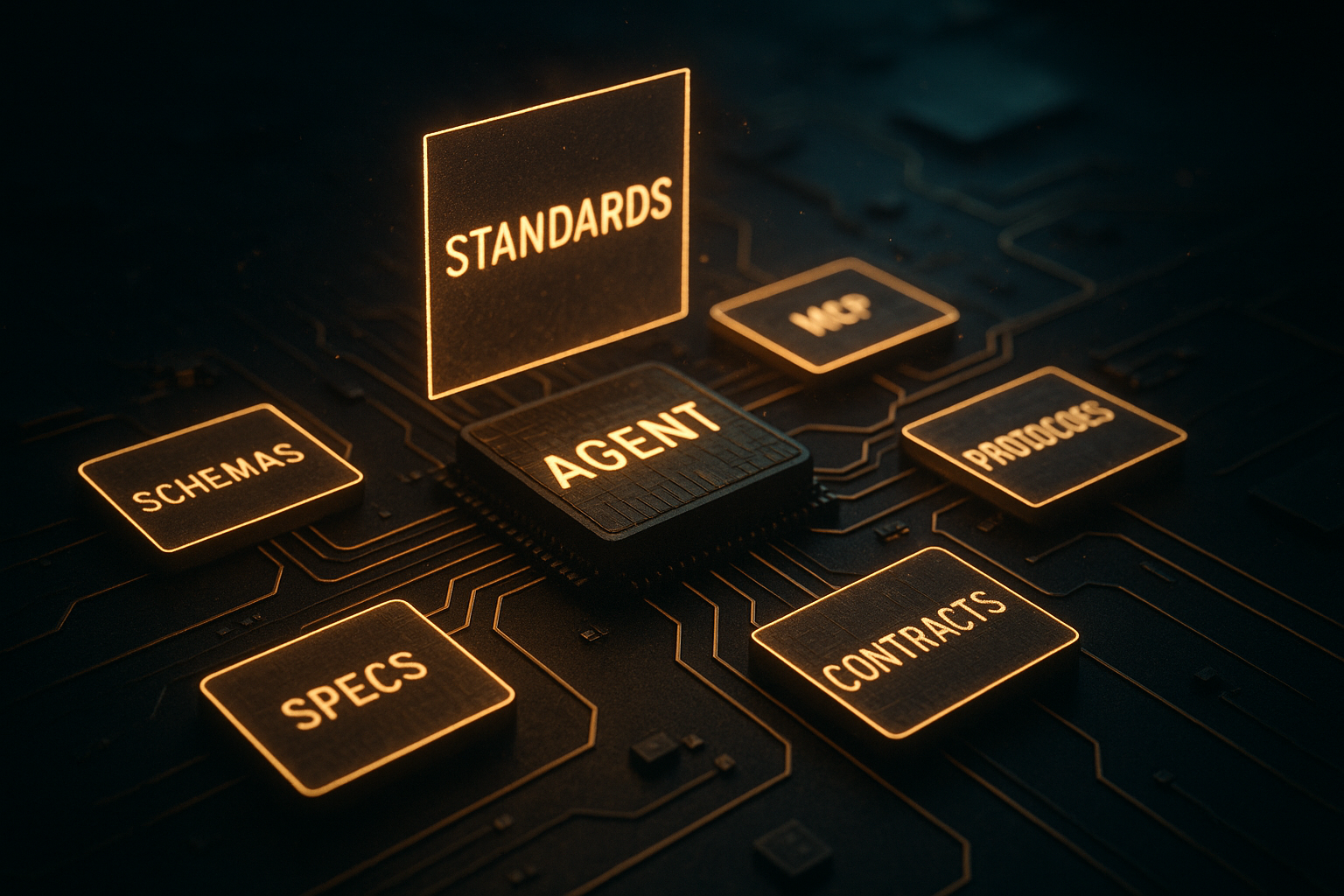
Most teams do not search for synonyms of standards because they enjoy vocabulary work. They search because an AI agent integration has stalled. One team calls something a protocol. Another calls it a schema. A third says it is just a convention. Then the implementation breaks at the boundary.
Teams think the problem is terminology. The real problem is architecture ownership.
In 2026, agent systems are no longer isolated demos. They call tools, share credentials, coordinate tasks, trigger payments, emit events, and operate across hosted products. That changes the conversation. A standard-like artifact is not just a document. It is a decision about validation, compatibility, trust, migration, and support.
The practical question is not which synonym sounds best. The practical question is which artifact gives engineers enough structure to interoperate without freezing the system too early.
Table of contents
- What synonyms of standards actually control in agent systems
- Synonyms of standards by layer
- The interoperability stack behind the vocabulary
- How to choose the right artifact for an agent workflow
- What breaks when teams use the wrong standard synonym
- A practical workflow for publishing agent standards
- Identity, credentials, and trust boundaries
- Payments, events, and auditable state
- Governance without bureaucracy
- Where LogicSRC fits and what to implement next
What synonyms of standards actually control in agent systems
Vocabulary is an interface decision
A useful way to think about synonyms of standards is that each word points to a different interface promise.
A schema promises shape. A protocol promises interaction. A contract promises obligations. A convention promises expected behavior without full enforcement. A profile narrows a larger standard for a specific environment. A manifest advertises capabilities. A registry provides discoverability and naming.
Those are not interchangeable in production. If a plugin sends a valid payload but violates the expected sequence, the schema did its job and the protocol failed. If an agent has a permission token but no revocation path, the credential format may be fine while the trust contract is broken.
The mistake teams make is treating standards language as branding. They rename the same loose document until it sounds mature. But operators need to know what they can validate, what they can reject, what they can migrate, and who owns the breakage.
Why agent teams argue about naming
AI agent systems amplify naming disputes because they cross organizational and runtime boundaries. A browser extension, a hosted agent, a local MCP server, a payment adapter, and a SaaS plugin may all participate in one workflow. Each participant needs a shared view of identity, permissions, state, and errors.
The frontend team may want a JSON schema. The platform team may want a protocol. The security team may want a policy. The open source maintainer may want a convention that can evolve without blocking contributors.
They are all partly right. The problem is that each group is solving for a different failure mode.
Practical rule: If two teams disagree on whether something is a spec, protocol, schema, or convention, ask what failure they want to prevent. The answer usually names the correct artifact.
The operator test for any standard-like artifact
Before naming anything a standard, apply a simple operator test:
- Can an implementer know if they are compliant?
- Can a receiving system reject invalid behavior deterministically?
- Can two versions coexist during migration?
- Can a human or agent inspect what happened after the fact?
- Can an owner explain how changes are proposed and adopted?
If the answer is no, you may still have a useful document. You do not yet have an operational standard.
This is why the phrase synonyms of standards matters in agent architecture. The words are shortcuts for operational guarantees.
Synonyms of standards by layer
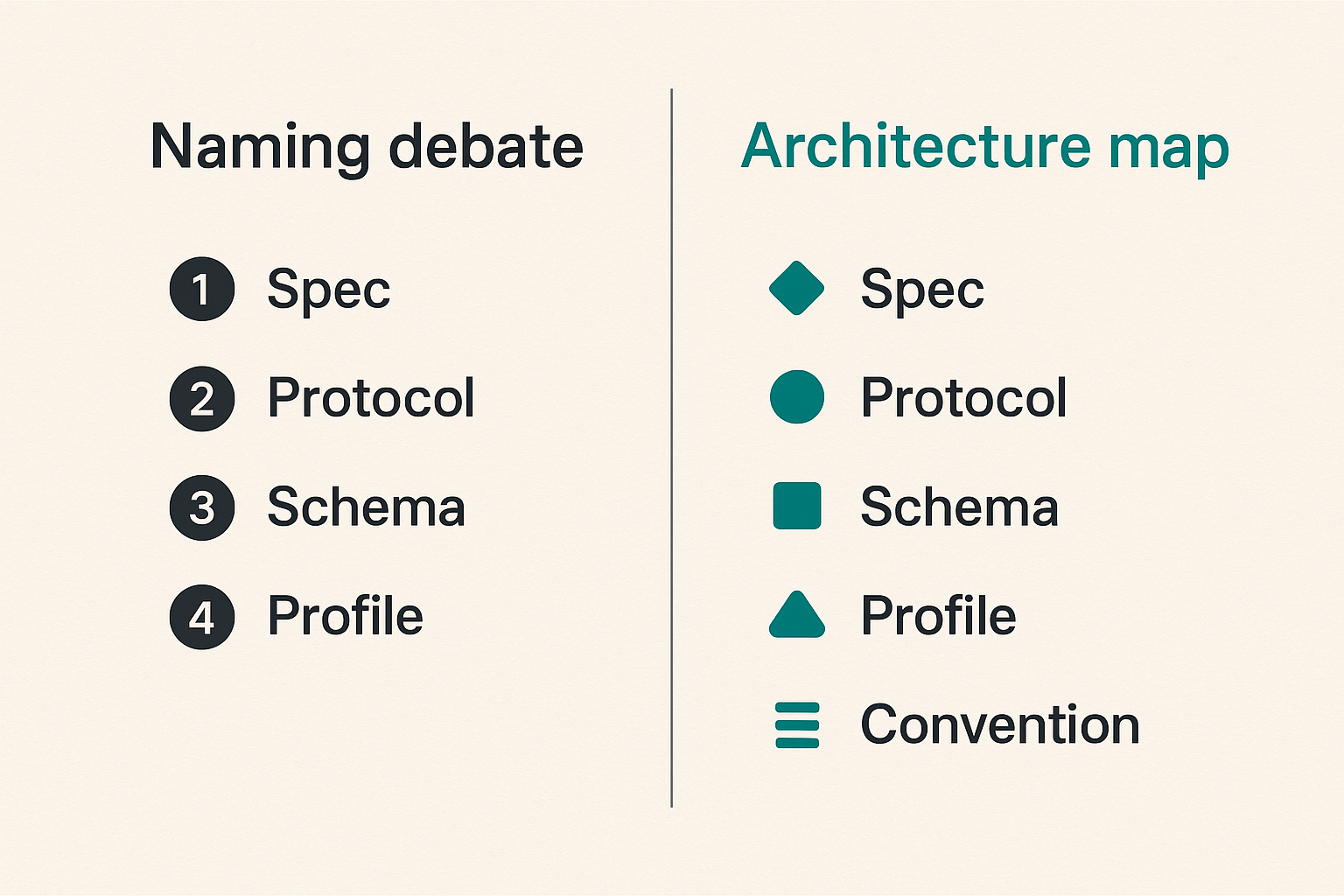
Spec, protocol, schema, profile
Here is the practical distinction most agent platform teams need:
| Term | Controls | Best use | What fails when misused |
|---|---|---|---|
| Specification | Requirements and expected behavior | Defining a capability or subsystem | Too vague to test if examples are missing |
| Protocol | Message sequence and interaction rules | Agent-to-tool or agent-to-agent coordination | Payloads validate but workflows deadlock |
| Schema | Data structure and field constraints | Tool calls, events, manifests, receipts | Valid data can still mean the wrong thing |
| Profile | A constrained subset of a broader standard | Industry, product, or runtime-specific compatibility | Fragmentation if every vendor creates one |
A spec is often the umbrella. It explains intent, terms, scope, and compliance. A protocol is narrower and more runtime-oriented. It defines how messages move and what responses mean. A schema is narrower still. It defines data shape. A profile reduces optionality so real implementations can interoperate.
The practical question is not which one is most prestigious. It is which one matches the integration boundary.
Contract, convention, policy
Contracts, conventions, and policies sit closer to behavior and obligation.
A contract says what a party must do. In agent systems, that may include response time expectations, supported error codes, payment settlement commitments, or credential handling rules.
A convention is softer. It tells implementers what is expected, but it may not be enforceable at every boundary. Conventions are useful for early ecosystems because they allow coordination before full conformance tooling exists.
A policy defines allowed and disallowed behavior. Policies often belong at security, identity, data handling, or payment boundaries.
The mistake teams make is pretending conventions are contracts. That works until money, credentials, or production support enter the workflow.
Registry, capability, manifest
Registries, capabilities, and manifests answer a different question: how does one system know what another system can do?
A manifest is a self-description. A capability is a named function or permission. A registry is a shared lookup surface. Agent ecosystems need all three when tools and plugins are discovered dynamically.
For a deeper adjacent vocabulary map, the prior LogicSRC post on synonyms of standards for AI agent architecture is useful because it treats specs, schemas, protocols, profiles, and conventions as different architecture decisions rather than dictionary entries.
Related reading from our network: teams dealing with public storage face the same distinction between naming a control and operationalizing it in CI/CD, as covered in Security Public Storage in 2026.
The interoperability stack behind the vocabulary
Transport versus semantics
Transport is how messages move. Semantics are what messages mean. Agent teams often over-standardize transport and under-standardize meaning.
HTTP, WebSocket, local IPC, message queues, and MCP-style tool calls can all carry agent interactions. But if one side interprets completed as final and another interprets it as accepted for processing, the transport is irrelevant. The workflow will still break.
What works is separating layers:
- Transport: how bytes or messages move
- Envelope: metadata, sender, receiver, trace, version
- Payload: task, tool call, event, credential, receipt
- Semantics: state transitions and obligations
- Policy: who may do what under which conditions
Each layer may need a different standard synonym. Do not force one word to carry the whole stack.
State transitions matter more than payload shape
A valid event is not necessarily a valid transition. This is the core problem in agent workflows.
Consider a task delegated from one agent to another. The payload may validate in every state. But a transition from cancelled to completed should be rejected. A transition from pending to paid may require an authorization event. A transition from credential-granted to credential-used may require scope verification.
Schemas help with shape. Protocols and contracts help with sequence and obligation. Policies help with permission. Audit logs help with reconstruction.
Practical rule: If the bug report says the data looked valid but the system did the wrong thing, you are probably missing a protocol, state machine, or policy, not another schema field.
Validation turns language into operations
A standard-like artifact becomes useful when it can be tested. Validation does not have to be heavy at first. It can start with examples, fixtures, JSON Schema, test vectors, compatibility suites, or reference implementations.
For agent systems, useful validation usually includes:
- Payload validation for schemas
- Sequence validation for protocols
- Permission checks for policies
- Replay tests for events
- Compatibility tests across SDK versions
- Human-readable audit traces
Validation is also how you reduce support load. Instead of debugging every integration as a unique case, maintainers can ask for the failing fixture, trace, or conformance report.
How to choose the right artifact for an agent workflow
Start from the failure mode
Do not begin by asking whether you need an open standard. Begin by asking what breaks without coordination.
If tools return inconsistent output, you likely need schemas and examples. If agents disagree about task lifecycle, you need a protocol or state machine. If plugins misuse tokens, you need a credential policy and audit semantics. If multiple vendors expose similar capabilities under different names, you need a registry or capability profile.
A useful mapping looks like this:
| Failure mode | Better artifact | Why |
|---|---|---|
| Payload mismatch | Schema | Reject malformed data early |
| Workflow race | Protocol | Define sequence and state |
| Permission leakage | Policy or contract | Define obligations and enforcement |
| Vendor divergence | Profile | Reduce optionality |
| Poor discovery | Registry or manifest | Make capabilities inspectable |
| Breaking upgrades | Versioning convention | Allow migration without outages |
The word follows the failure mode.
Pick the weakest sufficient artifact
There is a cost to over-standardization. If you turn every convention into a rigid protocol too early, you slow down implementers and create fake compliance. If you keep everything informal too long, production teams build private assumptions and later call them standards.
The practical approach is to pick the weakest artifact that prevents the real failure.
- Use a convention when behavior is useful but not safety-critical.
- Use a schema when structure is the main risk.
- Use a protocol when sequence and state matter.
- Use a contract when obligations cross ownership boundaries.
- Use a policy when enforcement and risk decisions are required.
- Use a profile when a broad standard has too much optionality.
Practical rule: Standardize the boundary that creates operational risk. Leave the rest flexible until implementations prove the shape.
Version for migration, not decoration
Version numbers are not badges. They are migration tools.
Agent ecosystems often break because versioning is added after multiple SDKs, plugins, and hosted services already depend on implied behavior. Versioning should appear in the envelope, docs, fixtures, and compatibility tests from the beginning.
A minimal manifest might look like this:
agent_surface: task-delegation
profile: hosted-agent-v1
schema_version: 1.2.0
protocol_version: 1.0.0
capabilities:
  - task.accept
  - task.reject
  - task.complete
required_events:
  - task.created
  - task.accepted
  - task.completed
compatibility:
  accepts_minor_versions: true
  rejects_unknown_required_fields: true
The important part is not the exact fields. The important part is that compatibility behavior is explicit.
What breaks when teams use the wrong standard synonym
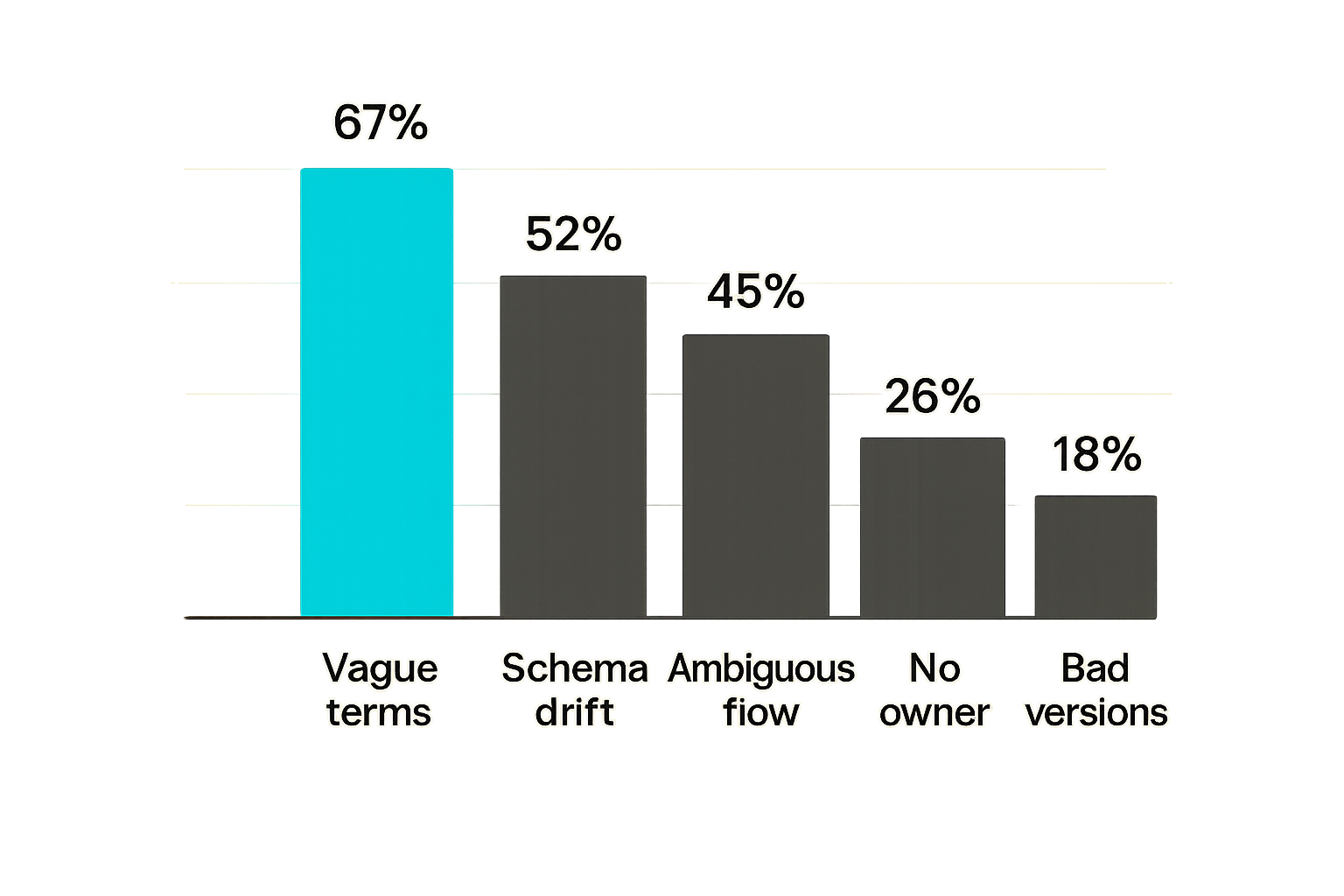
Definitions without enforcement
Definitions are useful, but definitions alone do not make systems interoperable. Many teams publish glossaries and call the work done. Then every implementer maps the words to a different runtime behavior.
What breaks in practice is support. A maintainer receives an issue that says an agent completed a task incorrectly. The logs show that both systems used the same words. But one product treated approved as user consent, while another treated it as model confidence.
That is not a glossary problem anymore. It is a semantics and validation problem.
Schemas without lifecycle
Schemas fail when teams treat them as static files instead of lifecycle artifacts.
Common mistakes include:
- Adding required fields without a compatibility plan
- Reusing field names with changed meaning
- Failing to publish examples for edge cases
- Treating unknown fields inconsistently
- Letting SDKs generate incompatible client behavior
A schema needs release notes, deprecation rules, fixture coverage, and runtime error behavior. Otherwise it becomes a fragile document that looks precise but creates hidden drift.
Related reading from our network: infrastructure teams see the same migration issue at lower layers, especially when routing, validation, and payments cross compute boundaries, in IaaS in Cloud Computing.
Protocols without ownership
Protocols are expensive because they define interaction. Someone has to own ambiguity, timing, retries, error classes, and version negotiation.
A protocol without ownership becomes a blame surface. The client says the server responded incorrectly. The server says the client retried incorrectly. The SDK says the spec was unclear. The user sees a failed workflow.
What works is assigning owners for each boundary:
- Protocol owner for sequence and state
- Schema owner for payload evolution
- SDK owner for implementation behavior
- Security owner for permission and credential rules
- Operations owner for observability and incident response
Without ownership, synonyms of standards become synonyms for nobody is accountable.
A practical workflow for publishing agent standards
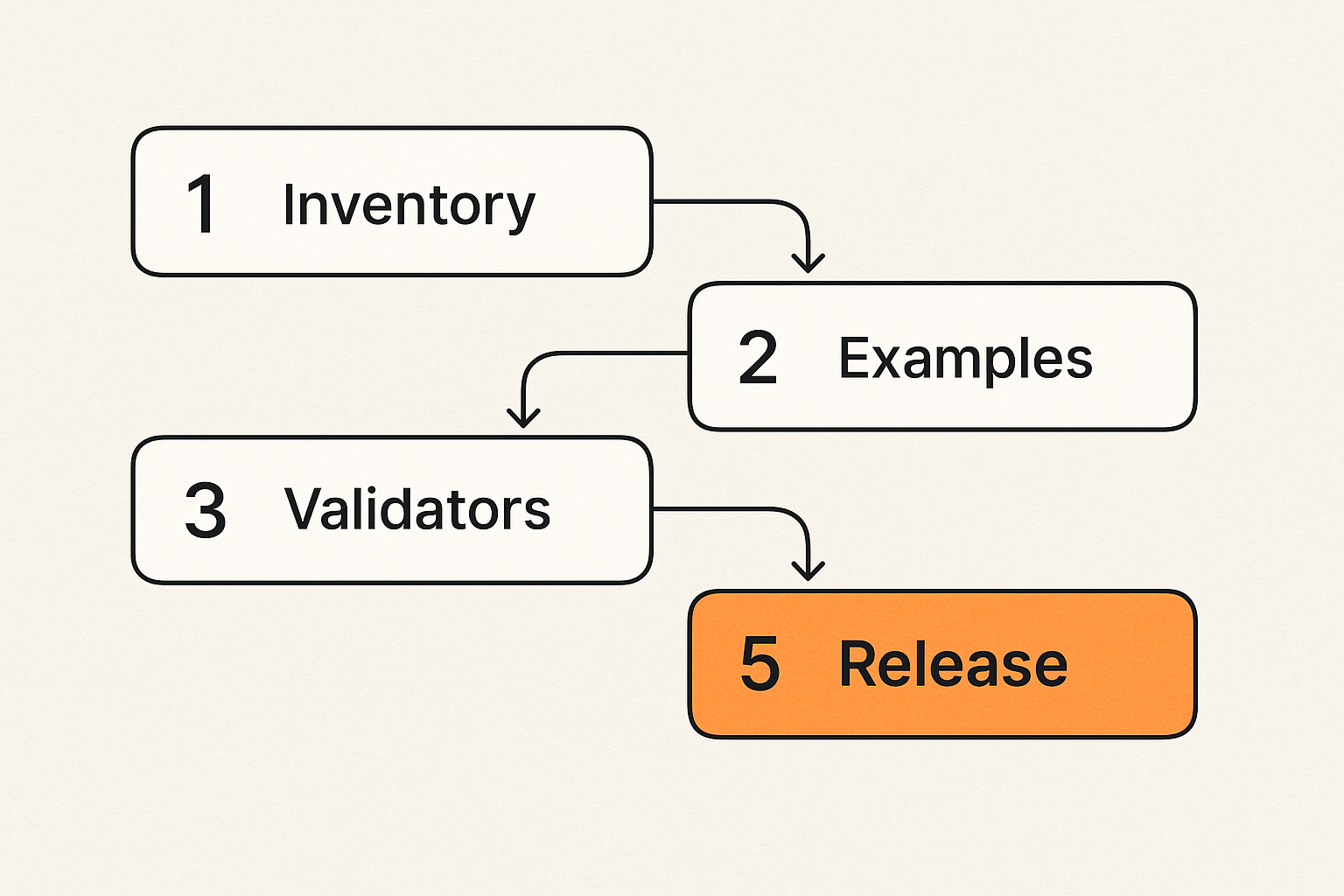
Inventory the surfaces
Start by listing the surfaces where agents, tools, plugins, users, and platforms exchange responsibility. Do not start with a document title.
A practical inventory includes:
- Identify actors: user, agent, plugin, host, tool, payment processor, credential issuer.
- List exchanged objects: task, event, credential, receipt, policy decision, capability manifest.
- Mark trust boundaries: local process, hosted service, third-party plugin, external network.
- Identify irreversible actions: payment, deletion, credential use, external communication.
- Capture current assumptions: retries, errors, timeouts, user approval, audit retention.
This sequence turns vague standardization into an implementation backlog.
Write canonical examples
Canonical examples are more useful than abstract prose early in a standard effort. They force decisions.
Write examples for:
- Happy path
- Missing permission
- Unsupported capability
- User revocation
- Retry after timeout
- Partial completion
- Version mismatch
- Duplicate event delivery
Each example should include input, expected output, state transition, and audit trace. If you cannot write the example, the standard synonym is probably too vague.
Build validators before evangelizing
The mistake teams make is announcing a standard before implementers can test against it. This creates attention but not compatibility.
Build a small validator first. It can be a CLI, test suite, SDK helper, or hosted checker. The purpose is to turn the artifact into something operational.
For example:
agent-standard validate manifest.yaml
agent-standard replay examples/task-timeout.yaml
agent-standard check --profile hosted-agent-v1 --sdk ./plugin
The commands are illustrative. The workflow is the point. Implementers should be able to answer: does my system conform enough to interoperate?
Run compatibility reviews
Compatibility review is where standard-like work becomes real. Review the proposed artifact against existing clients, SDKs, hosted runtimes, and open source implementations.
Ask:
- What breaks on older clients?
- Can new senders talk to old receivers?
- Are unknown fields ignored, stored, rejected, or surfaced?
- What error code should support teams expect?
- What trace proves the workflow was correct?
Related reading from our network: local coordination systems face similar issues when asks, offers, trust, and follow-up need shared operating rules, as discussed in Supreme Community.
Identity, credentials, and trust boundaries
Agent identity is not user identity
Agent identity is easy to get wrong because the agent acts for a user without being the user. A platform needs to distinguish the human principal, the agent runtime, the tool, the host, and the credential issuer.
If those are collapsed into one identity, audit and revocation become messy. A tool call may be attributed to a user when it was actually executed by a delegated agent under a limited policy. Or a credential may continue working after the user expected delegation to end.
A good identity standard or profile should make delegation explicit:
- Who requested the action?
- Which agent executed it?
- Which host or runtime mediated it?
- Which credential was used?
- Which policy allowed it?
- What audit record proves it?
Credential sharing needs explicit scope
Credential sharing is not just passing tokens between components. It is an architecture boundary involving scope, consent, expiry, revocation, and audit.
LogicSRC treats this as a first-class coordination problem, and the credential sharing surface is a useful place to think about how agents, plugins, and hosted products can exchange access without turning every integration into a bespoke trust model.
The practical question is whether a receiving system can tell what it is allowed to do before it acts. If it cannot, the standard is incomplete.
Consent, revocation, and audit are part of the standard
Teams often treat consent screens and audit logs as product features outside the standard. That is a mistake.
For agent systems, consent and revocation are part of interoperability. If one product can revoke a delegated credential but another product has no way to observe the revocation, the workflow is unsafe. If an audit event cannot be correlated across systems, incident response becomes guesswork.
Practical rule: Any standard touching credentials must define scope, expiry, revocation, and audit events. Otherwise it defines access but not control.
Payments, events, and auditable state
Events before dashboards
Dashboards are not the source of truth. Events are.
When agents trigger paid actions, request escrow, call metered APIs, or settle usage, teams need event semantics before they need charts. A dashboard can summarize state only if state is emitted consistently.
Events should answer:
- What happened?
- Who or what initiated it?
- Which authorization allowed it?
- Was the action accepted, completed, failed, reversed, or settled?
- What idempotency key or trace links retries?
Without this, operations teams end up reconciling screenshots, logs, payment provider exports, and user complaints.
Idempotency and retries are standard behavior
Retries are not implementation details. They are part of the standard behavior for any distributed workflow.
If an agent calls a payment-capable tool and the network times out, what happens next? Can it retry safely? Does the receiver deduplicate by idempotency key? Is the previous attempt pending, failed, or unknown? Does a human need to approve a second attempt?
A protocol that ignores retries is incomplete. A schema that has no idempotency field may still validate, but it does not protect the business process.
What works:
- Require idempotency keys for irreversible actions
- Separate accepted from completed
- Emit events for retries and deduplication
- Define terminal states clearly
- Make reconciliation possible from logs alone
Settlement semantics need shared words
Payments and settlement expose weak vocabulary quickly. Paid, authorized, captured, settled, refunded, reversed, expired, and disputed are not synonyms. They are state transitions.
Agent platforms that use loose payment language will create support and accounting problems. A user may think an action is paid. A plugin may think funds are merely authorized. A vendor may deliver work before settlement. An agent may retry and create duplicate obligations.
This is where synonyms of standards become business architecture. The artifact may be a protocol, event schema, contract, or policy profile, but it must define the settlement state machine clearly enough that finance, support, and engineering agree.
Governance without bureaucracy
Change control is an operational primitive
Governance sounds slow, so engineering teams avoid it until they need it. Then they discover that nobody knows how changes are proposed, accepted, deprecated, or rejected.
Governance for agent standards does not have to mean committees. It does need basic change control:
- An owner or maintainer group
- A proposal path
- Compatibility labels
- Deprecation timelines
- Test fixture updates
- Reference implementation notes
- Security review for sensitive boundaries
The useful version of governance is operational. It tells implementers what will happen when the artifact changes.
Extension points prevent forks
Every ecosystem needs extension points. If you do not define them, vendors will create private fields, private states, private capabilities, and private interpretations.
Extension points should say where customization is allowed and how receivers should behave. For example:
- Namespaced custom fields are allowed in metadata.
- Unknown required fields must be rejected.
- Unknown optional fields may be stored but ignored.
- Experimental capabilities must be marked clearly.
- Reserved words cannot be repurposed by vendors.
This prevents the common failure mode where everyone claims compatibility while quietly forking the standard.
Adoption signals beat announcement energy
Announcements are cheap. Adoption is visible in boring places.
Look for:
- Multiple independent implementations
- Passing conformance tests
- Real SDK usage
- Stable issue resolution patterns
- Backward-compatible version migration
- Operational traces from production workflows
A standard without adoption may still be useful. But it should not be treated as infrastructure until it has implementation pressure behind it.
The LogicSRC blog continues to track these practical boundaries because agent standards are becoming less about whitepapers and more about whether real SDKs, plugins, hosted products, and workflows can coordinate safely.
Where LogicSRC fits and what to implement next
Product fit for open agent systems
LogicSRC is built around the idea that open AI agent systems need shared surfaces, not just shared slogans. The important surfaces are identity, coordination, agents, payments, events, credential sharing, MCP-style tool interaction, and auditable workflows.
That means the product fit is architectural. If your team is defining how agents discover tools, exchange credentials, coordinate state, emit events, or prove what happened, you need more than a naming convention. You need artifacts that implementers can build against.
The LogicSRC about page frames this as open schemas, primitives, and conventions for coordination between humans, AI agents, plugins, payment systems, and hosted products. That is the right level of abstraction: concrete enough to implement, broad enough to avoid a closed ecosystem trap.
Implementation checklist
If you are working on synonyms of standards for an agent platform this quarter, start with a small, enforceable surface.
Use this checklist:
- Pick one workflow, not the entire ecosystem.
- Name the actors and trust boundaries.
- Decide whether the artifact is a schema, protocol, profile, contract, policy, convention, manifest, or registry.
- Write canonical examples before prose expands.
- Define state transitions, not just fields.
- Add versioning and compatibility behavior.
- Build a validator or fixture suite.
- Assign owners for schema, protocol, SDK, security, and operations.
- Define audit events for sensitive actions.
- Publish extension rules before vendors invent them.
What fails is trying to standardize everything at once. What works is choosing a boundary where lack of coordination already costs engineering time, support time, or user trust.
The closing point is simple: synonyms of standards are useful only when they help teams choose the right implementation artifact. If the word does not clarify validation, ownership, state, or migration, it is just vocabulary.
Try logicsrc.com
logicsrc.com is for developers and platform teams building interoperable AI agent systems, SDKs, plugins, and hosted products. Try logicsrc.com.