Synonyms of Standards: A Practical Vocabulary for Open AI Agent Architecture

Teams building agent platforms keep running into the same argument: do we need standards, protocols, schemas, conventions, or just a good SDK?
That argument sounds semantic until an integration ships. Then one tool calls something a capability, another calls it a permission, a third treats it as a scope, and the workflow breaks at the handoff. The issue is not that engineers do not know the synonyms of standards. The issue is that each synonym implies a different operational contract.
Teams think the problem is picking the right word. The real problem is deciding where interoperability lives: in the wire format, the identity model, the runtime behavior, the audit trail, the payment boundary, or the human approval loop.
That changes the conversation. In AI agent systems, vocabulary is architecture. The practical question is not “what is another word for standards?” It is “which layer of the agent workflow needs a stable agreement, and how strict does that agreement need to be?”
Table of contents
- Why synonyms of standards matter in agent systems
- A working map of standards synonyms
- Standards versus protocols versus APIs
- Schemas are not standards until they are operational
- Conventions are the fastest path to coordination
- Profiles and primitives make standards usable
- How to choose the right synonym for the job
- What breaks when standards are implemented badly
- What works in production
- Where logicsrc.com fits
Why synonyms of standards matter in agent systems

The word choice hides an operating model
A useful way to think about it is this: every synonym for standards points to a different kind of agreement.
A specification says what something must mean. A protocol says how participants communicate. A schema says what shape the data takes. A convention says how teams behave when the formal rule is not enough. A profile narrows a broader standard into something implementable. A contract defines obligations between parties or systems.
In a simple SaaS product, those distinctions may not matter much. The app owns the UI, database, permissions, and support queue. In an agent system, the pieces are split across models, plugins, MCP servers, credential stores, orchestrators, hosted tools, user approval flows, and third-party products.
The mistake teams make is treating “standard” as a label for documentation. In practice, a standard is an operational dependency. If two agents cannot agree on identity, permissions, event meaning, retry behavior, or success states, the workflow is not interoperable.
Practical rule: If a word affects how two independent systems coordinate, treat it as architecture, not terminology.
Where AI agents make the problem harder
Agents make standards harder because they do not just exchange data. They interpret intent, choose tools, request credentials, delegate tasks, spend money, emit events, and produce artifacts that humans may trust.
That means a weak vocabulary turns into weak control. If “approval” can mean a UI click, an OAuth grant, a delegated policy, or a signed workflow event, then incident review becomes guesswork. If “completion” can mean tool call finished, task objective achieved, or user accepted the output, downstream systems will disagree.
This is why open AI agent standards need more than clean JSON. They need shared terms for identity, coordination, capability discovery, credential sharing, payments, eventing, and auditability. LogicSRC describes this broader surface as open schemas, primitives, and conventions for coordination between humans, AI agents, plugins, payment systems, and hosted products.
Related reading from our network: teams designing private coordination systems face similar vocabulary and boundary problems in end-to-end encrypted messaging workflows, where identity, devices, metadata, and recovery all need explicit contracts.
A working map of standards synonyms
Specifications, protocols, and schemas
These three get mixed together often, but they solve different problems.
A specification is the written agreement. It defines semantics, constraints, required behavior, optional behavior, and compatibility expectations. A good spec answers “what does this mean?” and “what must an implementation do?”
A protocol is the interaction pattern. It defines messages, ordering, negotiation, errors, timeouts, retries, and state transitions. A good protocol answers “how do participants communicate safely?”
A schema is the data structure. It defines fields, types, allowed values, nesting, and sometimes validation rules. A good schema answers “what does a valid payload look like?”
For example, an agent capability declaration might use a JSON schema. The protocol might define how a client discovers that declaration, verifies freshness, and negotiates permissions. The specification should define what “capability,” “permission,” “scope,” and “revocation” actually mean.
Conventions, profiles, and contracts
Conventions are informal or semi-formal agreements that reduce coordination cost. Naming patterns, event names, resource identifiers, error categories, and metadata keys often begin as conventions.
Profiles are constrained subsets of larger standards. If a broad agent event spec allows many optional fields, a profile can say: for hosted plugin execution, these seven fields are required, these two are forbidden, and these retry states are mandatory.
Contracts are enforceable expectations. They may be legal, operational, or technical. In developer tooling, a contract often means “if you send this input, the provider commits to this behavior, error model, and lifecycle.”
The practical question is whether you need flexibility or enforcement. Early ecosystem work often starts with conventions. Production workflows eventually need profiles and contracts because support, billing, security, and compliance depend on predictable behavior.
Standards versus protocols versus APIs
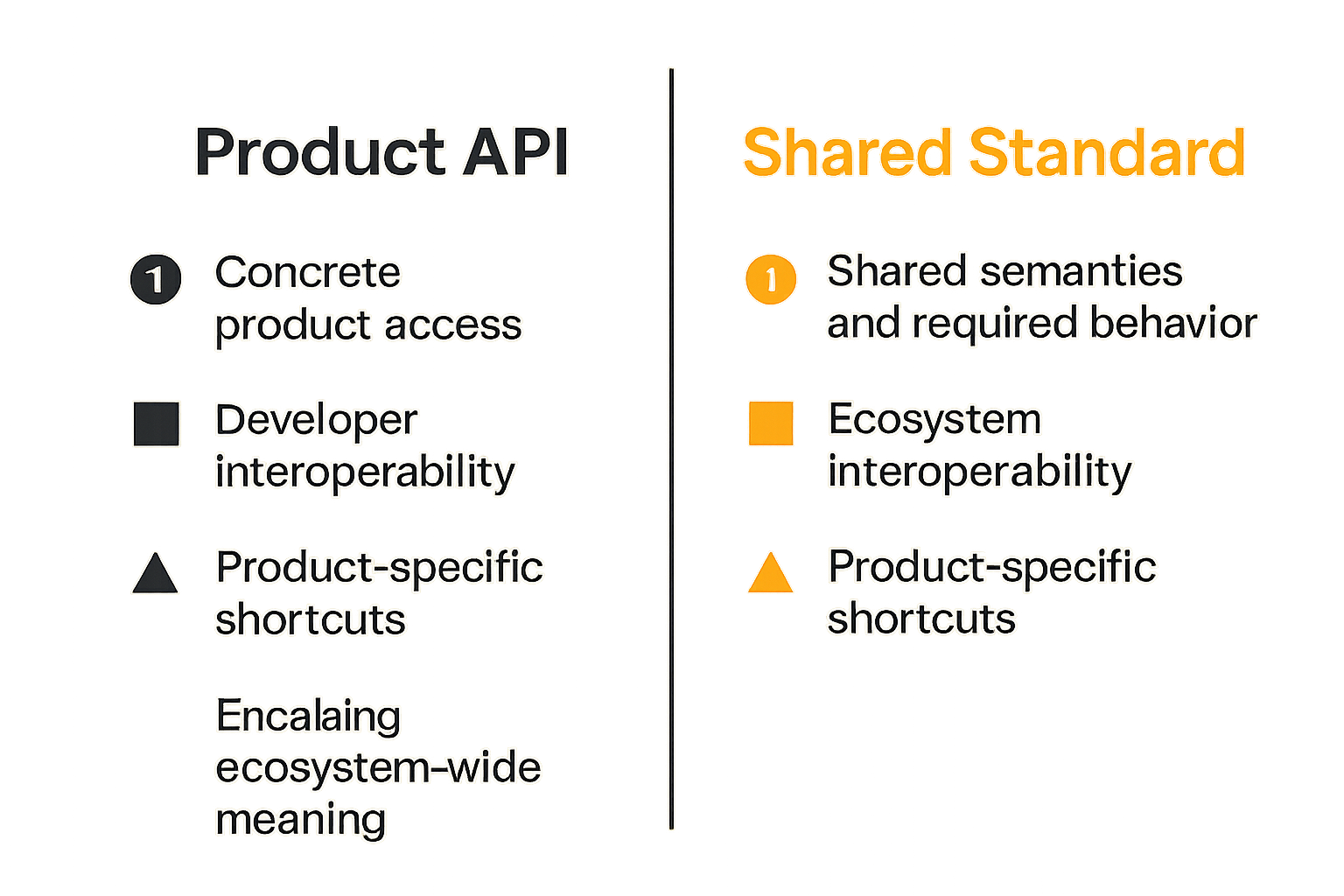
What each layer should own
An API is a product surface. A protocol is a communication model. A standard is a shared agreement that can outlive one product surface.
This distinction matters for AI agent builders because APIs change faster than standards should. You may ship a new endpoint, SDK helper, or hosted workflow without changing the underlying standard. Conversely, if the standard changes, every conforming API may need a migration path.
| Layer | Primary job | Good for | Bad when used for |
|---|---|---|---|
| Standard | Shared semantics and required behavior | Ecosystem interoperability | Product-specific shortcuts |
| Protocol | Message exchange and state transitions | Tool calls, negotiation, retries | Business policy alone |
| API | Concrete product access | Developer integration | Encoding ecosystem-wide meaning |
| Schema | Payload validation | Events, manifests, credentials | Runtime behavior guarantees |
| Convention | Lightweight coordination | Names, labels, defaults | Security-critical enforcement |
| Profile | Practical subset | Compatibility testing | Hiding incompatible behavior |
What breaks in practice is that teams push all meaning into the API. The API then becomes the only place where semantics exist. Other tools can call it, but they cannot reason about it independently.
Practical rule: APIs should expose behavior; standards should explain behavior; protocols should coordinate behavior.
Where teams overload the API
The most common overload happens around permissions. A product exposes an endpoint like POST /agent/run, accepts a token, and assumes the token tells the whole story. But agent workflows need to know who authorized the action, what the agent may do, whether the permission is reusable, when it expires, and what should be logged.
If that is only documented in one provider’s API guide, another platform cannot safely interoperate. An agent may be able to call the endpoint, but a second orchestrator cannot verify the same authorization model.
A better pattern is to separate the layers:
{
  "actor": "agent:research-bot",
  "subject": "user:42",
  "capability": "calendar.create_event",
  "authority": "delegated",
  "expires_at": "2026-07-06T18:00:00Z",
  "audit_required": true
}
The schema validates the shape. The standard defines the meaning of actor, subject, authority, and audit_required. The protocol defines how this permission is requested, granted, refreshed, revoked, and logged. The API executes the product-specific operation.
Schemas are not standards until they are operational
The minimum useful schema
Schemas are attractive because they feel concrete. Engineers can validate them, generate types, and publish examples. But a schema without operational semantics is only a shape.
The minimum useful schema for agent coordination should usually include:
- Stable identifiers for actors, resources, sessions, and workflows.
- Explicit version fields.
- Required timestamps for creation and state transition.
- Error categories that downstream systems can act on.
- Extension points that do not destroy compatibility.
- A documented relationship between fields and runtime behavior.
For agent events, this means a task.completed event should not just include a string payload. It should include task identity, actor identity, causality, evidence references, status, and whether human acceptance is still pending.
Many teams can generate payloads. Fewer teams can explain what the payload commits them to.
Versioning is part of the standard
Versioning is not housekeeping. It is how standards survive real adoption.
If your agent manifest, event envelope, or credential descriptor has no versioning policy, every consumer will invent one. Some will use URL paths. Some will use package versions. Some will inspect optional fields. Some will fork the schema.
A practical versioning model needs to define:
- Which changes are backward compatible.
- Which fields are required, optional, deprecated, or reserved.
- How long older versions remain valid.
- How consumers should react to unknown fields.
- How producers advertise supported versions.
Practical rule: A schema is not production-ready until it defines how old and new implementations coexist.
Related reading from our network: product teams launching focused software face the same compatibility pressure when they turn a narrow workflow into a maintained product; the operating discipline is similar in specialty product launch systems.
Conventions are the fastest path to coordination
When a convention is enough
Not every agreement needs a formal standards body or a long specification. In early ecosystems, conventions are often the right tool because they let teams coordinate before the full shape of the problem is known.
A convention is enough when the cost of being slightly wrong is low, the behavior is easy to observe, and migration is realistic. Examples include event naming patterns, recommended metadata keys, capability labels, documentation structure, and default timeout names.
For example, using agent.task.started, agent.task.failed, and agent.task.completed as event names may start as a convention. If multiple tools adopt it and dashboards depend on it, the convention may later become a profile or specification.
The mistake teams make is either formalizing too early or never formalizing at all. Early formalization freezes bad assumptions. Permanent informality creates integration debt.
When a convention becomes technical debt
A convention becomes technical debt when systems depend on it but no one owns its meaning.
You see this when support teams ask why two agents report the same task differently. You see it when analytics dashboards merge incompatible event types. You see it when security review cannot tell whether a credential was shared, delegated, proxied, or copied.
A useful test: if breaking the convention would cause customer-visible failure, it should probably graduate into a profile, specification, or contract.
This is common in agent-ready workflow surfaces. Presentation, document, and collaboration tools start with loose conventions around comments, actions, and generated artifacts. As those surfaces become agent-executable, the conventions need stronger state and identity boundaries. We covered adjacent workflow patterns in interactive presentation tools becoming agent surfaces, where UI actions are no longer the whole system.
Profiles and primitives make standards usable
Profiles narrow the implementation surface
Broad standards are useful for ecosystems, but broadness creates implementation ambiguity. Profiles solve that by defining a practical subset for a specific use case.
For example, an agent event standard might support many event categories. A “hosted plugin execution profile” could require only these:
workflow.requestedcredential.grantedtool.invokedtool.resultedhuman.approvedworkflow.completedworkflow.failed
The profile should also define required fields, retry behavior, audit expectations, and compatibility tests. That gives product teams a smaller target and gives platform teams something testable.
Profiles are especially useful when multiple vendors support the same high-level standard but make different choices. Without a profile, everyone can claim compliance while still failing to interoperate.
Primitives prevent every product from rebuilding the same layer
Primitives are reusable building blocks. In agent systems, common primitives include actor identity, capability descriptors, credential grants, event envelopes, workflow IDs, policy assertions, payment intents, and audit records.
The point of primitives is not abstraction for its own sake. The point is to keep every product from inventing incompatible versions of the same foundational objects.
Credential sharing is a good example. If every plugin implements credential delegation differently, users lose control and platforms lose observability. A shared primitive can describe who is sharing what, with whom, under what authority, for how long, and with what audit requirements. LogicSRC’s work around credential sharing is relevant because credentials are not just secrets; they are coordination objects with lifecycle and accountability.
How to choose the right synonym for the job
A decision table for platform teams
The useful question is not “which synonym sounds best?” It is “what kind of failure are we trying to prevent?”
| If the risk is... | Use this agreement type | Example in agent systems | Enforcement mechanism |
|---|---|---|---|
| Different meanings | Specification | What counts as delegation | Conformance tests and docs |
| Invalid payloads | Schema | Agent event envelope | Validators and generated types |
| Bad interaction order | Protocol | Tool negotiation and retry | State machines and test harnesses |
| Too many options | Profile | Hosted plugin execution subset | Compatibility suites |
| Slow coordination | Convention | Event naming and labels | Linters and examples |
| Broken obligations | Contract | Payment, escrow, or service terms | Runtime checks and audit logs |
| Rebuilt foundations | Primitive | Actor ID or credential grant | Shared libraries and registries |
A useful way to think about it is to map each standard-like object to one owner, one validation method, and one migration path. If you cannot name those three things, the “standard” is probably just documentation.
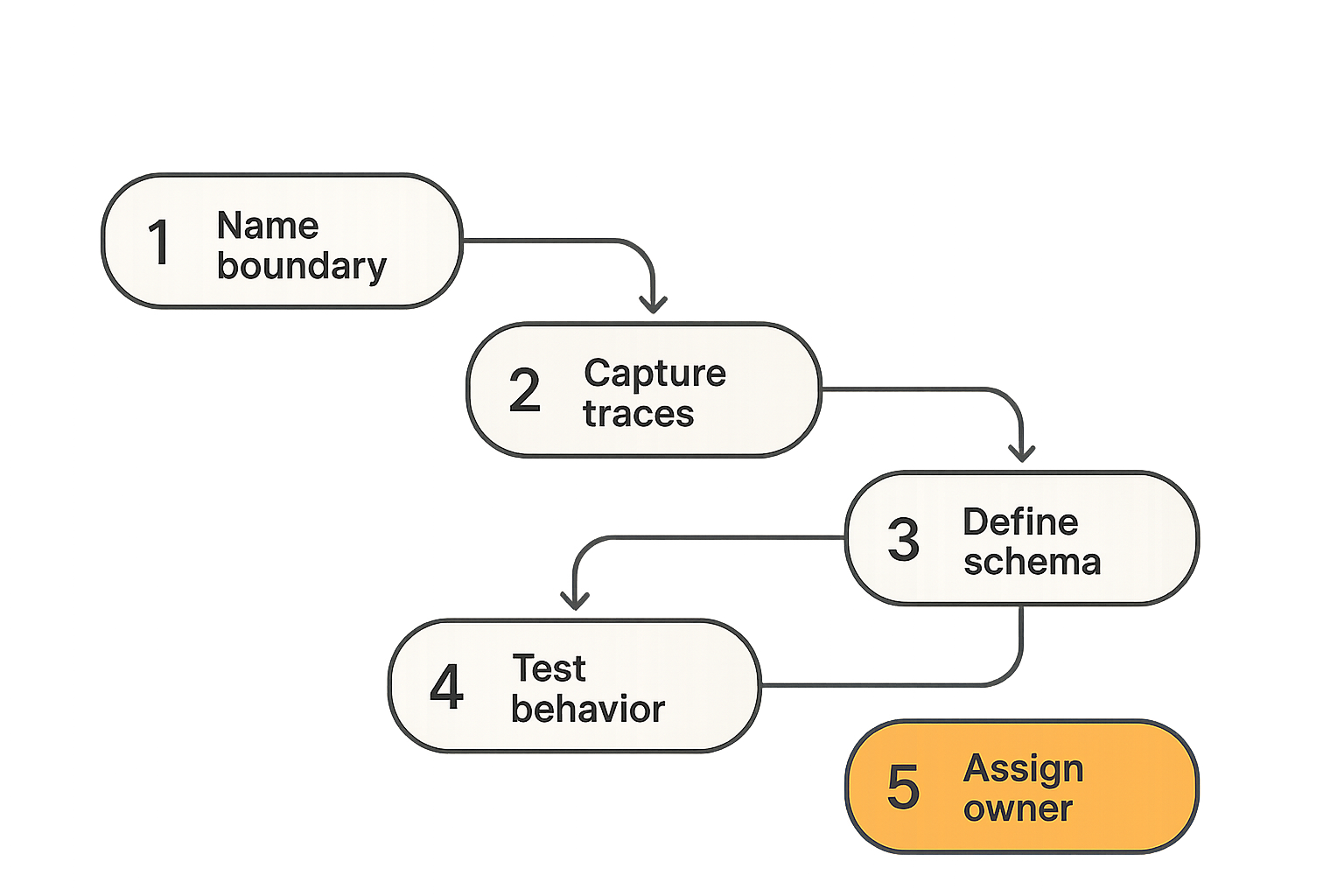
A workflow for standardizing without freezing the product
Platform teams need to standardize carefully. Too much process kills shipping. Too little agreement creates an integration swamp.
A practical sequence looks like this:
- Name the coordination boundary. Decide whether the problem is identity, capability discovery, events, credentials, payments, state, or audit.
- Capture real payloads and traces. Do not standardize imaginary flows. Use production-like examples from multiple implementations.
- Separate semantics from shape. Define meanings before locking field names.
- Publish a small schema. Validate the smallest useful payload, not the whole future roadmap.
- Create a profile for one workflow. Pick a concrete path such as “agent invokes hosted plugin with delegated credential.”
- Add compatibility tests. Test behavior, unknown fields, errors, retries, and version negotiation.
- Document migration rules. Explain deprecation, extension, and compatibility before adoption grows.
- Assign ownership. Someone must triage issues, approve changes, and maintain examples.
This is also where local development matters. Teams building agent runtimes, MCP servers, and credential flows need repeatable toolchains so they can test standards before shipping them. The patterns in our guide to Mac tools for AI agent builders apply here: local runtimes, credentials, events, and validation need to be exercised together, not in isolated demos.
What breaks when standards are implemented badly
Failure mode one semantic drift
Semantic drift happens when the same word keeps its spelling but changes meaning across implementations.
A provider says “agent.” Another means “model.” A third means “workflow runner.” One system says “user approved,” but it only recorded that a prompt was displayed. Another says “credential delegated,” but it actually copied a long-lived token into a plugin environment.
The result is quiet incompatibility. Nothing crashes immediately. Logs look plausible. Dashboards populate. Then a customer asks who authorized an action, or why an agent spent money, or why a revoked credential still worked.
Semantic drift is harder to debug than schema failure because the payloads are valid. The meaning is wrong.
Failure mode two unowned compatibility
Unowned compatibility is what happens when everyone supports a standard “in principle” but no one owns conformance.
You get optional fields that are effectively required. You get SDKs that normalize away important differences. You get examples that do not match the schema. You get old clients that accept new fields but ignore security-relevant semantics.
What works is boring ownership: test fixtures, version matrices, changelogs, negative test cases, and deprecation windows. What fails is assuming that open source adoption automatically produces interoperability.
Related reading from our network: local network operators run into the human version of this same problem when intake, routing, and follow-up are not owned; the coordination model in community-first local networks is a useful adjacent comparison.
Failure mode three agent behavior without audit
Agent systems without audit trails are difficult to trust. Standards that ignore auditability are incomplete.
For every meaningful agent action, production systems should be able to answer:
- Who or what initiated the action?
- Which human, organization, or policy authorized it?
- Which tool or plugin executed it?
- Which credentials were used?
- What inputs and outputs mattered?
- What changed in external systems?
- Was the action retried, reversed, escalated, or approved?
If the standard only covers a tool call payload, it misses the operational story. The agent may function, but the platform cannot investigate, reconcile, support, or govern it.
Practical rule: If an agent action can affect money, data, access, or customer trust, the standard must include audit context.
What works in production
Treat standards as lifecycle objects
A standard-like object needs a lifecycle. It should be proposed, tested, versioned, adopted, deprecated, and sometimes removed.
For developer tool builders and open source maintainers, that means keeping the artifact small enough to maintain. A 90-page specification with no test suite is less useful than a short profile with validators, examples, and real integration traces.
What works:
- A glossary that names terms precisely.
- Machine-readable schemas with human-readable semantics.
- Example payloads from real workflows.
- Compatibility tests that vendors can run locally.
- Clear extension points.
- A public issue process for ambiguity.
- Migration notes for every breaking change.
What fails:
- Treating documentation as enforcement.
- Publishing schemas without behavioral expectations.
- Allowing optional fields to carry required meaning.
- Encoding security policy in examples only.
- Letting SDK convenience functions hide protocol errors.
Validate behavior, not just payloads
Payload validation catches malformed messages. It does not prove that the system behaves correctly.
For agent standards, behavioral validation should cover state transitions and negative paths. If a credential expires, does the agent stop? If a tool call fails after partial execution, what event is emitted? If a user revokes approval during a workflow, which participant owns cancellation? If a payment authorization succeeds but settlement fails, how is the workflow reconciled?
This is where test harnesses matter. A conformance suite should not only parse JSON. It should simulate real sequences:
1. discover capability
2. request delegated credential
3. receive scoped grant
4. invoke tool
5. emit audit event
6. revoke grant
7. verify future invocation fails
That sequence tells you more than a static schema. It proves that the standard has runtime teeth.
Where logicsrc.com fits
An open standards surface for agent coordination
LogicSRC is not trying to make “standard” mean one thing. That would be the wrong abstraction.
The better approach is to provide an open surface for the different synonyms of standards that agent systems actually need: schemas for shape, primitives for shared objects, conventions for early coordination, profiles for interoperable workflows, and audit-friendly patterns for production systems.
This matters because AI agent interoperability is not a single endpoint. It is a stack of agreements across identity, coordination, agents, payments, events, credential sharing, MCP, and hosted products. Each layer needs the right level of strictness. Each layer needs migration. Each layer needs enough operational context for humans and systems to trust the result.
The practical question for platform architects is simple: where are your agents making assumptions that another system cannot verify? That is where you need a stronger agreement.
Synonyms of standards are useful only when they help you choose that agreement. Use a specification when meaning is unstable. Use a protocol when interaction order matters. Use a schema when payload shape needs validation. Use a convention when coordination should stay lightweight. Use a profile when broad standards are too loose. Use a primitive when everyone is rebuilding the same foundation.
Try logicsrc.com
logicsrc.com is for developers and platform teams building interoperable AI agent systems, SDKs, plugins, and hosted products. If you are turning synonyms of standards into real agent architecture, Try logicsrc.com.