Synonyms of Standards in AI Agent Systems: Specs, Protocols, Schemas, Contracts, and Conventions

Teams building agent platforms run into a strange problem: everyone says they support standards, but nobody means the same thing by standard.
One team ships a JSON schema and calls it a protocol. Another publishes a document and calls it a contract. A plugin ecosystem relies on naming conventions, then acts surprised when third-party tools interpret those conventions differently. The UI demo works. The integration surface does not.
Teams think the problem is finding the right synonyms of standards. The real problem is deciding which coordination mechanism belongs at each boundary of an AI agent system.
That changes the conversation. In 2026, agent systems are not single products. They are tool calls, identity grants, model contexts, payment events, hosted plugins, workflow runners, and audit logs stitched together by platform teams that rarely control every component. The practical question is not what word sounds most standard. The practical question is what must be stable, testable, versioned, and enforceable.
Table of contents
- Why synonyms of standards matter in agent systems
- Standards synonyms are not interchangeable
- Contracts profiles and conventions in practice
- A working vocabulary for open agent architecture
- Where synonym confusion breaks production systems
- Implementation workflow for standards language
- What works when building interoperable agent surfaces
- What fails in open standards programs
- Metrics that tell you the vocabulary is working
- How LogicSRC fits the standards layer
- Closing checklist for synonyms of standards
Why synonyms of standards matter in agent systems
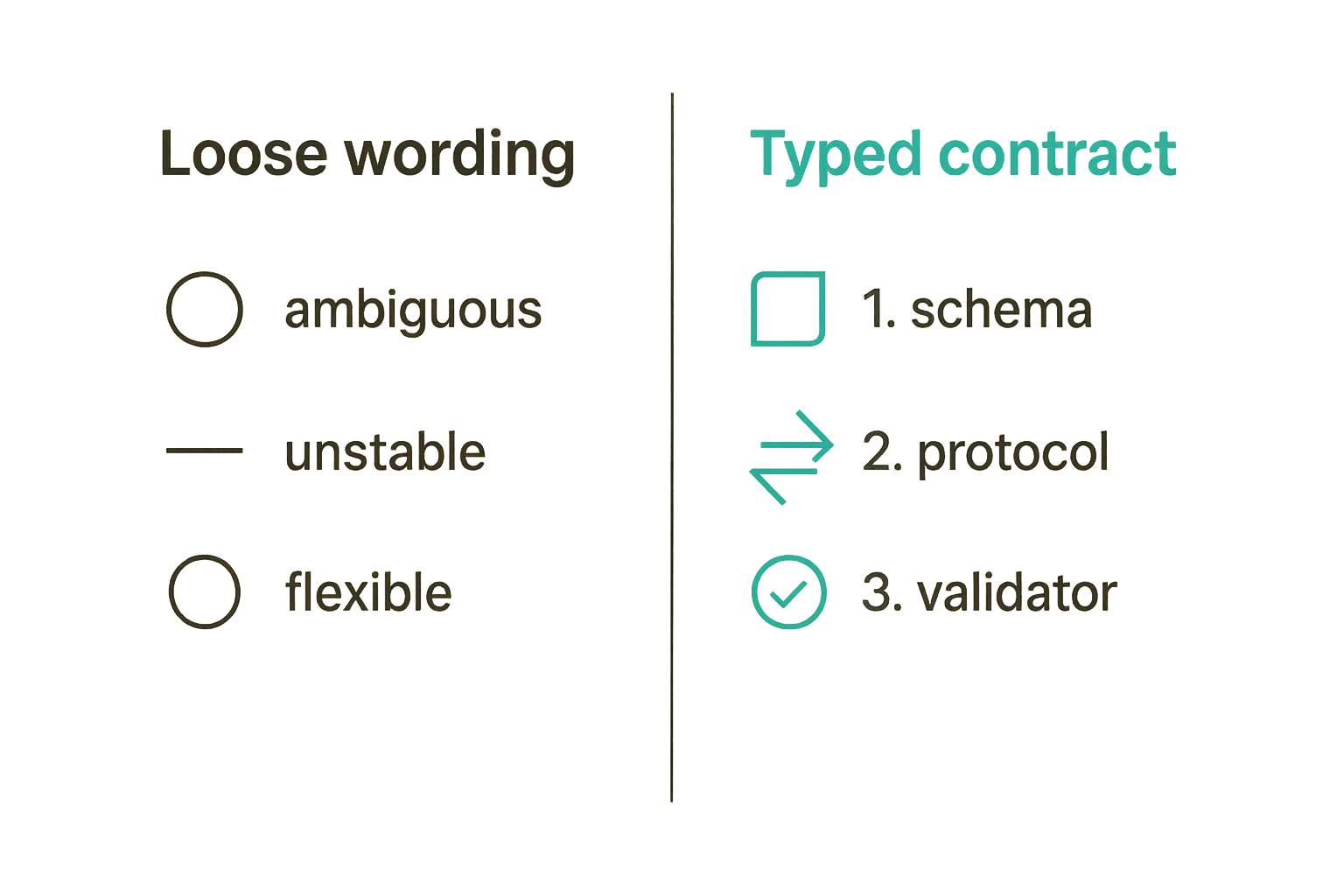
AI agent architecture turns vocabulary into runtime behavior. A human can read ambiguous documentation and ask a follow-up question. An agent usually cannot. It receives a tool description, policy hint, context object, credential envelope, event payload, or model context resource and proceeds based on whatever structure is available.
The mistake teams make is treating synonyms of standards as editorial choices. They are not. In an agent ecosystem, the word you choose usually implies who implements something, how breakage is detected, and whether a downstream builder can trust the surface.
If you call something a standard, maintainers expect stability. If you call it a draft spec, they expect change. If you call it a convention, they expect flexibility. If you call it a contract, they expect compatibility promises. Those expectations become real support costs.
The naming problem shows up as runtime drift
Runtime drift is what happens when two systems appear compatible in documentation but diverge during execution. In agent systems, drift can be subtle:
- A tool returns
pendingwhile the caller expectsqueued. - A plugin interprets
user_approvedas consent for one action, while the host treats it as consent for a workflow. - A credential handoff includes scope names but not expiration semantics.
- An event stream sends retries without idempotency keys.
- A model context adapter exposes a resource but omits freshness metadata.
None of these are philosophical problems. They are production problems. They create failed tool calls, unsafe automation, duplicate actions, broken audits, and support threads that begin with the phrase: we followed the standard.
Vocabulary becomes an integration boundary
A useful way to think about it is that vocabulary is part of your API surface. Not because words are magic, but because teams use words to decide what to build against.
When you publish a specification, you are saying there is testable intent. When you publish a protocol, you are saying interaction order matters. When you publish a schema, you are saying shape and validation matter. When you publish a convention, you are saying social alignment matters more than enforcement. When you publish a contract, you are saying downstream dependencies deserve compatibility guarantees.
That is why a vocabulary mismatch creates engineering mismatch. One side builds a validator. Another side builds a best-effort parser. One side assumes semantic versioning. Another side edits examples in place.
Practical rule: If a term changes implementation behavior, treat the term as part of the interface, not as documentation decoration.
The practical question is ownership
Every standards synonym implies an owner. Specs need editors. Protocols need compatibility testing. Schemas need validation suites. Contracts need change control. Conventions need community stewardship.
When nobody owns the word, nobody owns the failure mode.
For agent platforms, ownership matters because the same interaction often crosses multiple control planes: model provider, agent runtime, plugin host, identity provider, payment processor, workflow orchestrator, and product UI. A vague standard becomes an argument across organizations.
Standards synonyms are not interchangeable
The phrase synonyms of standards is useful only if it makes teams more precise. If it turns into a thesaurus exercise, it makes architecture worse.
Here is the comparison most platform teams need before they publish anything.
| Term | Best use | Artifact | What breaks if misused |
|---|---|---|---|
| Specification | Describing expected behavior | Versioned document plus tests | Implementers interpret intent differently |
| Protocol | Coordinating message order | State machine, wire format, examples | Systems send valid messages at invalid times |
| Schema | Validating data shape | JSON Schema, Protobuf, OpenAPI, Zod | Payloads parse but semantics drift |
| Contract | Managing dependencies | Compatibility policy, SLA, changelog | Consumers break without warning |
| Profile | Narrowing options | Conformance subset | Implementers support incompatible subsets |
| Convention | Aligning behavior loosely | Naming rules, examples, guidance | Informal rules become hidden requirements |
| Standard | Stabilizing a shared surface | Governance, tests, versions, adoption path | Early drafts are treated as permanent law |
Related reading from our network: teams dealing with public storage face similar boundary problems when a bucket is treated as a setting instead of a workflow surface in this security public storage CI/CD workflow guide.
Specification means testable intent
A specification should answer what must happen, what must not happen, and how an implementation can prove it. It can be written in prose, but prose is not enough once adoption grows.
For AI agent systems, a good spec usually includes:
- Terminology with narrow meanings.
- Required and optional fields.
- State transitions.
- Error behavior.
- Security assumptions.
- Example requests and responses.
- Conformance tests or fixtures.
The mistake teams make is publishing a long document and calling it done. A spec without tests is a negotiation starter, not an interoperability layer.
Protocol means ordered interaction
A protocol is not just a schema with more pages. A protocol describes how participants interact over time.
Agent systems need protocols anywhere ordering matters:
- Tool invocation and cancellation.
- Consent request, approval, execution, and revocation.
- Payment authorization, capture, settlement, and refund.
- Credential issuance, presentation, verification, and expiration.
- Event subscription, delivery, retry, and acknowledgement.
What breaks in practice is that teams validate each message independently and forget the conversation. The payload is valid, but the sequence is wrong.
Practical rule: Use protocol when timing, retries, state transitions, or acknowledgements are part of correctness.
Schema means shape and validation
A schema defines structure. It is the right artifact when systems need to agree on field names, types, required properties, enum values, and basic constraints.
Schemas are powerful because they are machine-checkable. They are also limited. A schema can tell you that amount is a number. It cannot fully tell you whether the amount is authorized, settled, refundable, or safe for an agent to act on.
That means schemas should be paired with semantic rules. For example:
payment_event:
  type: object
  required:
    - event_id
    - merchant_id
    - state
    - occurred_at
  states:
    allowed:
      - authorized
      - captured
      - settled
      - refunded
  operational_rules:
    - event_id must be idempotent across retries
    - settled cannot occur before captured
    - refunded must reference a previous capture
The schema gives parsers a floor. The rules give operators a system.
Contracts profiles and conventions in practice
Contracts, profiles, and conventions are often treated as weaker words than standards. That is only partly true. They are weaker in formal governance, but sometimes stronger in daily implementation because they describe how real teams coordinate.
A standard may be the destination. A contract, profile, or convention is often the path that gets working software there.
Contract means dependency management
A contract exists when another team depends on your behavior. It may be formal, legal, technical, or operational. In platform engineering, the most useful contracts are usually compatibility contracts.
A contract should say:
- Which versions remain supported.
- Which fields can be added without breaking consumers.
- Which fields can be removed only in a major release.
- How deprecations are announced.
- What error behavior clients can rely on.
- What uptime, latency, or retry assumptions are reasonable.
Contracts matter in agent ecosystems because agents compose across surfaces. A plugin host may depend on a credential provider. A workflow engine may depend on a payment event. A marketplace may depend on plugin metadata. Break one contract and the failure is rarely local.
Profile means a constrained implementation choice
Profiles are underrated. A profile says: the broader standard has many options, but this product, ecosystem, or deployment supports this subset.
That changes the conversation for open source maintainers. You do not need every implementation to support every optional feature on day one. You need implementers to declare which subset they support and how others can detect it.
Profiles work well for:
- Minimal agent tool metadata.
- Enterprise identity claims.
- Payment event subsets.
- MCP resource capabilities.
- Plugin permission models.
- Audit log retention requirements.
Without profiles, optionality becomes fragmentation. With profiles, optionality becomes explicit compatibility.
Convention means social coordination
Conventions are useful when enforcement would be too heavy or premature. Naming conventions, directory conventions, metadata conventions, and event naming conventions can help ecosystems move fast.
But conventions are dangerous when they become hidden requirements. If failure to follow a convention breaks integration, it is no longer just a convention. It is a contract or schema pretending to be casual guidance.
Practical rule: A convention is safe only while violations remain survivable. If violations cause runtime failure, promote the convention into a schema, contract, or protocol.
A working vocabulary for open agent architecture
A shared vocabulary should help engineering teams decide what to build, not just what to call it. The goal is not semantic purity. The goal is fewer surprises at integration time.
For a deeper vocabulary primer on specs, protocols, schemas, profiles, contracts, and conventions, see this practical vocabulary primer.
Use one noun per boundary
Start with the boundary, then choose the noun.
A boundary may be:
- Agent to tool.
- Host to plugin.
- Runtime to model context server.
- User to credential issuer.
- Agent to payment rail.
- Workflow engine to audit log.
- Marketplace to developer package.
Do not call all of these standards. Use narrower language:
- Tool input shape: schema.
- Tool call lifecycle: protocol.
- Host compatibility promise: contract.
- Minimal implementation subset: profile.
- Package naming rule: convention.
- Whole ecosystem target: standard.
The practical question is: what does the next team need in order to implement correctly without asking you?
Map each noun to an artifact
A term should map to something maintainable. If it does not, you have a naming layer without an operations layer.
Good mappings look like this:
| Boundary | Term | Artifact | Owner |
|---|---|---|---|
| Agent tool input | Schema | Versioned schema file and fixtures | SDK team |
| Consent workflow | Protocol | State machine and conformance tests | Identity team |
| Plugin compatibility | Contract | Compatibility policy and changelog | Platform team |
| Enterprise deployment | Profile | Required subset document | Solutions team |
| Event naming | Convention | Naming guide and linter | Developer experience team |
The artifact is what keeps the word honest. Without an artifact, the word standard becomes a badge.
Treat synonyms as lifecycle stages
In many ecosystems, a surface matures through stages:
- Convention: teams agree informally.
- Schema: the common shape becomes validated.
- Spec: expected behavior is documented.
- Protocol: multi-step interaction becomes defined.
- Profile: subsets become explicit.
- Contract: compatibility promises become operational.
- Standard: governance and adoption stabilize the surface.
Not every surface needs to reach every stage. A log naming convention may never need to become a full standard. A credential exchange protocol probably does.
A useful way to think about it is maturity by blast radius. The more downstream systems depend on a behavior, the more formal the artifact should become.
Where synonym confusion breaks production systems
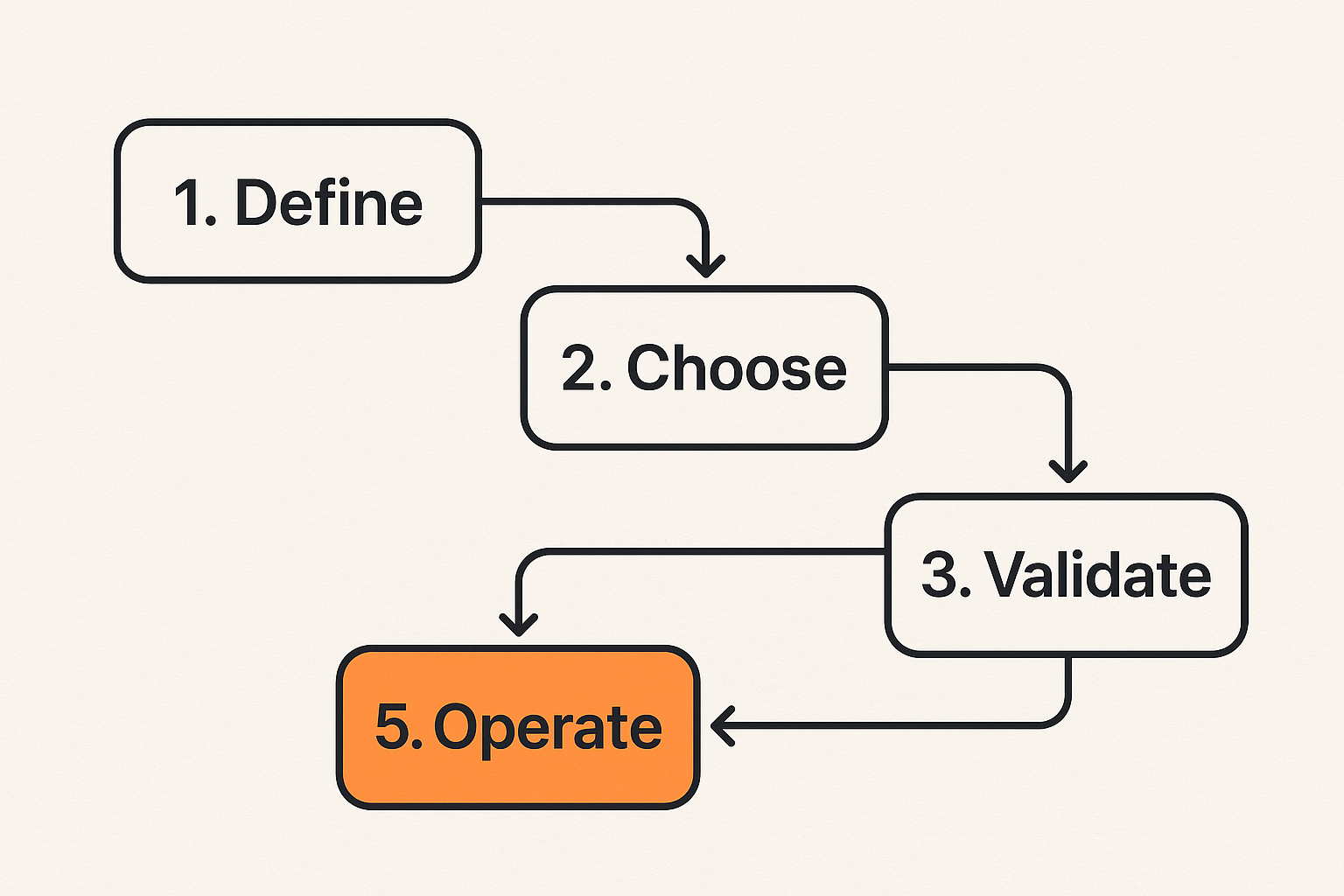
The cost of fuzzy terminology is not a bad glossary. The cost is production ambiguity.
Agent systems are particularly sensitive because they automate decisions across boundaries. A user clicking a button can notice missing context. An agent executing a workflow may silently proceed with partial context unless the surface forces a safe failure.
Agents call tools with different assumptions
Tool calling looks simple in demos. In production, the caller and callee need agreement on much more than parameter names.
They need agreement on:
- Whether the call is read-only or mutating.
- Whether the operation is reversible.
- Whether user consent is required per call or per workflow.
- Whether results are final or provisional.
- Whether retries are safe.
- Whether the tool can return partial success.
- Whether the agent should expose raw errors to users.
If these are described as conventions but treated as guarantees, integrations fail. If they are described as schema fields but not enforced semantically, agents misbehave.
Plugins drift faster than documentation
Plugin ecosystems drift because developers optimize for local success. They add optional fields. They change example payloads. They introduce new permission names. They expand enum values. None of this is malicious. It is normal product development.
The problem is that documentation often lags the ecosystem. If a platform calls the documentation a standard but does not provide validators, version negotiation, or conformance fixtures, the word standard gives false confidence.
Related reading from our network: product teams selling digital goods hit a similar issue when checkout is treated as the product instead of delivery, support, and reconciliation; see this practical system for selling digital products.
Hosted products inherit support tickets
Hosted agent products sit at the end of other people’s ambiguity. If a plugin returns an unexpected event, the hosted product gets the user complaint. If a credential provider changes a scope, the hosted product gets the failed workflow. If a payment event is duplicated, the hosted product gets the reconciliation problem.
This is where synonyms of standards become a business issue. Support teams cannot debug a philosophical distinction between a spec and a convention. They need to know which party owns compatibility and what evidence proves compliance.
Implementation workflow for standards language
Most teams need a workflow more than they need a glossary. The workflow below is deliberately operational. It assumes you are building an SDK, plugin platform, hosted agent product, open source project, or developer ecosystem where external implementers matter.
Step 1 define the interaction
Before choosing any standards synonym, describe the interaction in plain engineering terms.
Ask:
- Who sends data?
- Who receives data?
- Is the interaction synchronous or asynchronous?
- Is state carried across calls?
- Can the action mutate customer data?
- Is user consent required?
- Are retries possible?
- Does the receiver need to prove what happened later?
The answer determines whether you need a schema, protocol, contract, profile, or convention.
Step 2 choose the artifact type
Choose the weakest artifact that still makes failures visible.
- Use a convention when breakage is low-risk and human-readable.
- Use a schema when shape mismatch is the primary failure.
- Use a spec when behavior must be understood across teams.
- Use a protocol when ordering and state matter.
- Use a profile when a broad surface needs constrained adoption.
- Use a contract when consumers rely on stability.
- Use a standard when governance, adoption, and long-term compatibility are in scope.
This sequence prevents premature formalism. It also prevents casual language from hiding operational risk.
Step 3 publish validation and examples
Examples are not validation. They are examples.
For developer platforms, publish at least:
- Passing examples.
- Failing examples.
- Versioned fixtures.
- A validator or test harness.
- Error codes with remediation notes.
- Change logs tied to artifact versions.
A minimal validation layout might look like this:
standards-surface/
  schemas/
    tool-call.v1.yaml
    event-envelope.v1.yaml
  examples/
    valid-tool-call.yaml
    invalid-missing-consent.yaml
  tests/
    conformance-tool-call.md
    conformance-event-retry.md
  profiles/
    minimal-host-profile.md
    enterprise-audit-profile.md
  changelog.md
This is not bureaucracy. This is how you keep implementers from guessing.
Step 4 assign change control
Change control is where many open standards efforts become real or collapse.
You need answers to basic questions:
- Who can approve changes?
- What requires a major version?
- How long are old versions supported?
- How are deprecations communicated?
- Can experimental fields ship in stable schemas?
- How do implementers report ambiguity?
- Are conformance failures public, private, or both?
Related reading from our network: end-to-end encrypted messaging teams face similar tradeoffs around identity, devices, and operational trust; this architecture guide to end-to-end encrypted messaging is adjacent to agent credential and consent design.
What works when building interoperable agent surfaces
What works is usually less glamorous than the conference talk version. Interoperability improves when teams make compatibility inspectable.
Make compatibility explicit
Compatibility should not depend on reading the source code or asking the maintainer in a chat room. Publish compatibility data in a machine-readable place.
For example:
agent_surface:
  name: example-plugin-host
  supported_profiles:
    - minimal-tooling-v1
    - event-envelope-v1
  protocols:
    tool_call_lifecycle: v1.2
    consent_request: v1.0
  schemas:
    tool_input: v1
    audit_event: v1
  guarantees:
    additive_fields: allowed
    enum_expansion: minor_version_only
    deprecated_versions_supported_for: 180_days
This gives SDKs, marketplaces, and hosted products something concrete to inspect.
Separate identity consent and capability
Agent systems often collapse identity, consent, and capability into one permission string. That works until a workflow crosses tools.
Identity answers who the actor is. Consent answers what the user approved. Capability answers what the system is technically allowed to do. Audit answers what actually happened.
These should be related, but not identical. A user may consent to a workflow without granting a plugin direct access to all downstream resources. An agent may have capability to read a resource but not consent to mutate it. A tool may execute an action but need to emit an audit event for later verification.
This is why precise standards language matters. A credential schema is not the same thing as a consent protocol. A permission convention is not the same thing as an audit contract.
Design for partial adoption
Open ecosystems rarely adopt everything at once. If your standard requires full adoption before any value appears, most teams will route around it.
Design profiles for partial adoption:
- Minimal host profile.
- Read-only tool profile.
- Enterprise audit profile.
- Payments-enabled profile.
- Credential-sharing profile.
- Offline execution profile.
Each profile should define what is required, what is optional, and how support is advertised. This lets builders ship useful interoperability without pretending every deployment has the same risk model.
What fails in open standards programs
Failure usually looks boring. There is a repo. There is a logo. There is a document. There are examples. But integrations still require custom work for every partner.
The mistake teams make is optimizing for announcement value instead of implementation pressure.
Naming everything a standard too early
Calling something a standard can create trust before the surface deserves it. Early designs need room to change. If you label a draft as a standard, implementers may hard-code against it. Then every correction becomes a breaking change.
Use draft, proposal, convention, or experimental profile until the surface has survived real integrations.
Practical rule: Do not call a surface a standard until you can explain its governance, conformance path, versioning policy, and adoption boundary.
Shipping prose without validators
Prose is necessary. Prose is not sufficient.
If a standard affects runtime behavior, implementers need machines to check their work. Validators do not need to cover every semantic edge case on day one, but they should catch common failures:
- Missing required fields.
- Invalid state transitions.
- Unsafe retries.
- Unknown enum behavior.
- Missing idempotency keys.
- Unsupported profile claims.
- Deprecated version usage.
Without validators, support becomes the validator. That is the most expensive validator you can build.
Ignoring operational feedback
Open standards programs sometimes separate the standards group from the people handling incidents, support tickets, SDK bugs, and partner onboarding. That separation is expensive.
Operational feedback tells you which ambiguities matter. If three teams misunderstand a field, the field is not clear. If support keeps asking whether a workflow is idempotent, the protocol needs to say it. If SDK maintainers implement the same workaround, the contract is incomplete.
Standards work should have an issue intake path from production. Otherwise the document gets cleaner while the ecosystem gets messier.
Metrics that tell you the vocabulary is working
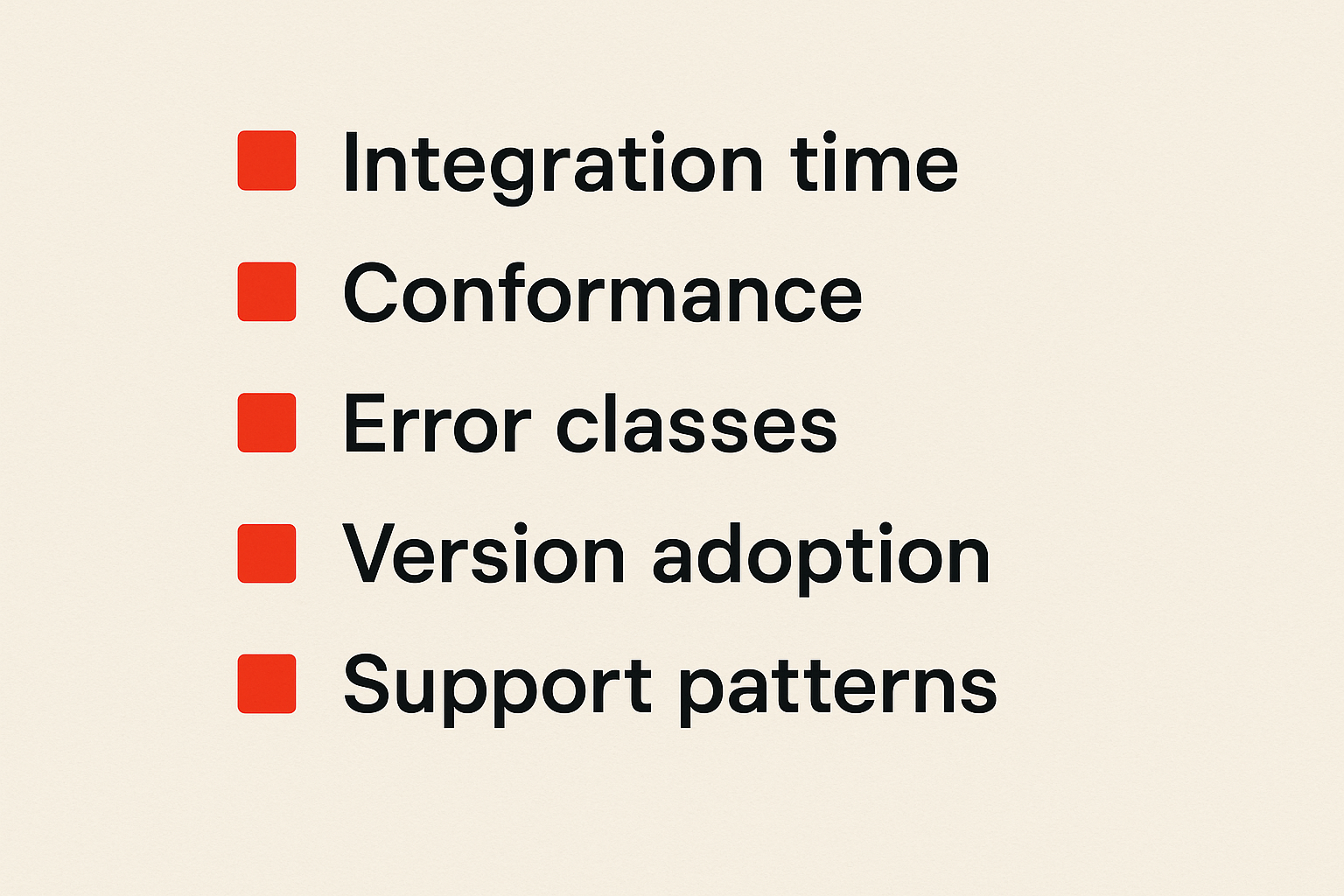
You do not need invented vanity metrics. You need signals that show whether your terminology is reducing integration ambiguity.
Integration time and rework
Track how long it takes a new implementer to build against the surface and how much rework happens after first integration.
Useful signals include:
- Time from first docs visit to successful test call.
- Number of clarification questions per implementer.
- Number of conformance failures before passing.
- Number of custom partner exceptions.
- Number of SDK patches caused by ambiguous docs.
If those numbers move in the right direction, your vocabulary and artifacts are doing real work.
Error classes and support patterns
Classify errors by standards artifact:
| Error class | Likely artifact gap | Fix |
|---|---|---|
| Missing field | Schema | Add validation and better examples |
| Wrong sequence | Protocol | Publish state machine tests |
| Unsupported subset | Profile | Add capability discovery |
| Breaking change | Contract | Improve version policy |
| Naming mismatch | Convention | Add linter or promote to schema |
| Unsafe action | Consent spec | Separate identity, consent, and capability |
This helps avoid the generic response: improve the docs. Sometimes docs are not the problem. Sometimes the wrong artifact owns the failure.
Version adoption and deprecation
Version adoption is where standards language meets reality. If old versions never go away, contracts are too weak. If new versions break consumers, change control is too aggressive.
Track:
- Active implementations by version.
- Deprecated version traffic.
- Conformance pass rates by SDK version.
- Percentage of events missing required metadata.
- Number of integrations pinned to experimental fields.
The goal is not forced uniformity. The goal is controlled evolution.
How LogicSRC fits the standards layer
LogicSRC is aimed at the layer where agent systems need shared primitives more than another closed platform. The LogicSRC coordination surface is about open schemas, primitives, and conventions for coordination between humans, AI agents, plugins, payment systems, and hosted products.
That is product language, but the architecture point is specific: agent interoperability needs stable surfaces for identity, coordination, events, credential sharing, payments, MCP, and auditable workflows.
Open primitives for coordination
A platform team should not have to reinvent the vocabulary of coordination for every product. The primitives that matter tend to repeat:
- Actor identity.
- Delegated authority.
- Consent request and approval.
- Tool capability declaration.
- Event envelope.
- Audit evidence.
- Payment state.
- Credential presentation.
- Workflow handoff.
Each primitive needs the right artifact. Some are schemas. Some are protocols. Some are profiles. Some begin as conventions. The important part is making the boundary explicit enough that builders can implement without private negotiation.
Credential sharing and auditable workflows
Credential sharing is a good example because the words matter. A credential format is not the same thing as a sharing protocol. A sharing protocol is not the same thing as a consent contract. An audit event schema is not the same thing as an evidence policy.
If you are designing agent workflows that need scoped exchange between humans, agents, plugins, and products, the credential sharing primitives are the kind of surface where standards synonyms need to map to implementation artifacts.
What breaks in practice is treating credential sharing as a single object. In production, it is a workflow:
- The actor requests access.
- The user or policy grants scoped authority.
- The credential is presented to a receiver.
- The receiver validates issuer, scope, freshness, and audience.
- The action is executed or denied.
- The workflow emits audit evidence.
Different parts of that workflow need different standards artifacts.
Where a platform team should start
Start with the highest-friction boundary in your ecosystem. Do not start by standardizing everything.
For many agent teams, the first useful surface is one of these:
- Tool call lifecycle.
- Consent and delegation.
- Event envelope for workflow state.
- Credential presentation.
- Plugin capability declaration.
- Audit log format.
- Payment state handoff.
Pick one. Define the interaction. Choose the artifact type. Publish examples and validators. Assign ownership. Then expand.
That approach is less dramatic than announcing a universal agent standard. It is also more likely to survive contact with real implementers.
Closing checklist for synonyms of standards
The closing point is simple: synonyms of standards are not interchangeable labels. They are operating decisions for interoperability.
Use the checklist before naming any new agent surface.
Decide the job before the label
Ask what job the artifact must do:
- Does it describe intent? Use a specification.
- Does it coordinate messages over time? Use a protocol.
- Does it validate data shape? Use a schema.
- Does it promise compatibility? Use a contract.
- Does it narrow optionality? Use a profile.
- Does it align behavior informally? Use a convention.
- Does it need governance and long-term adoption? Use a standard.
If the answer is multiple jobs, split the surface. One artifact should not pretend to do everything.
Keep the label tied to operations
The label should tell teams how to operate the surface:
- Who owns it.
- How it is tested.
- How it changes.
- How compatibility is discovered.
- How failures are reported.
- How deprecations happen.
- How implementers prove conformance.
When synonyms of standards are tied to operations, they reduce ambiguity. When they are used as branding, they create it.
Try logicsrc.com
You are writing for developers and platform teams building interoperable AI agent systems, SDKs, plugins, and hosted products. Try logicsrc.com.