Synonyms of Standards in AI Agent Systems: Specs, Protocols, Schemas, Contracts, and Conventions

Teams building agent platforms keep running into the same argument: what should be standardized first?
Someone asks for a protocol. Someone else wants a schema. A platform team says they need a contract. An open source maintainer says the community only needs conventions. The word choice sounds cosmetic until two agents cannot exchange credentials, a plugin breaks after a minor release, or a hosted product cannot explain why an automated payment was triggered.
Synonyms of standards matter because AI agent systems are becoming distributed systems with memory, identity, tools, payments, and delegated authority. Teams think the problem is terminology. The real problem is choosing the wrong interoperability surface for the job.
That changes the conversation. The practical question is not whether a spec, protocol, schema, contract, profile, or convention is the official synonym of a standard. The practical question is which one reduces ambiguity at the boundary where independent teams, agents, SDKs, and products must coordinate.
Table of contents
- Why synonyms of standards are architecture decisions
- A working taxonomy for agent builders
- Where each synonym belongs in the stack
- Comparison table: standard-like terms in practice
- Design workflow for choosing the right standard surface
- Common failure modes when teams standardize badly
- Governance, versioning, and ownership
- Testing standards with agent workflows
- How open standards should handle trust
- Where LogicSRC fits
Why synonyms of standards are architecture decisions
The vocabulary hides different failure modes
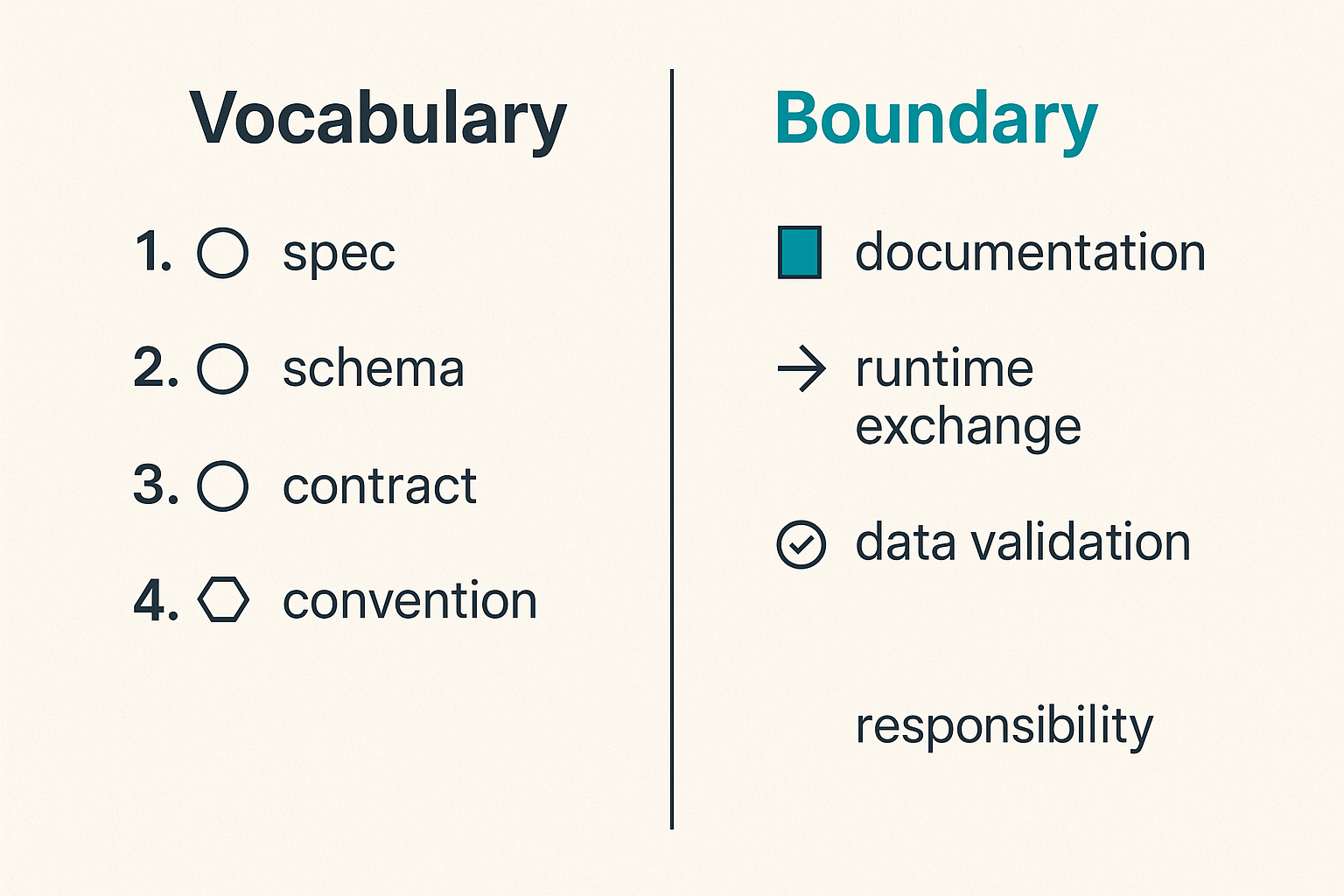
The mistake teams make is treating synonyms of standards as interchangeable labels. In meetings, spec, protocol, schema, contract, interface, convention, profile, and guideline often get used as if they point to the same artifact.
They do not.
A schema can tell you that an agent event has a field named actor_id. It cannot tell you whether the receiver must process the event before sending a response. A protocol can define the order of messages, retries, and acknowledgements. It may still rely on a schema for payload shape. A contract can define obligations between systems or organizations. A convention may only define a default naming pattern that helps humans and SDKs avoid confusion.
What breaks in practice is not the dictionary. What breaks is the integration.
The boundary decides the word
A useful way to think about it is this: the right term depends on the boundary you are trying to stabilize.
If the boundary is documentation, you probably need a specification. If the boundary is runtime exchange, you need a protocol. If the boundary is data validation, you need a schema. If the boundary is responsibility, you need a contract. If the boundary is ecosystem behavior, you may need a convention or profile.
For adjacent background, LogicSRC has already covered synonyms of standards in AI agent systems as a vocabulary problem. This article treats the same vocabulary as an implementation problem.
The cost of being vague
Vague standards create delayed failures. The system appears to work in demos because one team controls both sides. Then another SDK ships, a plugin author reads the docs differently, or a hosted agent starts retrying an operation that was never designed to be idempotent.
Practical rule: if two independent implementers cannot build compatible behavior from the artifact, you do not have a standard yet. You have a note.
That does not mean every standard-like artifact must be heavy. It means the artifact must match the coordination risk.
A working taxonomy for agent builders
Specs describe expected behavior
A specification is the broadest useful artifact. It explains behavior, terminology, data structures, error handling, security assumptions, and extension rules. Good specs are readable by humans and testable by machines.
In agent systems, a spec might define how an agent advertises capabilities, how a tool describes side effects, or how a workflow records delegated approval. The spec is where you explain intent and constraints.
The practical question is whether the spec is normative. Words like must, should, and may matter. If every sentence is optional, downstream implementers will create incompatible interpretations and still claim compliance.
Protocols coordinate live interaction
A protocol defines interaction over time. It answers questions like: who speaks first, what messages are allowed, how are errors returned, what happens on timeout, and when is state considered committed?
Agent protocols matter because agent work is not a single request-response call anymore. An agent may negotiate tool access, request credentials, ask for human approval, perform payment authorization, emit events, and resume later.
Related reading from our network: teams dealing with public infrastructure face similar workflow-first constraints in security public storage CI/CD workflow, where the control surface matters more than the storage label.
Schemas structure data exchange
A schema defines shape. It can validate that required fields exist, types match, enums are known, and nested objects are structured correctly.
Schemas are essential because LLM-facing systems are prone to soft ambiguity. If a tool call accepts amount, currency, recipient, and authorization_reference, the schema should not leave those fields as polite suggestions.
But schemas are not enough. A schema does not define replay protection, sequencing, consent, rate limits, or settlement timing. Those belong elsewhere.
Where each synonym belongs in the stack
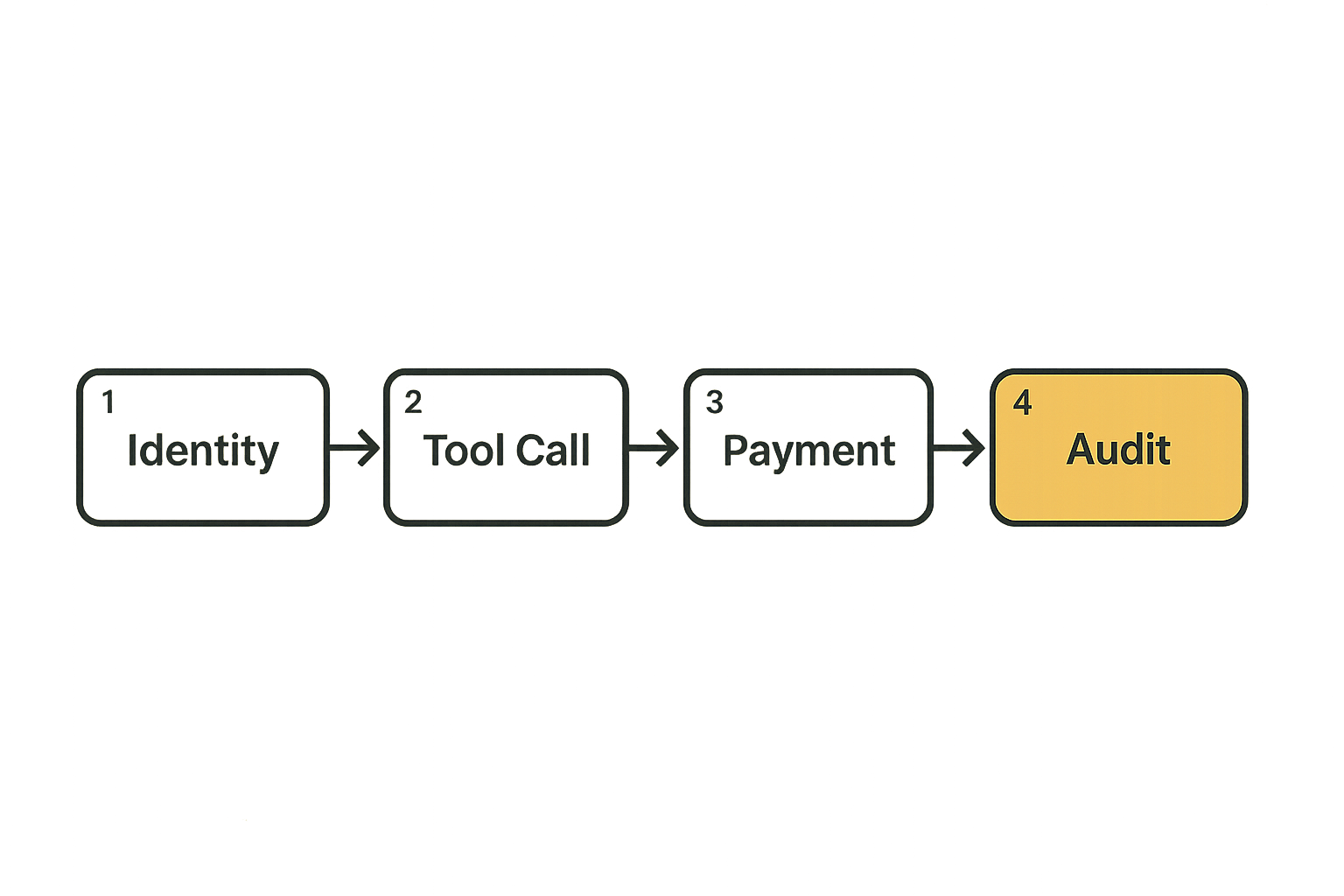
Identity and capability boundaries
Agent systems need a way to describe who or what is acting. Is the actor a human, an autonomous agent, a delegated sub-agent, a hosted plugin, or an organization-owned service account?
This boundary usually needs a mix of schema, protocol, and contract. The schema structures identity claims. The protocol handles credential presentation. The contract defines what the relying party is allowed to assume.
If you only standardize the token format, you miss the operational question: who is accountable when the agent acts?
Tool calls, events, and state changes
Tool interfaces are where many agent standards fail first. A tool call looks simple until it changes state. Reading a calendar is not the same as booking a meeting. Quoting a price is not the same as charging a payment method.
For tool calls, you typically need:
- a schema for arguments and results
- a protocol for retries, cancellations, and asynchronous completion
- a spec for side effect semantics
- conventions for names, descriptions, and examples
Practical rule: any operation with side effects needs idempotency, authorization context, and audit fields before it needs nicer prose.
Payments, credentials, and audit trails
Payments and credentials expose the weakness of loose standards. A payment event cannot be approximately settled. A credential cannot be vaguely delegated. An audit trail cannot depend on each vendor remembering to log the same thing.
LogicSRC treats credential sharing as a first-class coordination surface because agents need more than secret passing. They need scoped delegation, revocation, evidence, and policy context.
The same applies to payment authorization and agent-mediated escrow. The UI is not the system. State, trust, settlement, and support are the real work.
Comparison table: standard-like terms in practice
How to read the table
The table below is not a dictionary exercise. It is a design tool. Use it when a team says we need a standard and nobody agrees on what artifact should exist.
| Term | Best used for | Strong guarantee | Common misuse |
|---|---|---|---|
| Specification | Human-readable rules and behavior | Shared interpretation | Written without tests |
| Protocol | Message flow and runtime coordination | Interoperable interaction | Reduced to payload examples |
| Schema | Data shape and validation | Structural compatibility | Used as a full behavior model |
| Contract | Responsibilities and obligations | Accountability boundary | Confused with an API interface |
| Interface | Callable surface for software | Implementation integration | Published without lifecycle rules |
| Convention | Ecosystem defaults and naming | Low-friction consistency | Treated as enforceable law |
| Profile | Restricted implementation subset | Practical compatibility | Too many profiles to support |
| Guideline | Advice and recommended practice | Shared direction | Marketed as compliance |
What works
What works is layering. A mature agent capability often needs more than one artifact.
For example, an agent payment flow may use a schema for payment_intent, a protocol for authorization and settlement events, a contract for merchant responsibility, and conventions for event names. Each artifact does a smaller job well.
A useful implementation pattern is to publish a small core and then define profiles. The core contains must-level behavior. Profiles define optional capabilities such as streaming events, offline approvals, or escrow handling.
What fails
What fails is pretending one artifact can cover every concern.
A schema-only standard fails when implementations disagree on timing. A prose-only spec fails when SDK authors need test fixtures. A protocol without a security model fails when an agent can replay or escalate a request. A convention fails when vendors start depending on it without versioning.
Practical rule: the artifact that is easiest to publish is not always the artifact that creates interoperability.
Design workflow for choosing the right standard surface
Step 1: identify the coordination boundary
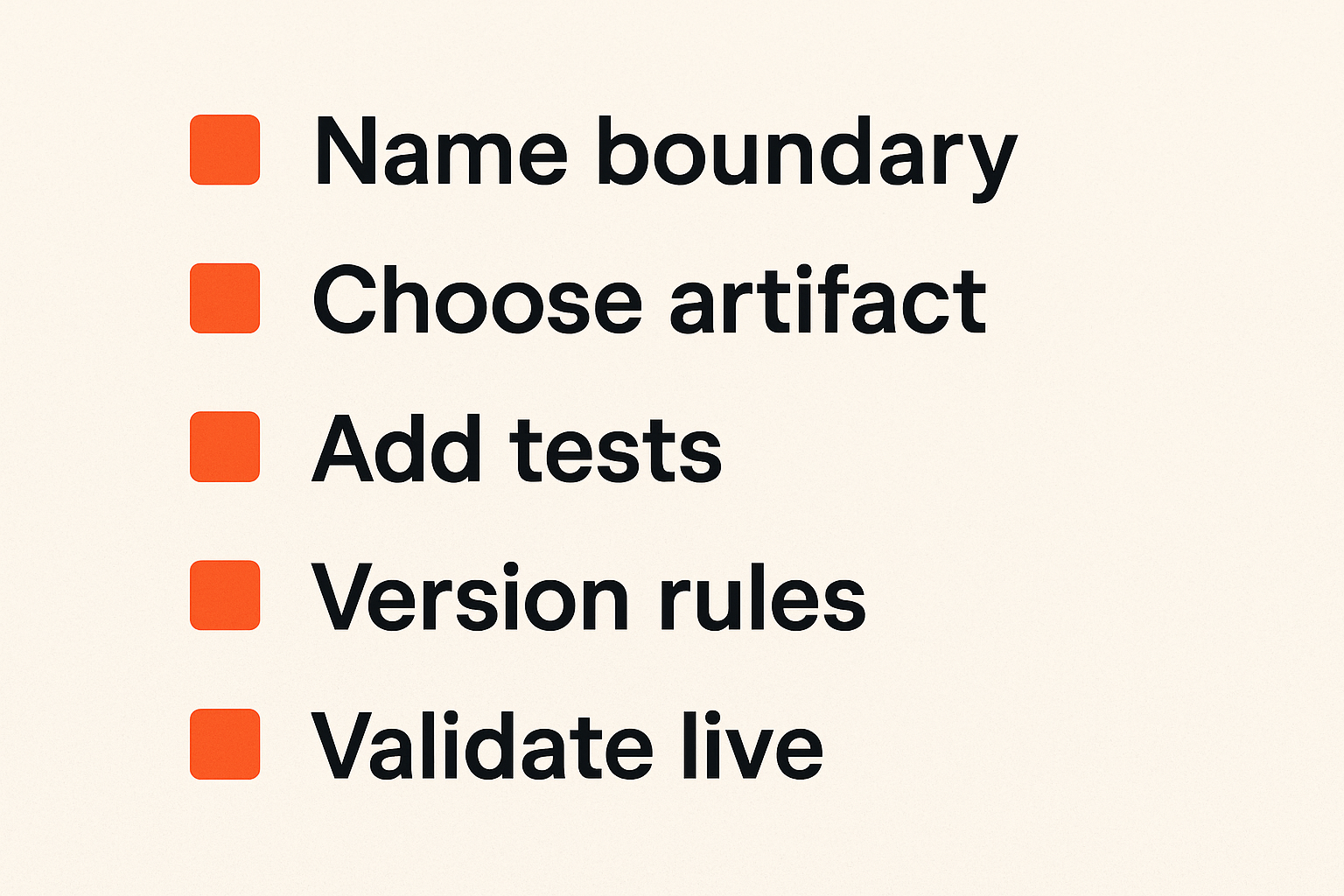
Start by naming the boundary. Do not start with the document type.
Ask:
- Are independent systems exchanging data?
- Are they coordinating over time?
- Is one party relying on another party's claim?
- Is money, identity, permission, or state changing?
- Can a failure create support, security, or legal exposure?
If the answer is only data shape, a schema may be enough. If systems coordinate over time, you need protocol semantics. If one organization depends on another's behavior, you need contract language.
Step 2: define the minimum enforceable artifact
The minimum enforceable artifact is the smallest thing that can be tested, reviewed, and versioned.
A practical sequence looks like this:
- Write the user-visible workflow in plain language.
- Mark every system boundary where state crosses ownership.
- Choose one artifact per boundary: schema, protocol, contract, convention, or profile.
- Add conformance examples for success, retry, rejection, timeout, and duplicate submission.
- Publish a changelog and compatibility policy before broad adoption.
This keeps the standard from becoming either too vague or too large.
Step 3: validate against real integrations
Do not validate a proposed standard against your own SDK only. That proves your implementation agrees with itself.
Run at least two independent implementations. Make one intentionally minimal. Make one production-like. Then compare logs. If the logs do not show the same state transitions, your standard is missing something.
Related reading from our network: the same proof-before-scale pattern shows up in AI-assisted freelance workflow design, where credible delivery depends on repeatable artifacts rather than claims.
Common failure modes when teams standardize badly
The PDF standard nobody implements
Many teams publish a long document and call the problem solved. The document may be accurate, thoughtful, and impossible to implement consistently.
The failure is usually lack of executable examples. Developers need canonical fixtures, expected outputs, error cases, and compatibility tests. Open source maintainers need to know which parts are required and which parts are advisory.
If the only source of truth is a PDF, every SDK becomes its own interpretation engine.
The schema that pretends to be a protocol
This is common in agent tooling. A team publishes JSON schemas for messages and assumes interoperability is handled.
Then receivers disagree about ordering. Senders retry unsafe operations. One SDK treats missing fields as defaults. Another rejects them. A third accepts stale authorization because the schema allowed the field.
Schemas are valuable, but they are static. Protocols are temporal. Conflating them creates production bugs that look like random integration issues.
The convention that becomes a hidden dependency
Conventions are useful when they reduce friction without pretending to be law. Naming conventions, folder layouts, event prefixes, and capability labels can help ecosystems move quickly.
The problem starts when a convention becomes a hidden dependency. A vendor assumes every tool named charge_customer has the same semantics. An agent routes sensitive actions based on a description string. A marketplace ranks compatibility based on optional metadata.
At that point, the convention should be promoted into a schema, profile, or protocol rule.
Governance, versioning, and ownership
Version the boundary, not the brand
Versioning should track compatibility at the boundary. A new website, repo, or working group name does not necessarily change the standard. A changed retry rule, field meaning, or authorization requirement does.
Use semantic versioning only if the ecosystem understands what breaking means. For standards, breaking usually means an implementation that was compliant yesterday can no longer interoperate without changes.
Related reading from our network: even in consumer media stacks, the architecture problems around interoperability and support show up in information technology for cord cutters, where formats, devices, networks, and workflows all collide.
Separate extension points from core guarantees
Open standards need extension points. Without them, vendors fork. With too many, compatibility becomes fictional.
A practical pattern is:
- keep the core small and mandatory
- define reserved namespaces
- require unknown-field handling rules
- publish extension registration conventions
- separate experimental extensions from stable profiles
This lets builders innovate without turning every integration into a negotiation.
Assign operational owners
A standard without ownership decays. Someone must triage issues, review extensions, maintain test fixtures, publish deprecation notices, and answer implementer questions.
This does not require centralized control over the ecosystem. It requires visible process. If nobody owns compatibility, compatibility becomes accidental.
Practical rule: governance is not bureaucracy when production systems depend on the boundary. It is incident prevention.
Testing standards with agent workflows
Conformance tests beat prose
Conformance tests turn ambiguity into engineering work. They also make adoption less political. Instead of arguing whether an implementation feels compatible, teams can run fixtures.
For agent systems, conformance should include:
- valid minimal messages
- valid full messages
- malformed messages
- stale credentials
- duplicate requests
- cancellation after partial completion
- event replay
- unknown extensions
The goal is not to catch every bug. The goal is to make the expected behavior hard to misunderstand.
Use fixtures for hostile edge cases
Agent workflows are messy because agents can be interrupted, delegated, retried, and resumed. Your fixtures should reflect that.
Test what happens when a human approval arrives after a timeout. Test duplicate payment authorization. Test a tool result that arrives after cancellation. Test a credential that is valid structurally but revoked operationally.
If your standard only covers the happy path, production will define the unhappy path for you.
Measure interoperability as a release gate
Interoperability should be part of release management. Before changing an SDK, protocol adapter, plugin runtime, or hosted API, run cross-version tests.
Useful release gates include:
- old client to new server
- new client to old server
- minimal implementation to full implementation
- extension-enabled implementation to extension-blind implementation
- recorded production event replay against new parsers
This is where standards stop being aspirational and become operational.
How open standards should handle trust
Trust is not only authentication
Authentication tells you who is presenting. It does not tell you whether the action is allowed, whether consent still applies, whether the delegation scope is correct, or whether the receiver should accept the risk.
Agent standards must model trust as workflow state. That includes identity, capability, consent, policy, proof, auditability, and revocation.
If a hosted agent can call a payment tool on behalf of a user, the standard must capture more than user_id. It must capture why the action is permitted now.
Make delegation explicit
Delegation is one of the hardest parts of agent architecture. A human delegates to an agent. The agent may delegate to a tool. The tool may call another service. Each step changes the trust boundary.
The standard should identify:
- principal
- delegate
- scope
- duration
- allowed actions
- revocation method
- evidence reference
Without explicit delegation, downstream systems either over-trust the agent or block useful automation.
Log decisions, not just requests
Logs that only record HTTP requests are not enough. Agent systems need decision logs: why a tool was allowed, which policy matched, which credential was presented, which approval was used, and which state transition occurred.
This is especially important for auditable workflows. When something goes wrong, support and security teams need a chain of reasoning that maps to the standard. Otherwise every incident becomes archaeology.
Where LogicSRC fits
An open standards surface for agent systems
LogicSRC is for developers and platform teams building interoperable AI agent systems, SDKs, plugins, and hosted products. The point is not to rename every concept as a standard. The point is to expose practical primitives for identity, coordination, agents, payments, events, credential sharing, MCP, and auditable workflows.
You can think of LogicSRC as a place to make the boundary explicit. Which pieces are schemas? Which require protocol behavior? Which are conventions? Which need audit evidence?
The broader project context is described on LogicSRC about, but the useful framing for implementers is simple: reduce ambiguity where independently built agent systems meet.
When to use LogicSRC patterns
Use LogicSRC patterns when your agent ecosystem has more than one implementation, more than one trust boundary, or more than one team interpreting the same workflow.
Good fits include:
- agents sharing scoped credentials with plugins
- tools declaring side effects and authorization needs
- event streams that must be replayable and auditable
- hosted products coordinating human approval with autonomous action
- SDKs that need stable schemas and compatibility tests
- payment or settlement flows that require durable state
Do not use standards work as theater. If one product controls every layer and there is no external integration, heavy standardization may slow you down. Start with internal interfaces and promote them only when the coordination boundary becomes real.
Closing thought on synonyms of standards
Synonyms of standards are not merely alternative words. In AI agent architecture, they are choices about enforcement, timing, trust, ownership, and compatibility.
The mistake teams make is trying to win the terminology argument before mapping the workflow. Map the boundary first. Then decide whether you need a spec, protocol, schema, contract, convention, profile, or guideline.
That is how open agent systems become interoperable without becoming vague.
Try logicsrc.com
LogicSRC is for developers and platform teams building interoperable AI agent systems, SDKs, plugins, and hosted products. Try logicsrc.com.